Home
Class 12
CHEMISTRY
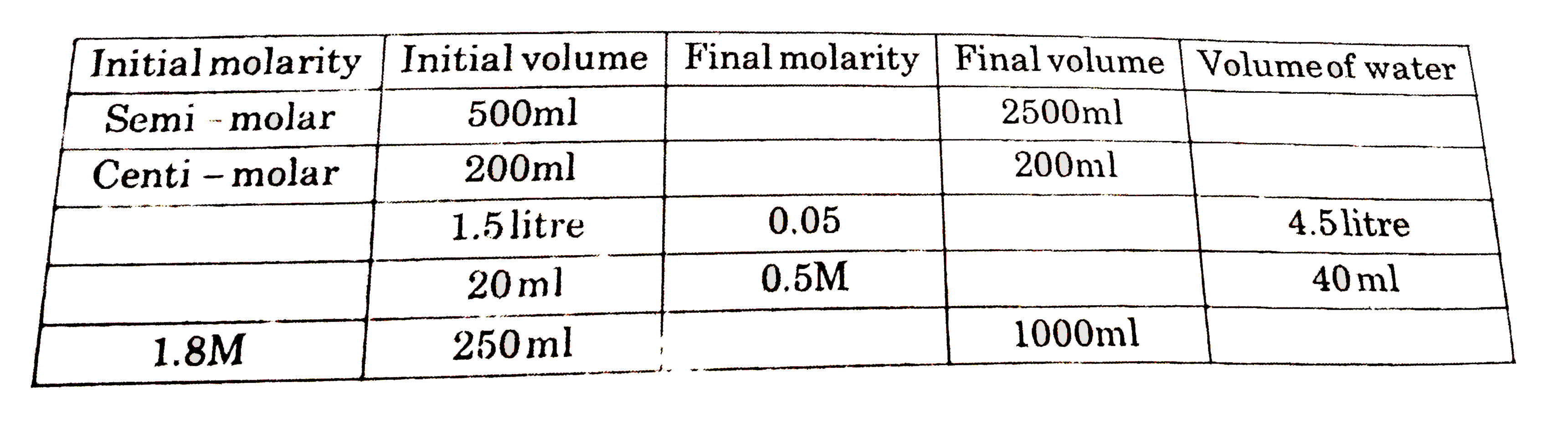
Use of dilution formula (M(1)V(1) = M(2)...

Use of dilution formula `(M_(1)V_(1) = M_(2) V_(2))`

Text Solution

Verified by Experts

The correct Answer is:

`(##ALN_NC_CHM_CT_E01_012_A01##)`
Promotional Banner

Topper's Solved these Questions

  • CONCENTRATION TERMS

    ALLEN|Exercise Exercise S - I|30 Videos
  • CONCENTRATION TERMS

    ALLEN|Exercise Exercise S - II|10 Videos
  • CONCENTRATION TERMS

    ALLEN|Exercise Previous|4 Videos
  • ACIDIC STRENGTH & BASIC STRENGTH

    ALLEN|Exercise Exercise V|16 Videos

Similar Questions

Explore conceptually related problems

V_(1)mL of CH_(3)COONa solution (of molarity M_(1) ) and V_(2)mL of a HCl solution (of Molarity M_(2) ) are available ,Can the two be mixed to obtain a buffer solution? If Yes, what should be the mathematical condition relating M_(1),M_(2),V_(1)& V_(2) for this?

A: 50 ml, decinormal HCl when mixed with 50 ml, decinormal H_(2) SO_(4) , then normality of H^(+) ion in resultant solution is 0.1 N. R: Here, MV = M_(1)V_(1) - M_(2)V_(2)

As part of his discovery of the neutron in 1932, James Chadwick determined the mass of the neutron (newly identified particle) by firing a beam of fast meutrons, all having the same speed, as two different targets and measuing the maximum recoil speeds of the target nuclei. The maximum speed arise when an elastic head-on collision occurs between a neutron and a stationary target nucleus. Represent the masses and final speeds of the two target nuclei as m_(1), v_(1), m_(2) and v_(2) and assume Newtonian mechanics applies. The neutron mass can be calculated from the equation: m_(n) = (m_(1)v_(1) - m_(2)v_(2))/(v_(2) - v_(1)) Chadwick directed a beam of neutrons on paraffin, which contains hydrogen. The maximum speed of the protons ejected was found to be 3.3 xx 10^(7) m//s . A second experiment was performed using neutrons from the same source and nitrogen nuclei as the target. The maximum recoil speed of the nitrogen nuclei was found to be 4.7 xx 10^(6) m//s . The masses of a proton and a nitrogen nucleus were taken as 1u and 14 u , respectively. What was Chadwick's value for the neutron mass?

Two particles of masses m_(1) and m_(2) in projectile motion have velocities vec(v)_(1) and vec(v)_(2) , respectively , at time t = 0 . They collide at time t_(0) . Their velocities become vec(v')_(1) and vec(v')_(2) at time 2 t_(0) while still moving in air. The value of |(m_(1) vec(v')_(1) + m_(2) vec(v')_(2)) - (m_(1) vec(v)_(1) + m_(2) vec(v)_(2))|

Two solution of H_(2)SO_(4) of molarities x and y are mixed in the ratio of V_(1) mL : V_(2) mL to form a solution of molarity M_(1) . If they are mixed in the ratio of V_(2) mL : V_(1) mL , they form a solution of molarity M_(2) . Given V_(1)//V_(2) = (x)/(y) gt 1 and (M_(1))/(M_(2)) = (5)/(4) , then x : y is

At low pressure, the van der Waal's equation become : (a) PV_(m)=RT (b) P(V_(m)-b)=RT (c) (P+(a)/(V_(M)^(2)))V_(m)=RT (d) P=(RT)/(V_(m))+(a)/(V_(m)^(2))

When a mass m is connected individually to two springs S_(1) and S_(2) , the oscillation frequencies are v_(1) and v_(2) . If the same mass is attached to the two springs as shown in figure, the oscillation frequency would be

Two bodies having masses m_(1) and m_(2) and velocities v_(1) and v_(2) colide and form a composite system. If m_(1)v_(1) + m_(2)v_(2) = 0(m_(1) ne m_(2) . The velocity of composite system will be

Two bodies having masses m_(1) and m_(2) and velocities v_(1) and v_(2) colide and form a composite system. If m_(1)v_(1) + m_(2)v_(2) = 0(m_(1) ne m_(2) . The velocity of composite system will be

A planet of mass M, has two natural satellites with masses m1 and m2. The radii of their circular orbits are R_(1) and R_(2) respectively. Ignore the gravitational force between the satellites. Define v_(1), L_(1), K_(1) and T_(1) to be, respectively, the orbital speed, angular momentum, kinetic energy and time period of revolution of satellite 1 , and v_(2), L_(2), K_(2) and T_(2) to be he corresponding quantities of satellite 2. Given m_(1)//m_(2) = 2 and R_(1)//R_(2) = 1//4 , match the ratios in List-I to the numbers in List-II.
