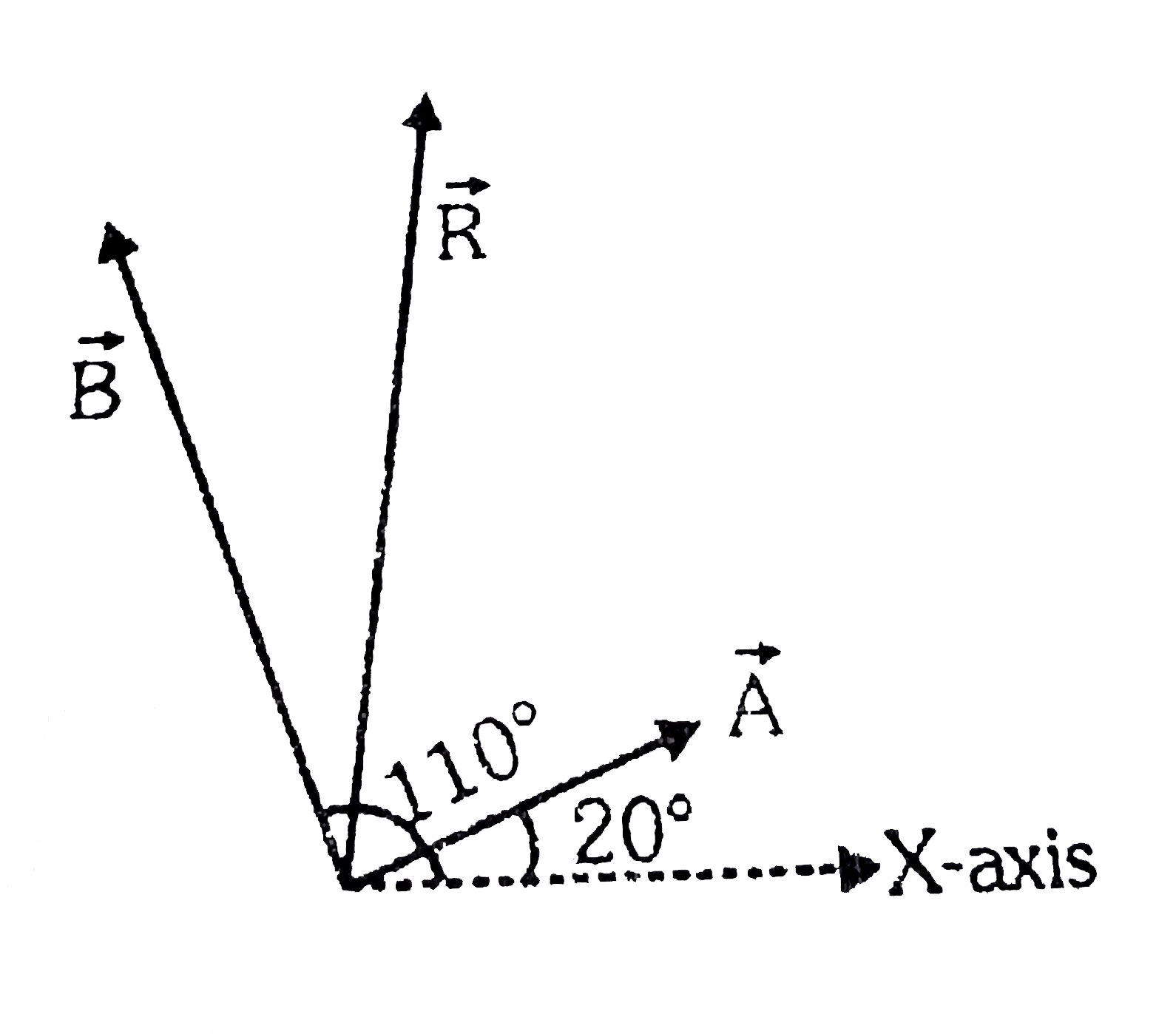
The magnetitude of pairs of displacement vectors are given. Which pairs of displacement vector cannot be added to give a resultant vector of magnitude `13` cm?
Text Solution
Verified by Experts
Angle between the `vec(A)` and `vec(B)=110^(@)-20^(@)=90^(@)` `R=sqrt(A^(2)+B^(2)+2AB cos 90^(@))=sqrt(5^(2)+12^(2))=13 m` Let angle of `vec(R)` from `vec(A)` is `alpha` `tan alpha=(B sin theta)/(A+B cos theta)=(12 sin 90^(@))/(5+12 cos 90^(@))=(12xx1)/(5+12xx0)=12/5` or `alpha=tan^(-1)(12/5)` with vector `vec(A)` or `(alpha+20^(@))` with X-axis
Topper's Solved these Questions
BASIC MATHS
ALLEN|Exercise Exersice-03|7 Videos
BASIC MATHS
ALLEN|Exercise ASSERTION-REASON|11 Videos
AIIMS 2019
ALLEN|Exercise PHYSICS|40 Videos
CIRCULAR MOTION
ALLEN|Exercise EXERCISE (J-A)|6 Videos
Similar Questions
Explore conceptually related problems
The four pairs of force vectors are given, which pairs of force vectors cannot be added to give a resultant vector of magnitude 10N ?
Which of the following pairs of forces cannot be added to give a resultant force of 4N ?
Resultant of two vector of equal magnitude A is
The magnitude of a vector cannot be :
Can we add displacement and force vectors ?
The minimum number of vector having different planes which can be added to give zero resultant is
How many minimum numbers of a coplanar vector having different magntidues can be added to give zero resultant
Is displacement a scalar or a vector quantity?
Can two vectors of different magnitude be combined to give a zero resultant ? Can three vectors ?
Discuss whether or not , angular displacement is a vector quantity ?