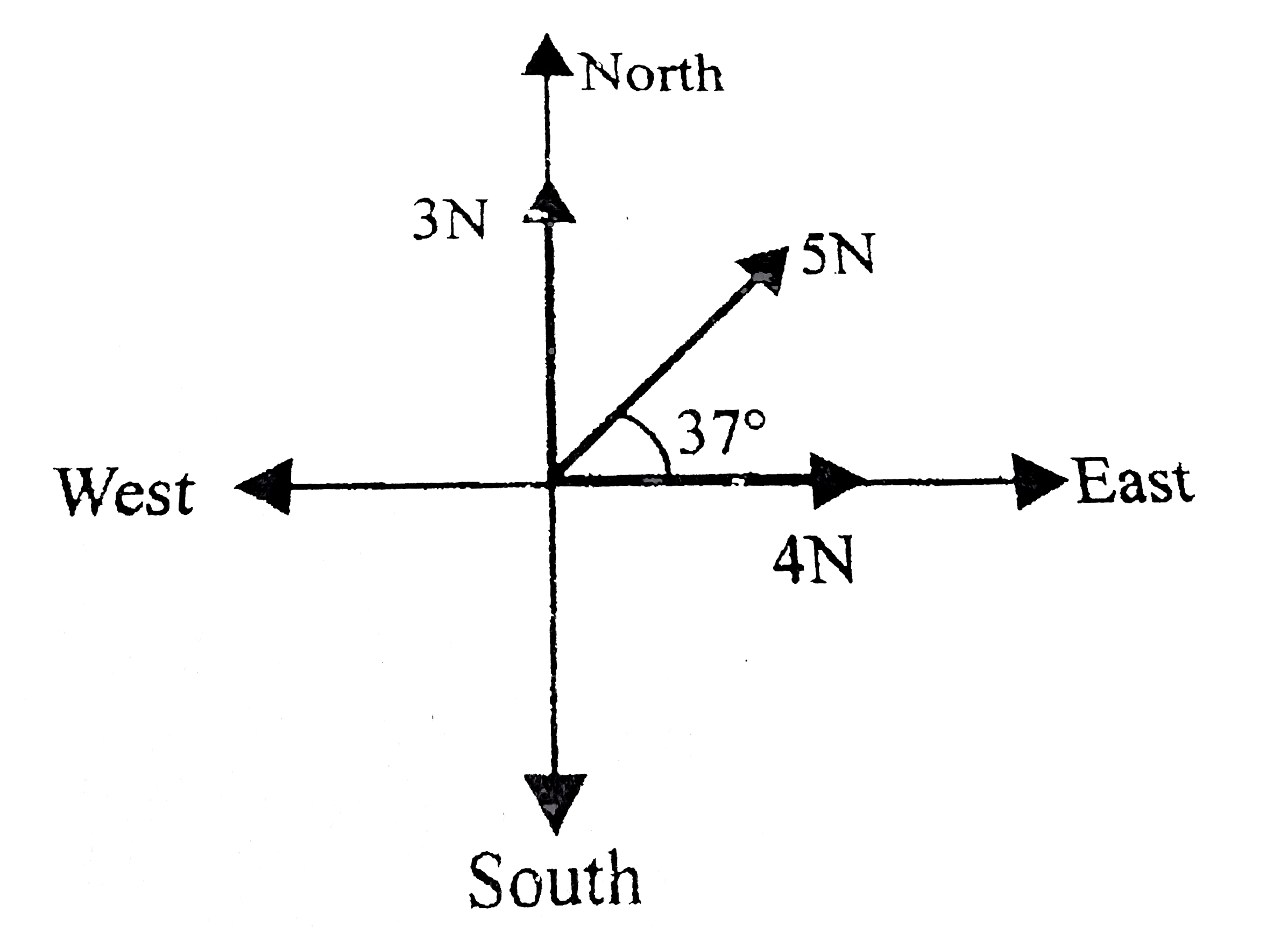
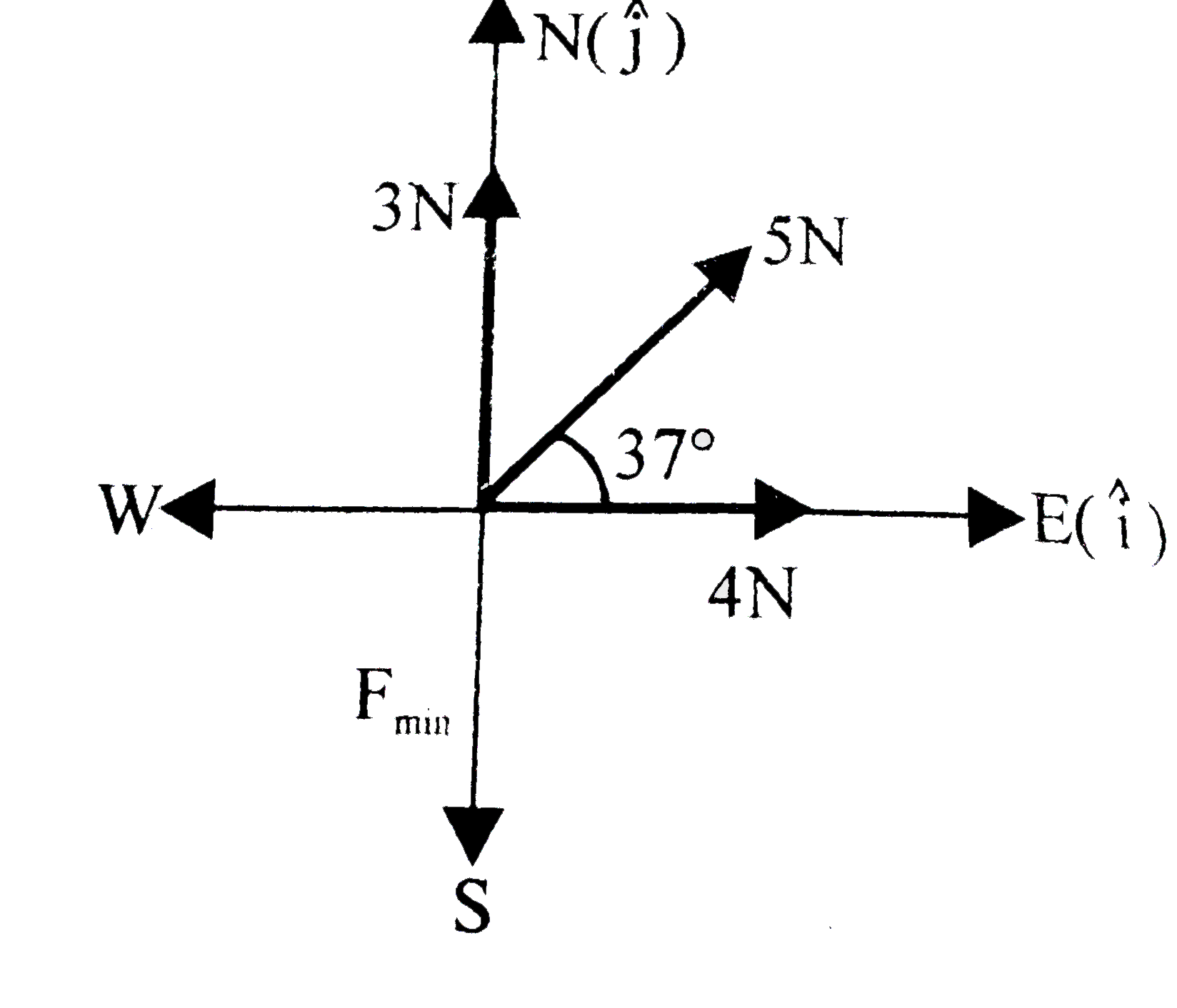
For shown situation, what will be the magnitude of minimum force in newton that can be applied in any direction so that the resultant force is along east direction?
Text Solution
Verified by Experts
The angle `theta` between the two vector is `120^(@)` and not `60^(@)`. `:. R=sqrt((10)^(2)+(10)^(2)+2(10)(10)(cos 120^(@)))` `=sqrt(100+100-100)=10` dyne
Topper's Solved these Questions
BASIC MATHS
ALLEN|Exercise Exersice-03|7 Videos
BASIC MATHS
ALLEN|Exercise ASSERTION-REASON|11 Videos
AIIMS 2019
ALLEN|Exercise PHYSICS|40 Videos
CIRCULAR MOTION
ALLEN|Exercise EXERCISE (J-A)|6 Videos
Similar Questions
Explore conceptually related problems
In the figure shown, the minimum force F to be applied perpendicular to the incline so that the block does not slide is
Find the magnitude of the resultant of shown forces :-
Two forces of 45 kg-f and 40 kg-f act on a body In opposite directions. What Is the resultant force ?
Assertion: In projectile motion, the acceleration is constant in both magnitude and direction but the velocity changes in both magnitude and direction. Reason: When a force or accelration is acting in an oblique direction to the direction of velocity then both magnitude and direction of the velocity may be changed.
A strong magnet is placed under a horizontal conducting ring of radius r that carries current i as shown in Fig. If the magnetic field makes an angle theta with the vertical at the ring's location, what are the magnitude and direction of the resultant force on the ring?
In the shown figure what amount of force and in which direction we should apply so that net force only acts along x-axis only :-
An object is subjected to a force in the north-east direction. To balance this force, a second force should be applied in the direction
For the circuit shown in figure the direction and magnitude of the force on PQR is :
Two forces are simultaneously applied on an object. What third force would make the net force to point to the left ( -x direction ) ?
Four forces are acting on a body as shown in figure. The magnitude of resultant of the forces is