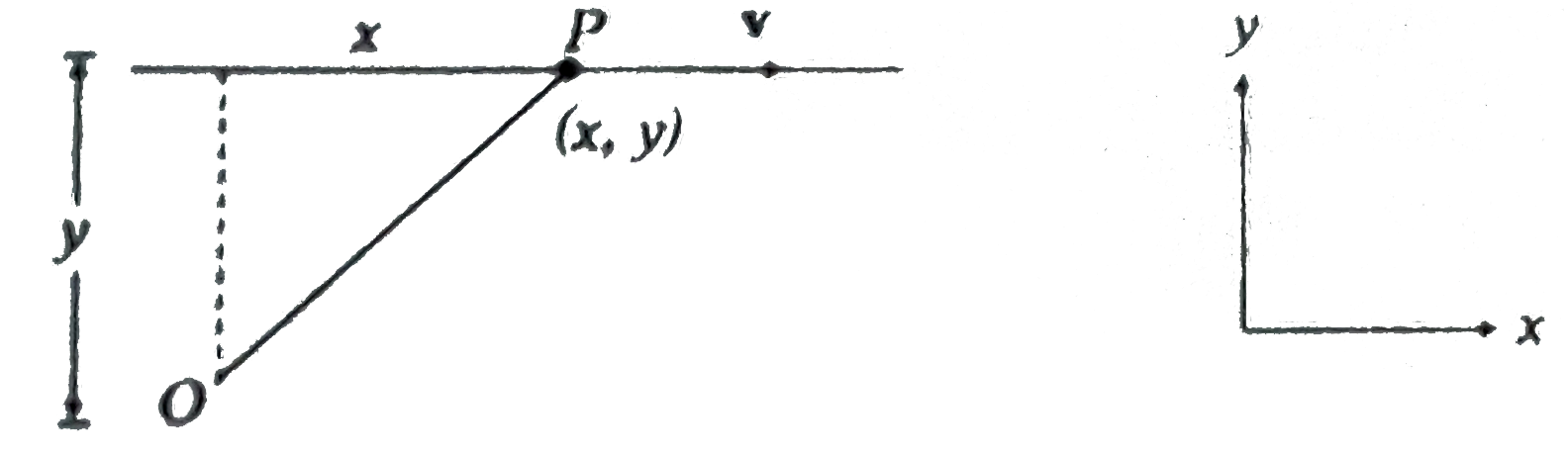
A particle moves on a given line with a constant speed v. At a certain time it is at point P on its staight line path.O is fixedpoint .show that `(Opxxv)` is independent of the position P.
A
`vec(A)=(vec(B)xxvec(C))`
B
`vec(A)=2(vec(B)xxvec(C))`
C
`vec(A)=2(vec(C)xxvec(B))`
D
`|vec(B)xxvec(C)|=sqrt(3)/2`
Text Solution
Verified by Experts
The correct Answer is:
B, C
As `vec(A) bot vec(B)` and `vec(A) bot vec(C)` so `vec(A)=+-((vec(B)xxvec(C)))/(|vec(B)xxvec(C)|)` But `|vec(B)xxvec(C)|=BC sin 30^(@)=1/2` So `vec(A)=+-2(vec(B)xxvec(C))rArr vec(A)=2(vec(B)xxvec(C))` and `vec(A)=-2(vec(B)xxvec(C))=2(vec(C)xxvec(B))`
Topper's Solved these Questions
BASIC MATHS
ALLEN|Exercise Exersice-03|7 Videos
BASIC MATHS
ALLEN|Exercise ASSERTION-REASON|11 Videos
AIIMS 2019
ALLEN|Exercise PHYSICS|40 Videos
CIRCULAR MOTION
ALLEN|Exercise EXERCISE (J-A)|6 Videos
Similar Questions
Explore conceptually related problems
A particle moves on a given straight line with a constant speed v. At a certain time it is at a point P on its straight lline path.O is a fixed point. Show than vec(OP)xxvec upsilon is independent of the position P.?
A particle moves on a given straight line with a constant speed v. At a certain time it is at a point P on its straight lline path.O is a fixed point. Show than vec(OP)xxvec upsilon is independent of the position P.?
A particle moves on a given straight line with a constant speed v. At a certain time it is at a point P o its straight lline path.O is a fixed point. Show than vec(OP)xxvec upsilon is independent of the position P.?
A particle is moving with a constant speed along a straight line path. A force is not required to
A particle is moving on a circular path with constant speed, then its acceleration will be constant in
A particle is moving on a circular path with a constant speed v . Its change of velocity as it moves from A to B is:
A particle is moving along a straight line with increasing speed. Its angular momentum about a fixed point on this line :
A particle is moving along an elliptical path with constant speed. As it moves from A to B, magnitude of its acceleration :
A particle is moving with constant speed v in xy plane as shown in figure. The magnitude of its angular velocity about point O is
A particle is moving on a circular path of radius R with constant speed v. During motion of the particle form point A to point B