Home
Class 12
PHYSICS
A man can swim with a speed of 4 km h^...

A man can swim with a speed of 4 km `h^(-1)` in still water. He crosses a river 1 km wide that flows steadily at 3 km `h^(-1)`. If he makes his strokes normal In the river current, how far down the river does he go when he reaches the other bank ?

Text Solution

Verified by Experts
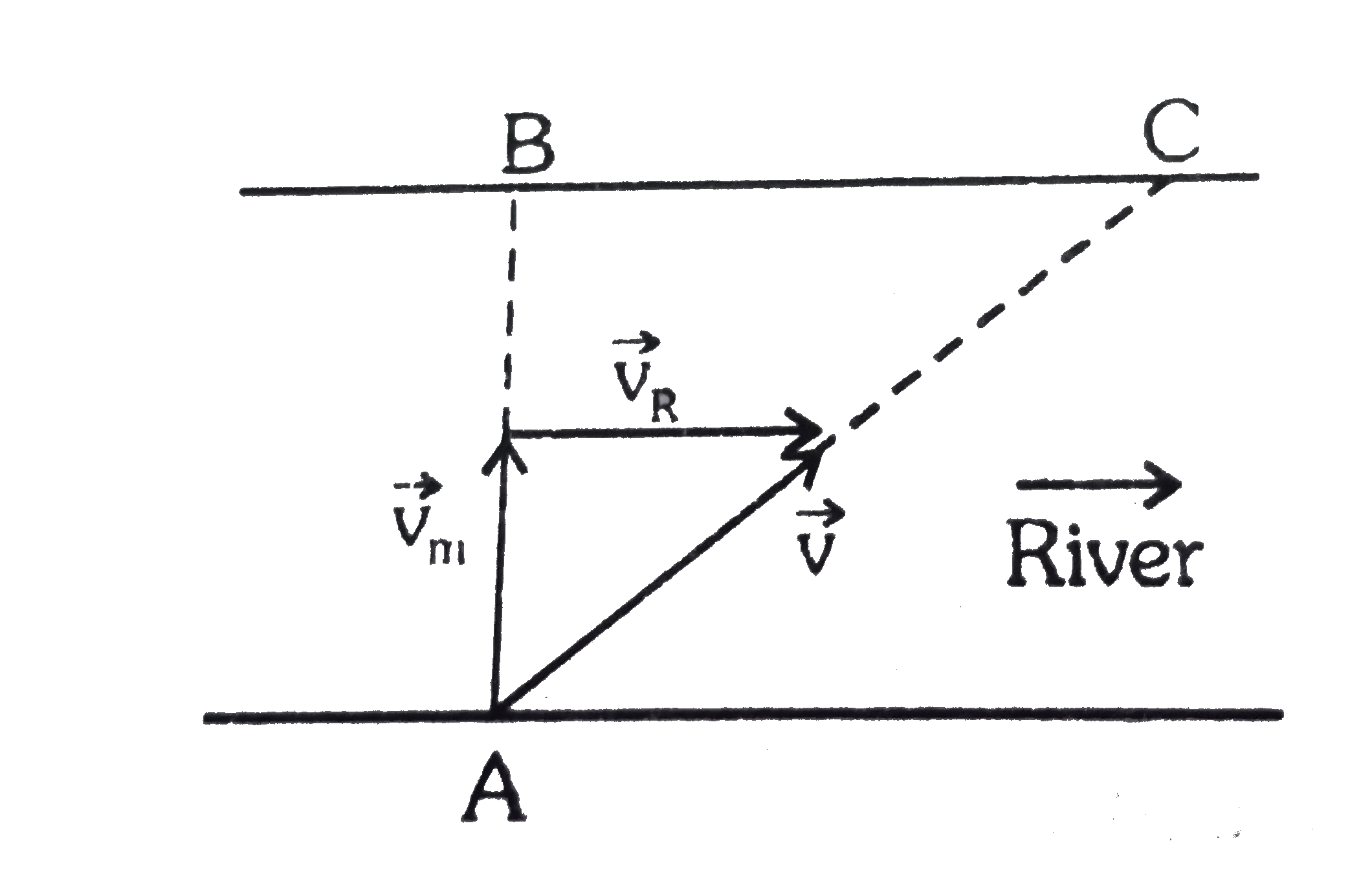
(a) time taken `t=(AB)/(v_(m))=(1)/(4)hr=15` min.
(b) The distance travelled along the river during its crossing is
`BC=v_(R)xxt=3xx(1)/(4)=0.75km`
Promotional Banner

Topper's Solved these Questions

  • MOTION IN A PALNE

    ALLEN|Exercise EXERCISE-1|99 Videos
  • MOTION IN A PALNE

    ALLEN|Exercise EXERCISE-2|170 Videos
  • MOTION IN A PALNE

    ALLEN|Exercise Integer Type Question|3 Videos
  • KINEMATICS-2D

    ALLEN|Exercise Exercise (O-2)|46 Videos
  • NEWTON'S LAWS OF MOTION & FRICTION

    ALLEN|Exercise EXERCISE (JA)|4 Videos

Similar Questions

Explore conceptually related problems

A man can swim with a speed of 4kmh^(-1) in still water. He crosses a river 1km wide that flows steadly at 3kmh^(-1) . If he makes his strokes normal to the river current, how far down the river does he go when he reaches the other bank?

A man can swim with a speed 4km/hr in still water. (a) How long does he takes to cross a river 1 km wide if the river flows steadily at 3 km/hr and makes his strokes normal to the river current? (b) How far down the river does he go when he go when he reaches the other bank?

A man can swim at a speed of 3 km h^-1 in still water. He wants to cross a 500-m wide river flowing at 2 km h^-1 . He keeps himself always at an angle to 120^@ with the river flow while swimming. The time taken to cross the river is.

A man can swim at a speed of 3 km h^-1 in still water. He wants to cross a 500-m wide river flowing at 2 km h^-1 . He keeps himself always at an angle to 120^@ with the river flow while swimming. The drift of the man along the direction of flow, when he arrives at the opposite bank is.

A man can swim at the rate of 5 kmh^(-1) in still water A. One km wide river flows at the rate of 3 kmh^(-1) . The man wishes to swim across the river directly opposite to the starting point. How much time will be take to cross the river

A boat man can row with a speed of 10 km h^(-1) in still water. If the river flows steadily at 5 km //h , in which direction should the boatman row in order to reach a point on the other bank directly opposite to the point from where he stared ? The width of the river is 2 km .

A man can swim at the rate of 5 km//h in still water. A river 1 km wide flows at the rate of 3km h^(-1) . A swimmer wishes to swim across the river directly opposite to the starting point. (a) Along what direction must the man swim ? (b) What should be his resultant velocity ? ( c) How much time will he take to cross the river ?

A man can swim at the rate of 5 km h^-1 in still water. A 1 - km wide river flows at the rate of 3 km h^-1 The man wishes to swim across the river directly opposite to the starting point. (a) Along what direction must the man swim ? (b) What should be his resultant velocity ? ( c) How much time will he take to cross the river ?

A man can swim with speed 5 ms^(-1) in still river while the river is also flowing speed 10ms ^(-1) If the width of the river is 100 m then minimum possible drift is

A man can swim at a speed of 3 km/h in still water. He wants t cross a 500 m wide river flowing at 2 km/h. He flow at an angle of 120 with the river flow while swimming. A. Find the time he takes to cross the river. b.At what point on the opposite bank will he arrive?

ALLEN-MOTION IN A PALNE-PHY
  1. A particle starts motion from rest and moves along a straight line. It...

    Text Solution

    |

  2. A drunkard walking in a narrow lane takes 5 steps forward and 3 steps ...

    Text Solution

    |

  3. The motion of a body is given by the equation dv//dt=6-3v, where v is ...

    Text Solution

    |

  4. (a) The position of a particle moving along the x-axis depends on the ...

    Text Solution

    |

  5. A particle is moving along x-axis with accelerationa = a(0) (1 – t//T)...

    Text Solution

    |

  6. A train, travelling at 20 kmh^(-1) is approaching a platform. A bird i...

    Text Solution

    |

  7. A train goes from rest to rest between two stations with uniform accel...

    Text Solution

    |

  8. A car starting from rest accelerates at the rate f through a distance ...

    Text Solution

    |

  9. A particle is projected vertically upwards and t second after another ...

    Text Solution

    |

  10. A stone dropped from the top of a tower of height 300 m high splashes...

    Text Solution

    |

  11. A man can swim with a speed of 4 km h^(-1) in still water. He crosse...

    Text Solution

    |

  12. A carrom board (4ftxx4ft ) has the queen at the centre. The queen hit ...

    Text Solution

    |

  13. The position-time (x-t) graphs for two children A and B returning from...

    Text Solution

    |

  14. Two trains A and B of length 400 m each are moving on two parallel tra...

    Text Solution

    |

  15. Two towns A and B are connected by a regular bus service with a bus le...

    Text Solution

    |

  16. On a long horizontally moving belt, a child runs to and fro with a spe...

    Text Solution

    |

  17. If s=2t^(3)+3t^(2)+2t+8 then find time at which acceleration is zero.

    Text Solution

    |

  18. Velocity of a particle varies with time as v=4t. Calculate the displac...

    Text Solution

    |

  19. A particle is thrown vertically upwards from the surface of the earth...

    Text Solution

    |

  20. Two cars start off a race with velocities 2m//s and 4m//s travel in st...

    Text Solution

    |

