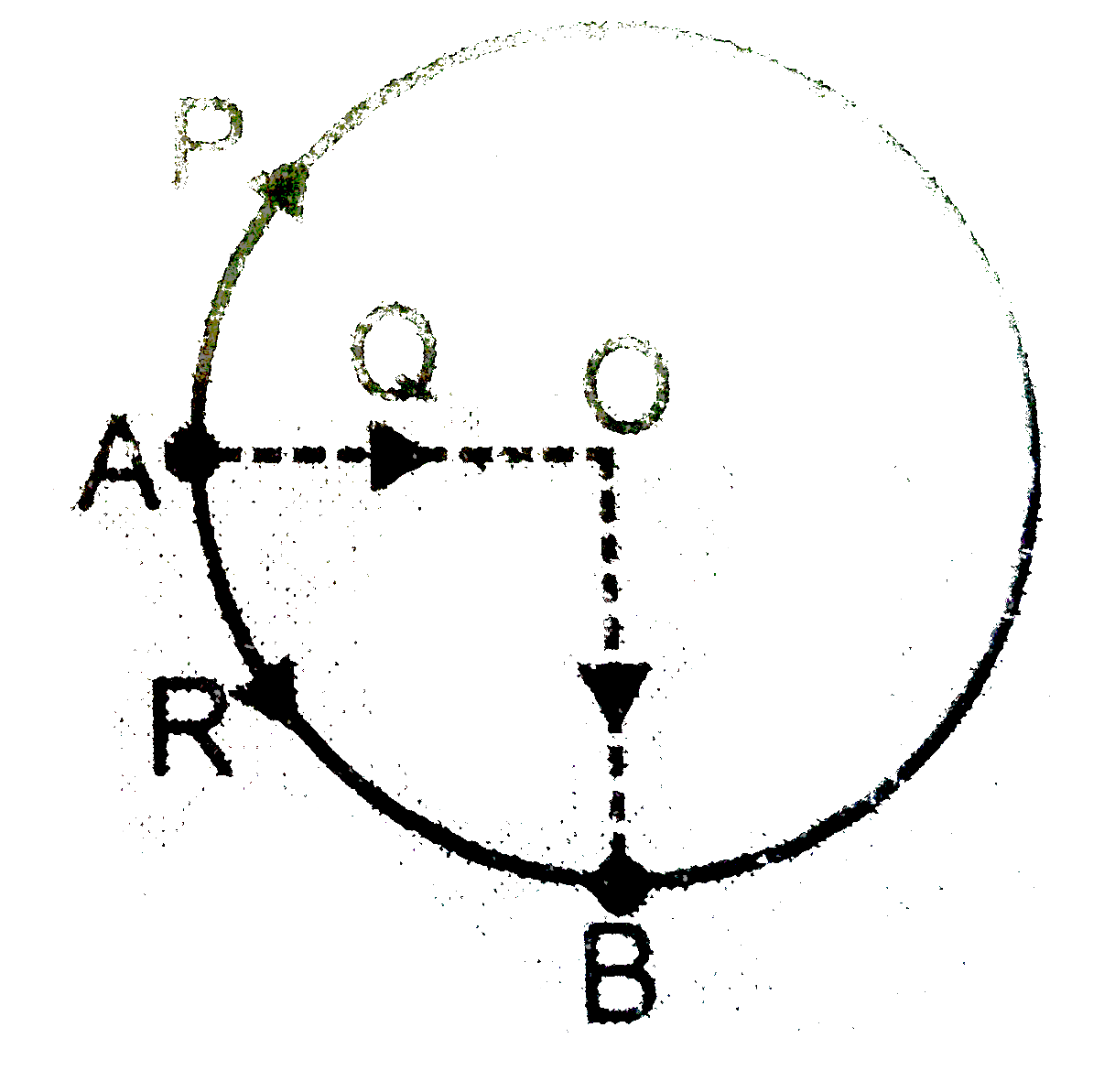
Three particles P, Q and R are situated at point A on the circular path of radius 10m. All three particles move along different path and reach at point B shown in figure. Then the ratio of distance traversed by particle P and Q is:-
A
`3/4`
B
`1/3`
C
`(3 pi) /4`
D
`pi /3`
Text Solution
Verified by Experts
The correct Answer is:
B
At maximum range vertical displacement `=0` `rArr t'=(2u sin theta)/g`. So range R `(u cos theta)((2u sin theta)/g)-1/2 a((2u sin theta)/g)^(2)` `=(2u^(2) sin theta cos theta)/g(g/a-tan theta)`
Topper's Solved these Questions
MOTION IN A PALNE
ALLEN|Exercise EXERCISE-04[A]|35 Videos
MOTION IN A PALNE
ALLEN|Exercise Exercise-04[B]|14 Videos
MOTION IN A PALNE
ALLEN|Exercise Comprehension#6|4 Videos
KINEMATICS-2D
ALLEN|Exercise Exercise (O-2)|46 Videos
NEWTON'S LAWS OF MOTION & FRICTION
ALLEN|Exercise EXERCISE (JA)|4 Videos
Similar Questions
Explore conceptually related problems
A particle moves along a path ABCD as shown in the figure. Then the magnitude of net displacement of the particle from position A to D is:
The speed-time graph of a particle moving along a fixed direction as shown in the figure. The distance traversed by the particle between t = 0 s to t = 10 s is
A particle is moving on a circular path of radius R with constant speed v. During motion of the particle form point A to point B
A particle of mass m is moving on a circular path of radius r with uniform speed v , rate of change of linear momentum is
A particle of mass 'm' is moving on a circular path of radius 'r' with uniform speed 'v'. Rate of change of linear momentum is
A particle of mass M moves with constant speed along a circular path of radius r under the action of a force F. Its speed is
A particle is moving in a circular path of radius r. The displacement after half a circle would be
A particle moves along a circular path of radius R. The distance and displacement of a particle after one completer revolution is
Three particles of equal mass M each are moving on a circular path with radius r under their mutual gravitational attraction. The speed of each particle is
A particle of mass m moves with constant speed v on a circular path of radius r as shown in figure. The average force on it during its motion from A to B is