Study the given figure which shows the development of root nodules in soyabean. Match the correct explanation and find the correct sequence for labelled diagrams.
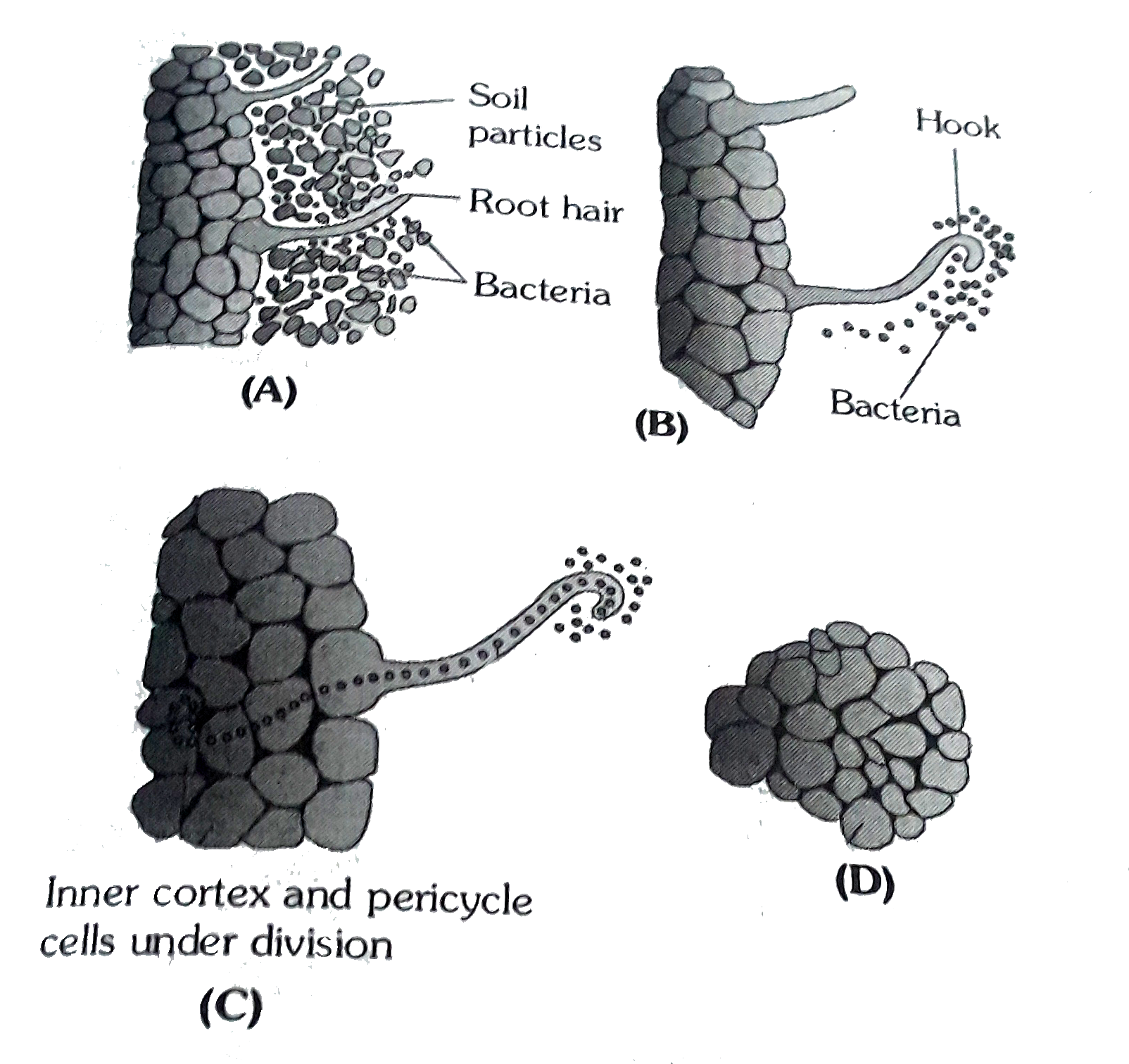
(I) Rhizobium bacteria contacting a susceptible root hair.
(II) A mature nodule having vascular connection with roots.
(III). Infection thread carrying bacteria to the inner cortex.
(IV). Curling of root hair due to successful infection.
Study the given figure which shows the development of root nodules in soyabean. Match the correct explanation and find the correct sequence for labelled diagrams.
(I) Rhizobium bacteria contacting a susceptible root hair.
(II) A mature nodule having vascular connection with roots.
(III). Infection thread carrying bacteria to the inner cortex.
(IV). Curling of root hair due to successful infection.
(I) Rhizobium bacteria contacting a susceptible root hair.
(II) A mature nodule having vascular connection with roots.
(III). Infection thread carrying bacteria to the inner cortex.
(IV). Curling of root hair due to successful infection.
Text Solution
Verified by Experts
The correct Answer is:
`A-I to B-IV to C-III to D-II`



Topper's Solved these Questions
Similar Questions
Explore conceptually related problems
Study the given figures carefully showing the development of root nodules and arrange them in a correct sequence.
Select the incorrect statement from the following. (a) Rhizobium multiply and colonises the surroundings of roots and gets attached to epidermal and root hair cell. (b) Successful infection of the root hair causes it to curl . (c) The nodule establishes a direct Vascular connection with the host . (d) Infection thread carries the bacteria to xylem and phloem .
Consider the following steps involved in nodule formation in the root of a legume. (i). Bacteria release chemicals and enzymes. (ii). Bacteria stop dividing and form bacteroides. (iii). Roots secrete chemical atractants. (iv). Formation of infection thread. (v). Formation of nodules. (v). Formation of nodulues. (vi). Division of infected cortical cells. (vii) Curlinig of root hair and degradation of their cell wall. (viii). Infection thread grows along with multiplication of bacteria. Arrange the steps in the right sequence and mark the correct option
Given below are diagrams showing the different stages in the process of fertilisation of an egg in the human female reproductive tract. Study the diagrams and answer the questions (i) Arrange the letters given below each diagram in a logical sequence to show the correct order in the process of fertilisation. (ii) Where does fertilisation normally take place? What is 'Implantation' that follows fertilisation ? (iii) Mention the chromosome number of the egg and zygote in humans. (iv) Explain the term 'Gestation'. How long does Gestation last in humans ? (v) Draw a neat, labelled diagram of a mature human sperm.
During nodule formation in leguminous plants, an infection thread is produced carrying the __(i)__ into the __(ii)__ of the root, where they initiate the nodule formation in the __(iii)__ of the root. Fill up the blanks by choosing the correct option.
Go through the following matches with reference to the elements and their deficiency symptoms in plants: (i) Sulphur - Reduced nodulation in legumes (ii) Boron - Whiptail disease (iii) Sulphur - Blossom end root of tomato (iv) Nitrogen - Wrinkling of cereal grains Which of these are correct
Go through the following statements (i) The most widely used compound as source of ethylene is ethephon. (ii) Ethylene helps the plants to increa their absorption surface by promotin root growth and root hair formation. (iii) 2, 4 - D is mainly used to kill mature monocotyledonous plants. (iv) Spraying juvenile conifers with GAs has- tens the maturity period, thus leading to early seed production. Which of these are correct
Study the following step which are followed during the process of gene therapy while treating a patient of SCID (i) Retrovirus infects lymphocytes extracted from bone marrow of the patient and cultured (ii) Engineered cells are injected into patient's bone marrow (iii) Normal allele is inserted into a retrovirus (iv) Retrovirus makes a DNA copy of its RNA. This DNA carrying the normal allele gets inserted into the chromosome of the host cell Arrangement the above given steps in correct sequence and select the correct option
Consider the following statements I. sulphur is present in two amino acids cysteine and valine II. Lower level of N,K,S and Mo causes inhibition of cell division. III. Microbe that fix nitrogen in the roots of non-leguminous plants alums in frankia IV. Denitrification is carried by bacteria Nitrosomonas and nitrobacter Select the correct pair of statements.
Statement - I: Beijernickia is free living nitrogen fixing bacterium. Statement - II: The enzyme, nitrogenase which is capable of nitrogen reduction is present exclusively in prokaryotes. Statement- III: The root nodules formed in soyabean never establishes a direct vascular connection with the host for exchange of nutrients. Select the suitable option wr.t. statements I to III.