Home
Class 12
CHEMISTRY
in the circuit shown in the figure initi...

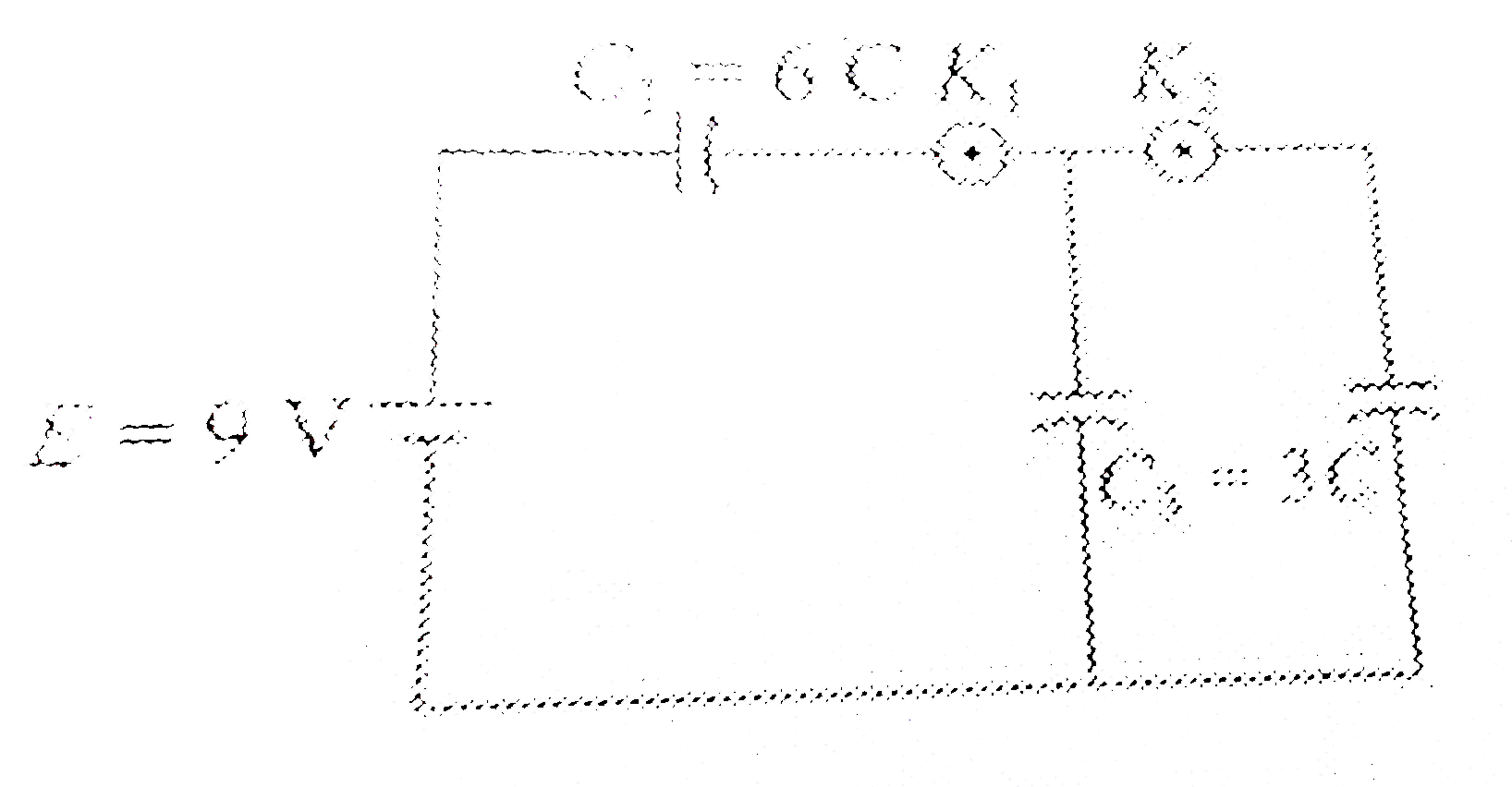
in the circuit shown in the figure initially `K_(1)` is closed and `K_(2)` is open. What are the charges on each capacitors? Now `K_(1)` was opened and `K_(2)` was closed (order is important) what will be the charge on each capacitor now? `" " [C=1muF]`

A

`(1)/(4)`

B

`(1)/(8)`

C

`(1)/(16)`

D

`(1)/(2)`

Text Solution

Verified by Experts

The correct Answer is:

2
Promotional Banner

Topper's Solved these Questions

  • Chemical bonding

    ALLEN|Exercise All Questions|39 Videos
  • CHEMISTRY AT A GLANCE

    ALLEN|Exercise ORGANIC CHEMISTRY|472 Videos

Similar Questions

Explore conceptually related problems

In the circuit shown in Fig, initially K_(1) is closed and K_(2) is open . What are the charges on each capacitor. Then K_(1) was opened and K_(2) was closed (order is important). What will be the charge on each capacitor now ? [C = 1muF]

In the circuit shown in the figure, if switches S_(1) and S_(2) have been closed for a long time, then charge on the capacitor.

In the ciruit shown in figure, Initially K_1 is closed and K_2 is open, let charge on capacitor C_2 is Q_2 Then K_1 was opened while K_2 kept closed, let charge on capacitor C_2 is Q_2 (Take, C=1muF ) Then ratio Q_2/Q_1 is

In the circuit shown in figure , initially key K_(1) is closed and key K_(2) is open. Then K_(1) is opened and K_(2) is closed (order is important). [Take Q_(1)^(') and Q_(2)^(') as charges on C_(1) and C_(2) and V_(1) and V_(2) as voltage respectively]. Then

In the circuit shown in figure , initially key K_(1) is closed and key K_(2) is open. Then K_(1) is opened and K_(2) is closed (order is important). [Take Q_(1)^(') and Q_(2)^(') as charges on C_(1) and C_(2) and V_(1) and V_(2) as voltage respectively]. Then

In the circuit shown in figure initially the switch is opened. The switch is closed now. The charge that will flow in direction 1 is

In the circuit shown in figure initially the switch is opened. The switch is closed now. The charge that will flow in direction 2 is

Consider the circuit shown in the figure. (a) Find the current i flowing through the circuit when the key K_(1) is open and K_(2) is closed. (b) Find the net charge on the capacitor when K_(1) is open & K_(2) is.closed and also when K_(1) & K_(2) both are closed. (c) What is the change in the current'i, when K_(1) is closed

what is the charge stored on each capacitor C_1 and C_2 in the circuit shown in fig.

Shown in the figure is a parallel R , L,C circuit with key K_(1) closed and K_(2) opened . When K_(1) is opened and K_(2) is closed simultaneously find the maximum potential difference across the capacitor and maximum charge stored in it .

ALLEN-Chemical Equilibrium-All Questions
  1. One mole of A reacts with one mole of B to form 0.1 mole of C and 0.1 ...

    Text Solution

    |

  2. For a reaction H(2(g))+I(2(g))rArr2HI((g))at 721^(@)C the value of eq...

    Text Solution

    |

  3. in the circuit shown in the figure initially K(1) is closed and K(2) i...

    Text Solution

    |

  4. In the reaction N(2(g))+O(2(g))rArr2NO((g))at equilibrium the concent...

    Text Solution

    |

  5. At the equilibrium of the reaction , N(2)O(4)(g)rArr2NO(2)(g), th...

    Text Solution

    |

  6. ArArr2B,K(p),CrArrD+E,K(p) . If degrees of dissociation of A and C a...

    Text Solution

    |

  7. When sulphur is heated at 800 K, the initial pressure of 1 atm decreas...

    Text Solution

    |

  8. K(p) value for C(2)H(4(g))+H(2(g))rArrC(2)H(6(g))is 5xx10^(18)" a...

    Text Solution

    |

  9. E(cell)^(@) for the reaction MnO(4)^(-)+5Fe^(+2)+8H^(+)rarrMn^(+2)+5Fe...

    Text Solution

    |

  10. The conversion of into oxygen is exothermic. Under what conditions is ...

    Text Solution

    |

  11. Consider the following gas - phase reaction : 2A(g)+B(g)rArrC(g)...

    Text Solution

    |

  12. In the dissociation of I(2)(g) at 1000 K in a container of 1 litre :-...

    Text Solution

    |

  13. What is the effect of temperature and pressure on the yields of produc...

    Text Solution

    |

  14. In a reversible reaction K(c)gtK(p)andDeltaH=+40kCal. The product w...

    Text Solution

    |

  15. For the dissociation reaction N(2)O(4) (g)hArr 2NO(2)(g), the degree o...

    Text Solution

    |

  16. The prepation of SO(3)(g) by reaction SO(2)(g)+(1)/(2)O(2)(g)hArrSO(3)...

    Text Solution

    |

  17. The equilibrium constant for : PCl(5)rArrPCl(3)+Cl(2) is 0.5 a...

    Text Solution

    |

  18. At 473 K,K(c) for the reaction PCl(5(g))rArrPCl(3(g))Cl(2(g)) ...

    Text Solution

    |

  19. 18.4 g of N(2)O(4) is taken in a 1 L closed vessel and heated till the...

    Text Solution

    |

  20. 5 moles of SO(2) and 5 moles of O(2) are allowed to react to form SO(3...

    Text Solution

    |
