Home
Class 12
CHEMISTRY
The enthalpy of hydrogenation of cyclohe...

The enthalpy of hydrogenation of cyclohexene is `-119.5 kJ mol^(-1)`. If resonance energy of benzene is `-150.4 k j mol^(-1)`, its enthalpy of hydrogenation would be

A

`-508.9 kJ mol^(-1)`

B

`-208.1 kJ mol^(-1)`

C

`-269.9 kJ mol^(-1)`

D

`-358.5 kJ mol^(-1)`

Text Solution

Verified by Experts

The correct Answer is:
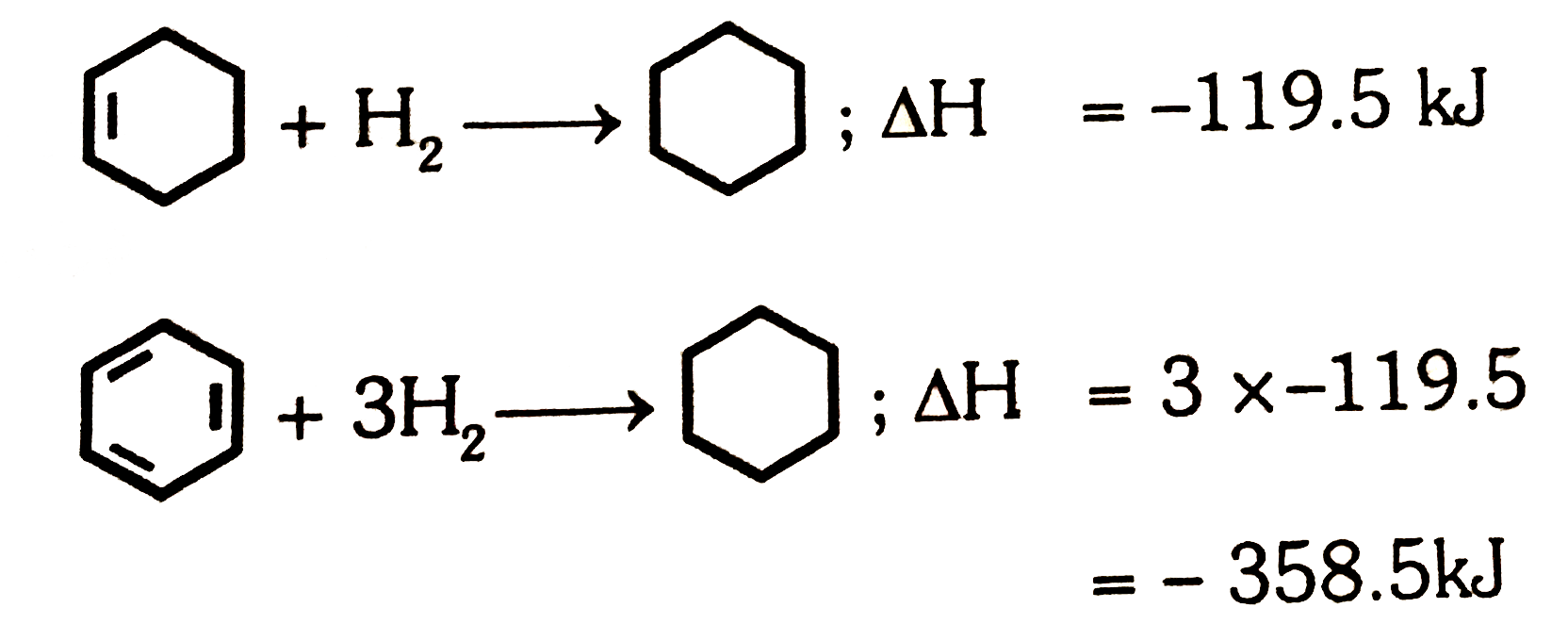
B


Resonance energy = Observed `Delta H` - Calculated `Delta H=150.4=-358.5-(Delta H)_("calculated")`
`therefore (Delta H)_("calculated")=-208.1 kJ mol^(-1)`
Promotional Banner

Topper's Solved these Questions

  • THERMODYNAMICS

    ALLEN|Exercise EXERCISE -1B|22 Videos
  • THERMODYNAMICS

    ALLEN|Exercise EXERCISE -2|100 Videos
  • THERMODYNAMICS

    ALLEN|Exercise Questions|46 Videos
  • TEST PAPERS

    ALLEN|Exercise MATHEMATICS|2 Videos
  • Thermodynamics And Thermo Chemistry

    ALLEN|Exercise All Questions|40 Videos

Similar Questions

Explore conceptually related problems

The enthalpy of hydrogenation of cyclohexene is -119.5kJ mol^(-1) . If resonance energy of benzene is -150.4kJ mol^(-1) , its enthalpy of hydrogenation would be :

The enthalpy of hydrogenation of cyclohexene is -119.5kJ mol^(-1) . If resonance energy of benzene is -150.4kJ mol^(-1) , its enthalpy of hydrogenation would be :

The enthalpy of hydrogenation of cyclohexene is -119.5kJ mol^(-1) . If resonance energy of benzene is -150.4kJ mol^(-1) , its enthalpy of hydrogenation would be :

If enthalpy of hydrogenation of cyclohexene is [-x kJ mol^-1] and resonance energy of benzene is [-y kJ mol^-1] then the enthalpy of hydrogenation of benzene will be

Resonance energy of benzene is 36 kcal mol^(-1) . This means

Enthalpy of hydrogenation of benzene is DeltaH_(1) and for cyclohexene is DeltaH_(2) . The resonance energy of benzene is

Delta_(f)H^(Theta) of Cyclohexene (l) and benzene at 25^(@)C is -156 and +46 kJmol^(-1) , respectively. Delta_("hydrogenation")H^(Theta) of cyclohexene (l) at 25^(@)C is -119 kJ mol^(-1) . Reasonance energy of benzene is found to be -38x kJ mol^(-1) . Find the value of x .

Calculate the enthalpy of combustion of benzene (l) on the basis of the following data: a. Resonance energy of benzene (l) =- 152 kJ// mol b. Enthalpy of hydrogenation of cyclohexene (l) =- 119 kJ//mol c. Delta_(f)H^(Theta)C_(6)H_(12)(l) =- 156 kJ mol^(-1) d. Delta_(f)H^(Theta) of H_(2)O(l) =- 285.8 kJ mol^(-1) e. Delta_(f)H^(Theta)of CO_(2)(g) =- 393.5 kJ mol^(-1)

The enthalpy of hydrogenation of but -1- ene is 125.8 kJ mol^(-1) but that of but -2- ene is nearly 120.0 kJ mol^(-1) . How will justify ?

The enthalpy of formation of hypothetical MgCl is -125kJ mol^(-1) and for MgCl_(2) is -642 kJ mol^(-1) . What is the enthalpy of the disproportionation of MgCl .

ALLEN-THERMODYNAMICS -EXERCISE -1A
  1. Assume each reaction is carried out in an open container. For which r...

    Text Solution

    |

  2. The enthalpy and entropy change for the reaction Br(2)(l)+Cl(2)(g)rarr...

    Text Solution

    |

  3. The enthalpy of hydrogenation of cyclohexene is -119.5 kJ mol^(-1). If...

    Text Solution

    |

  4. For the reaction of one mole of zinc dust with one mole of sulphuric a...

    Text Solution

    |

  5. When you make ice cubes, the entropy of water

    Text Solution

    |

  6. For a phase change H(2)O(l) to H(2)O (g)

    Text Solution

    |

  7. For a spontaneous process the correct statement is

    Text Solution

    |

  8. The enthalpy change (Delta H) for the reaction, N(2)(g)+3H(2)(g)to 2NH...

    Text Solution

    |

  9. Consider the following reactions: (a) H(aq)^(+) +OH(aq)^(-) to H(2)O...

    Text Solution

    |

  10. Given that bond energies of H–H and Cl–Cl are 430 kJ mol^(-1) and 240...

    Text Solution

    |

  11. Bond dissociation enthalpy of H(2), Cl(2) and HCl are 434, 242 and 431...

    Text Solution

    |

  12. For the gas phase reaction, PCl(5)(g) hArr PCl(3)(g) + Cl(2)(g) Wh...

    Text Solution

    |

  13. Which of the following are not a constant value between two given ther...

    Text Solution

    |

  14. From the following bond energies: H-H bond energy: 431.37KJmol^(-1) ...

    Text Solution

    |

  15. The values of DeltaH and DeltaS for the reaction, C("graphite")+CO(2...

    Text Solution

    |

  16. For vaporization of water at 1 atmospheric pressure the values of Delt...

    Text Solution

    |

  17. Three moles of an ideal gas expanded spontaneously into vaccum. The wo...

    Text Solution

    |

  18. The following two reactions are known : Fe(2)O(3)(s) + 3 CO(g) rightar...

    Text Solution

    |

  19. Standard entropies of X(2), Y(2) and XY(3) are 60, 40 and 50 JK^(–1) m...

    Text Solution

    |

  20. Intensive property is :-

    Text Solution

    |

