Home
Class 12
PHYSICS
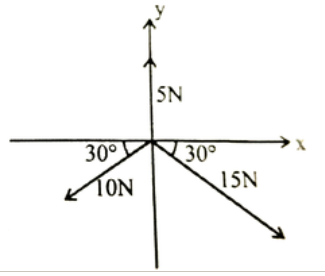
Find the magnitude of the resultant of s...

Find the magnitude of the resultant of shown forces :-

A

`5sqrt(3)N`

B

10N

C

`10sqrt(3)N`

D

`5sqrt(7)N`

Text Solution

Verified by Experts

The correct Answer is:

A
Promotional Banner

Topper's Solved these Questions

  • RACE

    ALLEN|Exercise Basic Maths (Units, Dimensions & Measurements)|30 Videos
  • RACE

    ALLEN|Exercise Basic Maths (KINEMATICS)|59 Videos
  • RACE

    ALLEN|Exercise Basic Maths (Co-ordinate & Algebra)|37 Videos
  • NEWTONS LAWS OF MOTION

    ALLEN|Exercise EXERCISE-III|28 Videos
  • SIMPLE HARMONIC MOTION

    ALLEN|Exercise Example|1 Videos

Similar Questions

Explore conceptually related problems

The forces each of magnitude 10N act vertically upwards and downwards respectively at the two ends A and B of a uniform rod of length 4m which is pivoted at its mid point O as shown is fig. 1.30, Determine the magnitude of the resultant moment of forces about the pivot O.

The maximum and minimum magnitudes of the resultant of two forces are 5 N and 5N respectively. Find the magnitude of resultant force when act orthogonally to each other.

The greatest & the least magnitude of the resultant of two forces of constant magnitudes are P & Q respectively. If the forces act at an angle 2 alpha , then prove that the magnitude of their resultant is given by sqrt(P^(2) cos^(2) alpha+Q^(2) sin^(2) alpha) .

Two forces with equal magnitudes F act on a body and the magnitude of the resultant force is F /3. The angle between the two forces is

Four forces are acting on a body as shown in figure. The magnitude of resultant of the forces is

Two forces of magnitudes P and Q are inclined at an angle (theta) . The magnitude of their resultant is 3Q. When the inclination is changed to (180^(@)-theta) , the magnitude of the resultant force becomes Q. Find the ratio of the forces.

Find the magnitude of the unknown forces X and Y if sum of all forces is zero.

Find the magnitudes of the unknown forces if the sum of all forces is zero (figure)

Find the magnitude and direction of the resultant of two vectors A and B in the terms of their magnitudes and angle theta between them.

The sum of the magnitudes of two forces acting at a point is 18 and the magnitude of their resultant is 12. If the resultant is at 90^(@) with the force of smaller magnitude, What are the magnitudes of forces?

ALLEN-RACE-Basic Maths (VECTORS)
  1. If v=(3hati+2hatj+6k) m/s and m=(2)/(7)kg then find kinetic energy (i....

    Text Solution

    |

  2. Two force vectors each having magnitude 6N are oriented as 30^(@) from...

    Text Solution

    |

  3. Find the magnitude of the resultant of shown forces :-

    Text Solution

    |

  4. If vecP=vec(KQ) (Here K is constant) them :-

    Text Solution

    |

  5. The dot product of two vectors of magnitudes 3 units and 5 units canno...

    Text Solution

    |

  6. If vecA=2hati+3hatj-hatk and vecB=-hati+3hatj+4hatk then projection of...

    Text Solution

    |

  7. If |hatAxxhatB|=-sqrt(3)hatA.hatB, then |hatA-hatB|=…………………..

    Text Solution

    |

  8. Find the torque of a force vecF=2hati+hatj+4hatk acting at the point v...

    Text Solution

    |

  9. What is the value of linear velocity ,if if omega=3hati-4hatj+hatkand ...

    Text Solution

    |

  10. The angle made by the vector vecA=hati+hatj with x-axis is

    Text Solution

    |

  11. Two vectors vecA=3hati+2hatj+hatk" and "vecB=5hatj-9hatj+Phatk are per...

    Text Solution

    |

  12. If the vectors (hati + hatj+hatk) and 3hati form two sides of a triang...

    Text Solution

    |

  13. The vactor projection of a vector 3hati+4hatkon y-axis is

    Text Solution

    |

  14. Consider two vectors vecF(1)=2hati+5hatk and vecF(2)=3hatj+4hatk. The ...

    Text Solution

    |

  15. The component of vector A=a(x)hati+a(y)hatj+a(z)hatk and the directioi...

    Text Solution

    |

  16. (vecA+2vecB).(2vecA-3vecB):-

    Text Solution

    |

  17. If vecA=3hati+4hatj and vecB=6hati+8hatj, select correct alternatives ...

    Text Solution

    |

  18. the angle between the vectors (hati+hatj) and (hatj+hatk) is

    Text Solution

    |

  19. vecA, vecB and vecC are vectors each having a unit magneitude. If ...

    Text Solution

    |

  20. The velocity of a particle is v=6hati+2hatj-2hatk The component of the...

    Text Solution

    |
