Home
Class 12
PHYSICS
Two composite rods made by A & B and C &...

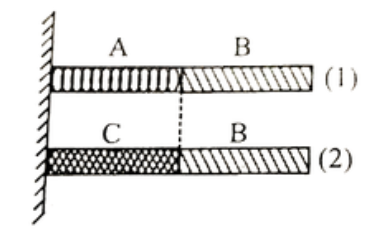
Two composite rods made by A & B and C & B materials as shown. When we increase the temperature `DeltaT`, relation between final lengths of rod becomes `L_(1)ltL_(2)`. Find the relation between `alpha_(A)` and `alpha_(C)`.

A

`alpha_(A)gtalpha_(C)`

B

`alpha_(A)=alpha_(C)`

C

`alpha_(A)ltalpha_(C)`

D

`alpha_(A)+alpha_(C)=alpha_(B)`

Text Solution

Verified by Experts

The correct Answer is:

C
Promotional Banner

Topper's Solved these Questions

  • RACE

    ALLEN|Exercise Basic Maths (Thermal Physics) (Calorimetry)|14 Videos
  • RACE

    ALLEN|Exercise Basic Maths (Thermal Physics) (Mode of Heat Transfer)|14 Videos
  • RACE

    ALLEN|Exercise Basic Maths (Properties of Matter & Fluid Mechanics)(Surface Tension)|26 Videos
  • NEWTONS LAWS OF MOTION

    ALLEN|Exercise EXERCISE-III|28 Videos
  • SIMPLE HARMONIC MOTION

    ALLEN|Exercise Example|1 Videos

Similar Questions

Explore conceptually related problems

Length v/s Temperature graph of A & B is given below. Find the relation between alpha_(A) & alpha_(B) .

A cubical block of co-efficient of linear expansion alpha_s is submerged partially inside a liquid of co-efficient of volume expansion gamma_l . On increasing the temperature of the system by DeltaT , the height of the cube inside the liquid remains unchanged. Find the relation between alpha_s and gamma_l .

If a^2+b^2+c^2-a b-b c-c a=0, then find the relation between a,b and c

A cube of coefficient of linear expansion alpha is floating in a bath containing a liquid of coefficient of volume expansion gamma_(l) . When the temperature is raised by DeltaT , the depth upto which the cube is submerged in the liquid remains the same. Find relation between alpha and gamma_(l)

A cube of coefficient of linear expansion alpha is floating in a bath containing a liquid of coefficient of volume expansion gamma_(l) . When the temperature is raised by DeltaT , the depth upto which the cube is submerged in the liquid remains the same. Find relation between alpha and gamma_(l)

Two metal rods of the same length and area of cross-section are fixed end to end between rigid supports. The materials of the rods have Young moduli Y_(1) and Y_(2) , and coefficient of linear expansion alpha_(1) and alpha_(2) . The junction between the rod does not shift and the rods are cooled

Two steel rods and an aluminium rod of equal length l_0 and equal cross- section are joined rigidly at their ends as shown in the figure below. All the rods are in a state of zero tension at 0^@ C . Find the length of the system when the temperature is raised to theta . Coefficient of linear expansion of aluminium and steel are alpha_(a) and alpha_(s) respectively. Young's modulus of aluminium is Y_(a) and of steel is Y_(s) .

Consider a cylindrical container of cross-section area A length h and having coefficient of linear expansion alpha_(c) . The container is filled by liquid of real expansion coefficient gamma_(L) up to height h_(1) . When temperature of the system is increased by Deltatheta then (a). Find out the height, area and volume of cylindrical container and new volume of liquid. (b). Find the height of liquid level when expansion of container is neglected. (c). Find the relation between gamma_(L) and alpha_(c) for which volume of container above the liquid level (i) increases (ii). decreases (iii). remains constant. (d). On the surface of a cylindrical container a scale is attached for the measurement of level of liquid of liquid filled inside it. If we increase the temperature of the temperature of the system by Deltatheta , then (i). Find height of liquid level as shown by the scale on the vessel. Neglect expansion of liquid. (ii). Find the height of liquid level as shown by the scale on the vessel. Neglect expansion of container.

Two rods of different materials having coefficient of thermal expansion alpha_(1), alpha_(2) and young's modulii Y_(1) ,Y_(2) respectively are fixed between two rigid massive walls. The rods are heated such that they undergo the same increase in temperature. There is no bending of rods. If alpha_(1) :alpha_(2)=2 : 3 , the thermal stresses developed in the two rods are equal provided Y_(1) : Y_(2) is equal to

Two rods of different materials having coefficient of thermal expansion alpha_(1), alpha_(2) and young's modulii Y_(1) ,Y_(2) respectively are fixed between two rigid massive walls. The rods are heated such that they undergo the same increase in temperature. There is no bending of rods. If alpha_(1) :alpha_(2)=2 : 3 , the thermal stresses developed in the two rods are equal provided Y_(1) : Y_(2) is equal to
