Home
Class 12
PHYSICS
A beam of monochromatic light is inciden...

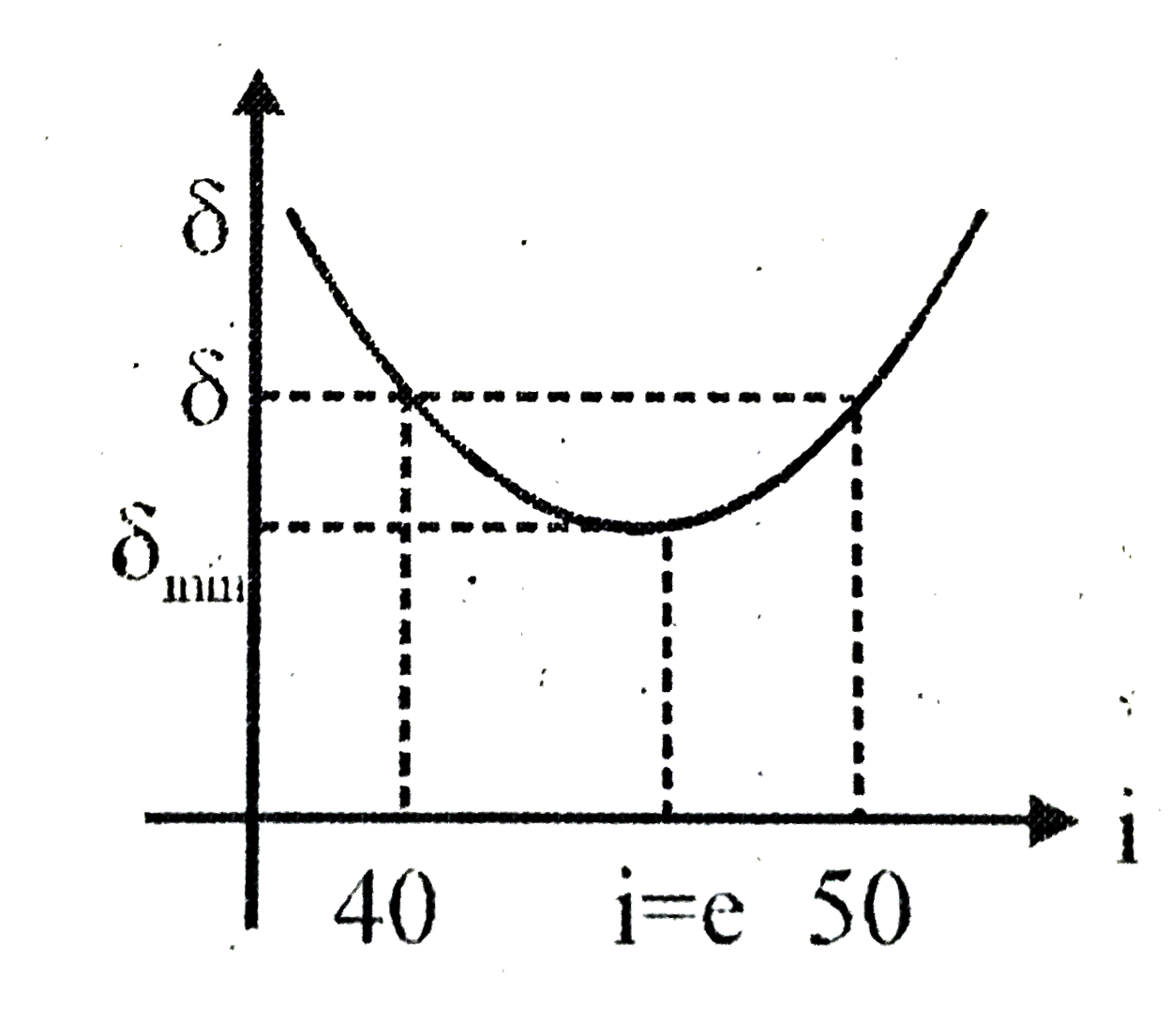
A beam of monochromatic light is incident at `i= 50^(@)` on one face of an equilateral prism, the angle of emergence is `40^(@)`, then the angle of minimum deviation is :

A

` 30 ^@ `

B

` lt 30 ^@ `

C

` le 30 ^@ `

D

` ge 30 ^@ `

Text Solution

Verified by Experts

The correct Answer is:
B


Graph between ` ( delta -i) ` for prism
For the given condition
` delta = ( i+e-A) = 40 + 50 - 60 , delta = 30 `
Then ` delta _ (min ) lt delta , delta _ (min) lt 30 `
Promotional Banner

Topper's Solved these Questions

Similar Questions

Explore conceptually related problems

A monochromatic beam of light is incided at 60^(@) in one face of an equilateral prism of refractive index n and emerges from the opposite face making an angle theta(n) with the normal (see the figure). For n=sqrt3 the value of theta is 60^(@) and d(theta)/(dn)=m . The value of m is

A ray of light is incident normally on one face of an equilateral prism of refractive index 1.5 . The angle of deviation is: (Given sin^-1.(2)/(3)=42^@ )

An equilateral prism produces a minimum deviation of 30^(@) . The angle of incidence is

The angle of a prism is 60^(@) When light is incident at an angle of 60^(@) on the prism, the angle of emerge is 40^(@) . The angle of incidence i for which the light ray will deviate the least is such that

A ray of light is incident at 65^(@) on one face of a prism of angle of 30^(@) and the emergent ray makes 35^(@) with the incident ray. The refractive index of the prism is:

A ray of light is incident at 60^(@) on one face of a prism of angle 30^(@) and the emergent ray makes 30^(@) with the incident ray. The refractive index of the prism is

A ray of light is incident at 60^(@) on one face of a prism of angle 30^(@) and the emergent ray makes 30^(@) with the incident ray. The refractive index of the prism is

A ray of light is incident on a prism whose refractive index is 1.52 at an angle of 40^(@) . If the angle of emergence is 60^(@) , calculate the angle of the prism.

A ray of light is normally incident on one face of an equilateral glass prism. Answer the following : (a) What is the angle of incidence on the first face of the prism? (b) What is the angle of refraction from the first face of the prism ? (c) What will be the angle of incidence at the second face of the prism ? (d) Will the light ray suffer minimum deviation by the prism ?

If the angle of prism is 60^(@) and the angle of minimum deviation is 40^(@) , the angle of refraction will be

ALLEN-AIIMS 2019-PHYSICS
  1. An equi-convex lens of focal length 10 cm and refractive index (mug=1....

    Text Solution

    |

  2. A boy of height 1.5m with his eye level at 1.4m stands before a plane ...

    Text Solution

    |

  3. Two plane mirrors are inclined at 70^@. A ray incident on one mirror a...

    Text Solution

    |

  4. A beam of diameter 'd' is incident on a glass hemisphere as shown. If ...

    Text Solution

    |

  5. Two lenses in contact made of materials with dispersive powers in the ...

    Text Solution

    |

  6. A beam of monochromatic light is incident at i= 50^(@) on one face of ...

    Text Solution

    |

  7. Find the height of image in the following diagram.

    Text Solution

    |

  8. A plane mirror is moving with velocity -2 hati - 3 hatj + 4hatk ....

    Text Solution

    |

  9. Find the lateral shift of a light ray while it passws through a paral...

    Text Solution

    |

  10. A thin convex lens from a real Image of a certain object 'p' times it ...

    Text Solution

    |

  11. The distance between the objective lens and the eye lens of an astrono...

    Text Solution

    |

  12. A far sighted person has a near point of 60"cm" . What power lens shou...

    Text Solution

    |

  13. If the potential at the centre of a uniformly charged hollow sphere of...

    Text Solution

    |

  14. A charge q is placed at the point P as shown in figure on the axis of ...

    Text Solution

    |

  15. A point charge Q is placed at the centre of a spherical conducting she...

    Text Solution

    |

  16. Two spherical , nonconducting and very tin shells of uniformly distrib...

    Text Solution

    |

  17. An infinite number of concentric rings carry a charge Q each alternate...

    Text Solution

    |

  18. If uniform electric field vec E = E 0 hati + 2 E 0 hatj ,...

    Text Solution

    |

  19. For an infinite line of charge having charge density lambda lying alon...

    Text Solution

    |

  20. A particle of mass m and charge +q approaches from a very large distan...

    Text Solution

    |

