

Home
Class 12
PHYSICS
Find the lateral shift of a light ray wh...

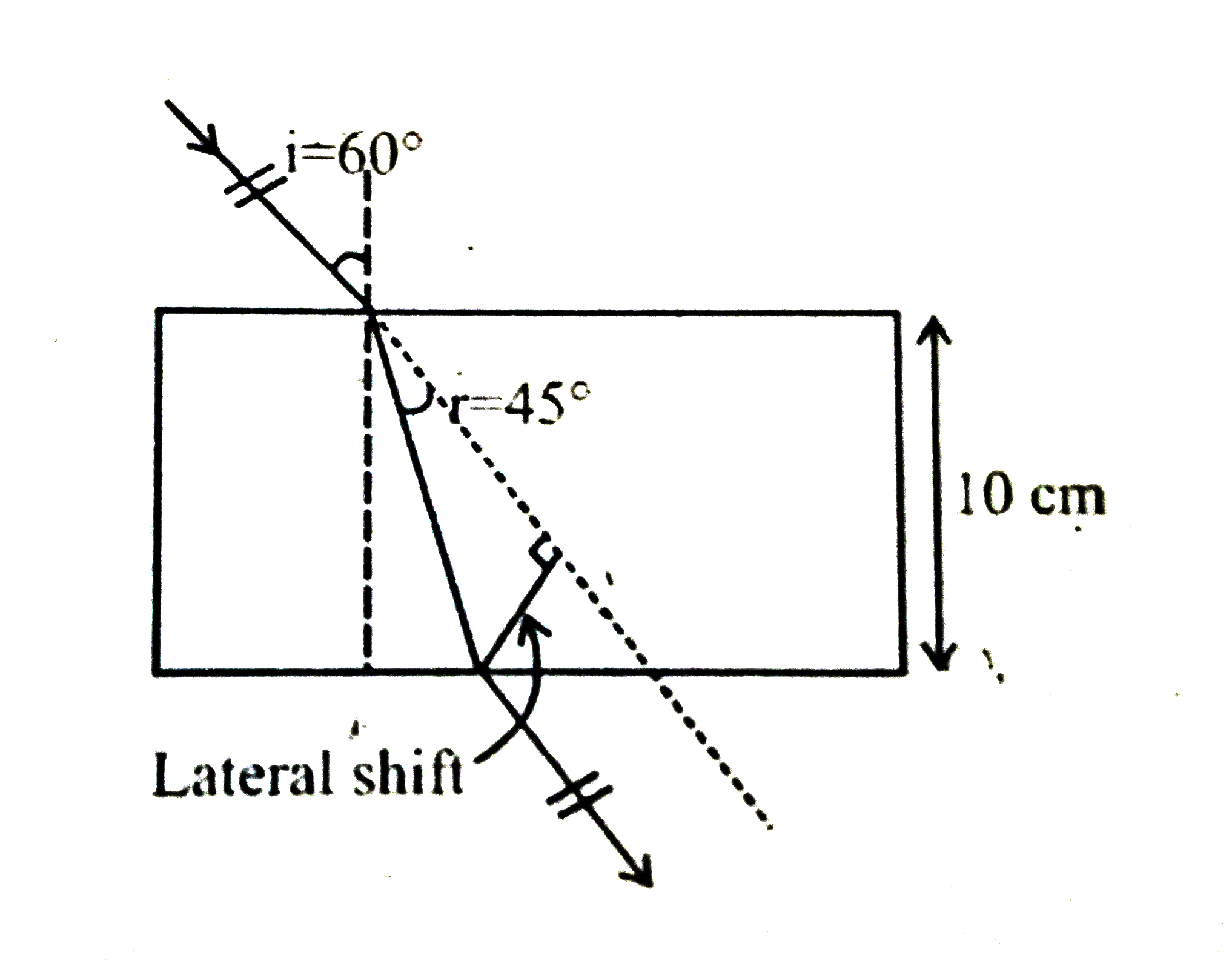
Find the lateral shift of a light ray while it passws through a parallel glass slab of thickness 10 cm places in air. The angle of incidence in air is `60^(@)` and the angle of refraction in glass is `45^(@)`.

A

` (10 ) /( sqrt 2 ) sin 45^@ `

B

` 10 sqrt 2 sin 15^@ `

C

` 10 `

D

None

Text Solution

Verified by Experts

The correct Answer is:
B

` d = (t sin (i-r) ) / ( cos r ) = ( 10 sin ( 60 ^@ - 45^@ ) ) / ( cos 45^@) `
` = ( 10 sin 15^@) /( cos 45^@) = 10 sqrt2 sin 15^@ `
Promotional Banner

Topper's Solved these Questions

Similar Questions

Explore conceptually related problems

(a) Figure below shows a parallel beam of monochromatic light incident on a convex sperical surface, radius of curvature R=30 cm, which separates glass (refractive). Find the distance of image formed. (b) A ray of light which is incident in air on the surface of a glass block is deviated through 15^(@) . The angle of incidence in air is 60^(@) . what is the angle of refraction in glass ? Also, claculate the critical angle for a glass-air interface.

A ray of light is incident on the surface of a glass plate of refractive index sqrt(3) at the polarising angle . The angle of incidence and angle of refraction of the ray is

A light enters a glass slab of thickness t with angle of incidence i suffers lateral shifts(s).If angle of refraction of light is r , then lateral shift is equal to

A ray of light passes from glass, having a refractive index of 1.6, to air. The angle of incidence for which the angle of refraction is twice the angle of incidence is

Light falls from glass (mu=1.5) to air. Find the angle of incidence for which the angle of deviation is 90^@ .

A light ray is travelling from air to glass. True reflected and refracted rays are perpendicular to each other. If the angle of incidence in air is I the refractive index of glass is

A ray of light is incident on a parallel slab of thickness t and refractive index n. If the angle of incidence theta is small, than the lateral displacement in the incident and emergent ray will be

Draw diagrams to show the refraction of light from (i) air to glass, and (ii) glass to air. In each diagram, label the incident ray, refracted ray, the angle of incidence (i) and the angle of refraction (r).

The angle of incidence is always smaller than angle of refraction when a ray travels from air to glass. ______

A ray of ordinary light is travelling in air. It is incident on air glass pair at a polarising angle of 56^@ . Find the angle of refraction in glass.

ALLEN-AIIMS 2019-PHYSICS
  1. An equi-convex lens of focal length 10 cm and refractive index (mug=1....

    Text Solution

    |

  2. A boy of height 1.5m with his eye level at 1.4m stands before a plane ...

    Text Solution

    |

  3. Two plane mirrors are inclined at 70^@. A ray incident on one mirror a...

    Text Solution

    |

  4. A beam of diameter 'd' is incident on a glass hemisphere as shown. If ...

    Text Solution

    |

  5. Two lenses in contact made of materials with dispersive powers in the ...

    Text Solution

    |

  6. A beam of monochromatic light is incident at i= 50^(@) on one face of ...

    Text Solution

    |

  7. Find the height of image in the following diagram.

    Text Solution

    |

  8. A plane mirror is moving with velocity -2 hati - 3 hatj + 4hatk ....

    Text Solution

    |

  9. Find the lateral shift of a light ray while it passws through a paral...

    Text Solution

    |

  10. A thin convex lens from a real Image of a certain object 'p' times it ...

    Text Solution

    |

  11. The distance between the objective lens and the eye lens of an astrono...

    Text Solution

    |

  12. A far sighted person has a near point of 60"cm" . What power lens shou...

    Text Solution

    |

  13. If the potential at the centre of a uniformly charged hollow sphere of...

    Text Solution

    |

  14. A charge q is placed at the point P as shown in figure on the axis of ...

    Text Solution

    |

  15. A point charge Q is placed at the centre of a spherical conducting she...

    Text Solution

    |

  16. Two spherical , nonconducting and very tin shells of uniformly distrib...

    Text Solution

    |

  17. An infinite number of concentric rings carry a charge Q each alternate...

    Text Solution

    |

  18. If uniform electric field vec E = E 0 hati + 2 E 0 hatj ,...

    Text Solution

    |

  19. For an infinite line of charge having charge density lambda lying alon...

    Text Solution

    |

  20. A particle of mass m and charge +q approaches from a very large distan...

    Text Solution

    |