

Home
Class 12
PHYSICS
Using Gauss’ law, derive an expression f...

Using Gauss’ law, derive an expression for the electric field at a point near an infinitely long straight uniformly charged wire.

Text Solution

Verified by Experts

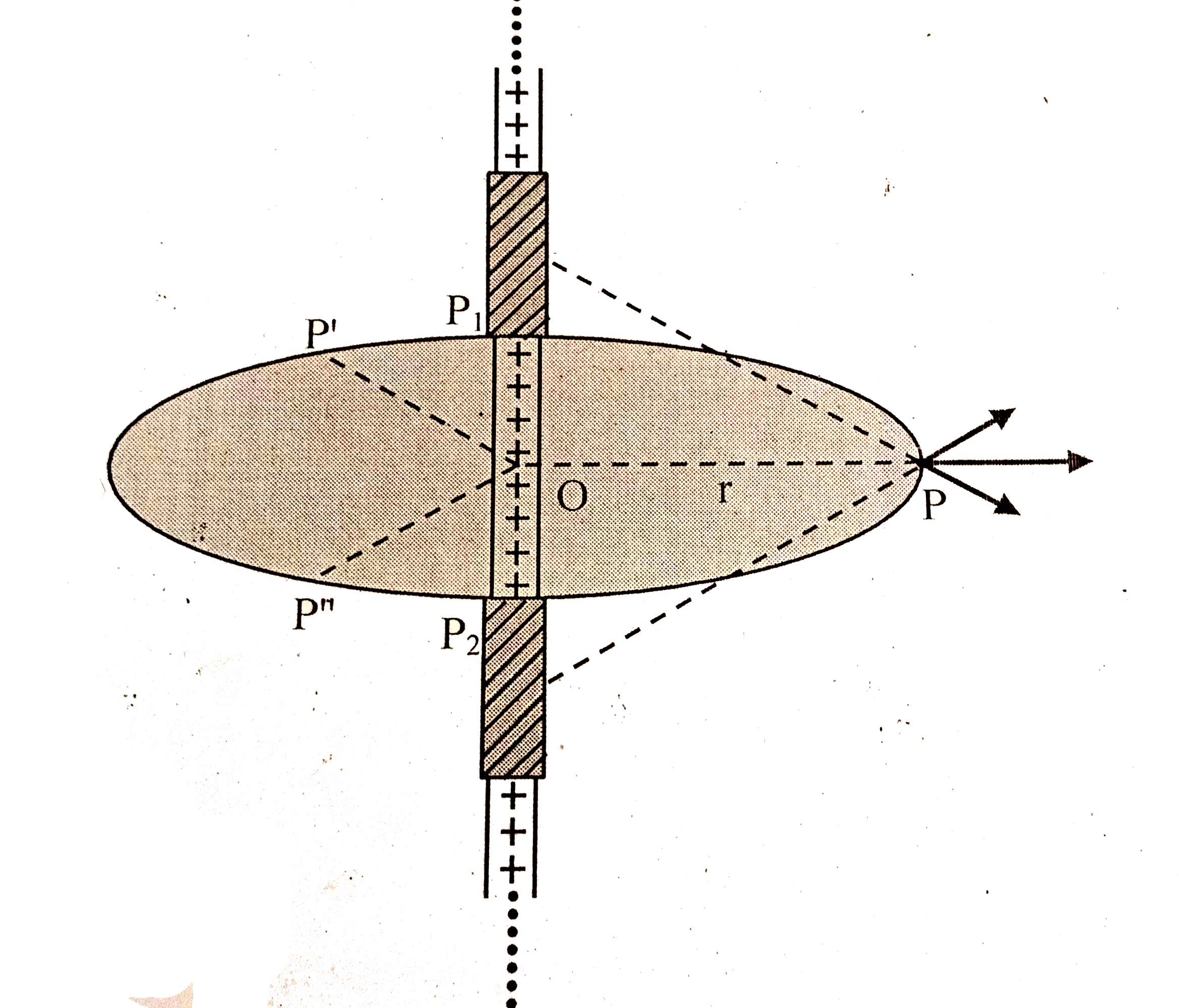
Considering the whole line charge to be made of symmetrically situated length elements, each of length dI, it is clear from the figure shown that, the resultant field will be directed perpendicular to the line charge as shown-

To find magnitude
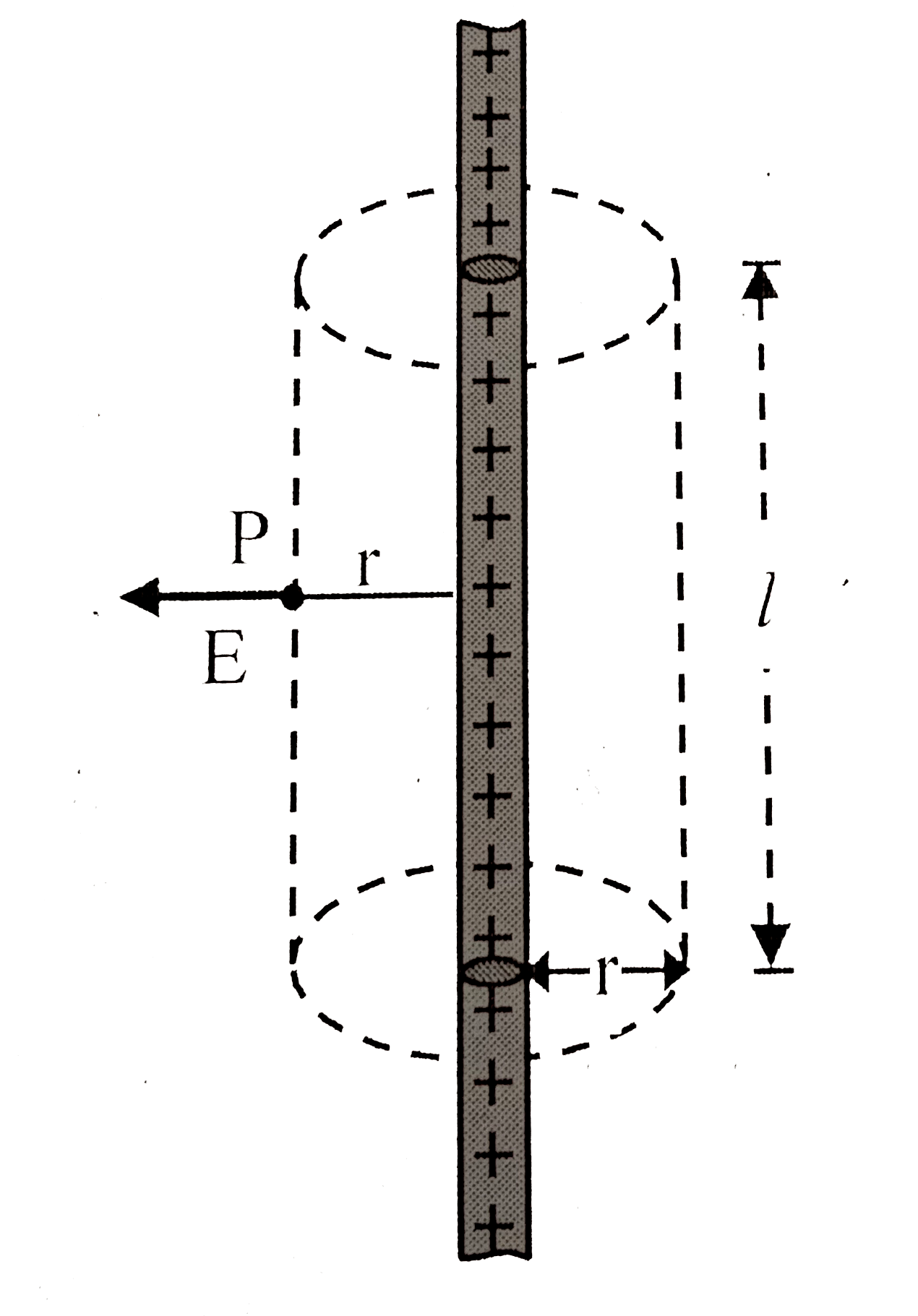
Now considering a cylindrical gaussian surface of radius r and length l , passing through point p , as shown

Flux through the Gaussian Surface= Flux through the curved Cylindrical part `Phi= E xx 2 pi r l ` .....(1) , But according to Gauss’ law `[Phi= (Sigma q)/( epsilon_(0))]`
net electric flux emerging from cylindrical surface is `[Phi = (lambda l ) / ( epsilon_(0))]` ....(2) [ The surface includes charge equal to `lambda l` ]
Now , eliminating`ul(Phi)` from equation (1) & (2), we get
`Exx 2 pi r l = (lambda)/(epsilon_(0))` or `E=(lambda)/(2 pi epsilon_(0)r ) = ( 2 k lambda)/(r)`
And in vector form `vec(E)=(2 k lambda)/(r^(2)) vec(r)`
Promotional Banner

Topper's Solved these Questions

Similar Questions

Explore conceptually related problems

Using Gauss’s law, derive expression for intensity of electric field at any point near the infinitely long straight uniformly charged wire. The electric field components in the following figure are E_(x) = alphax, E_(y) = 0, E_(z) = 0, " in which " alpha = 400 N//C m. Calculate (i) the electric flux through the cube, and (ii) the charge within the cube assume that a = 0.1m.

Answer the following: State Gauss' law in electrostatics. Derive an expression for the electric field due to an infinitely long straight uniformly charged wire.

(a) Using Gauss's law, derive an expression for the electric field intensity at any point outside a uniformly charged thin spherical shell of radius R and charge density sigma C//m^(2) . Draw the field lines when the charge density of the sphere is (i) positive, (ii) negative. (b) A uniformly charged conducting sphere of 2.5 m in diameter has a surface charge density of 100 mu C//m^(2) . Calculate the (i) charge on the sphere (ii) total electric flux passing through the sphere.

State Gauss's law in electrostatics. Use this law to derive an expression for the electric field due to an infinitely long straight wire of linear charge density lamda cm^(-1)

Answer the following: (a) State Gauss' law. Using this law, obtain the expression for the electric field due to an infinitely long straight conductor of linear charge density lamda . (b) A wire AB of length L has linear charge density lamda = kx , where x is measured from the end A of the wire. This wire is enclosed by a Gaussian hollow surface. Find the expression for the electric flux through this surface.

Derive an expression for electric field intensity at a point due to point charge.

State Gauss's law in electrostatics. Using this law derive an expression for the electric field due to a uniformly charged infinite plane sheet.

(a) Use Gauss's law to derive the expression for the electric filed (vecE) due to straight uniformaly charges infinite line of charges density lambda C//m . (b) Draw a graph to show the variation of E with perpendicular from the line of charge. (c) Find the work done in brining a charge q from prependicular distance r_(1) to r_(2) (r_(2) gt r_(1)) .

Use Gauss's law to derive the expression for the electric field between two uniformly charged large parallel sheets with surface charge densities sigma and -sigma respectively.

State Gauss's theorem in electrostatics. Apply this theorem to derive an expression for electric field intensity at a point outside a uniformly charged thin spherical shell.