Home
Class 12
PHYSICS
Find velocity of piston A in the given s...


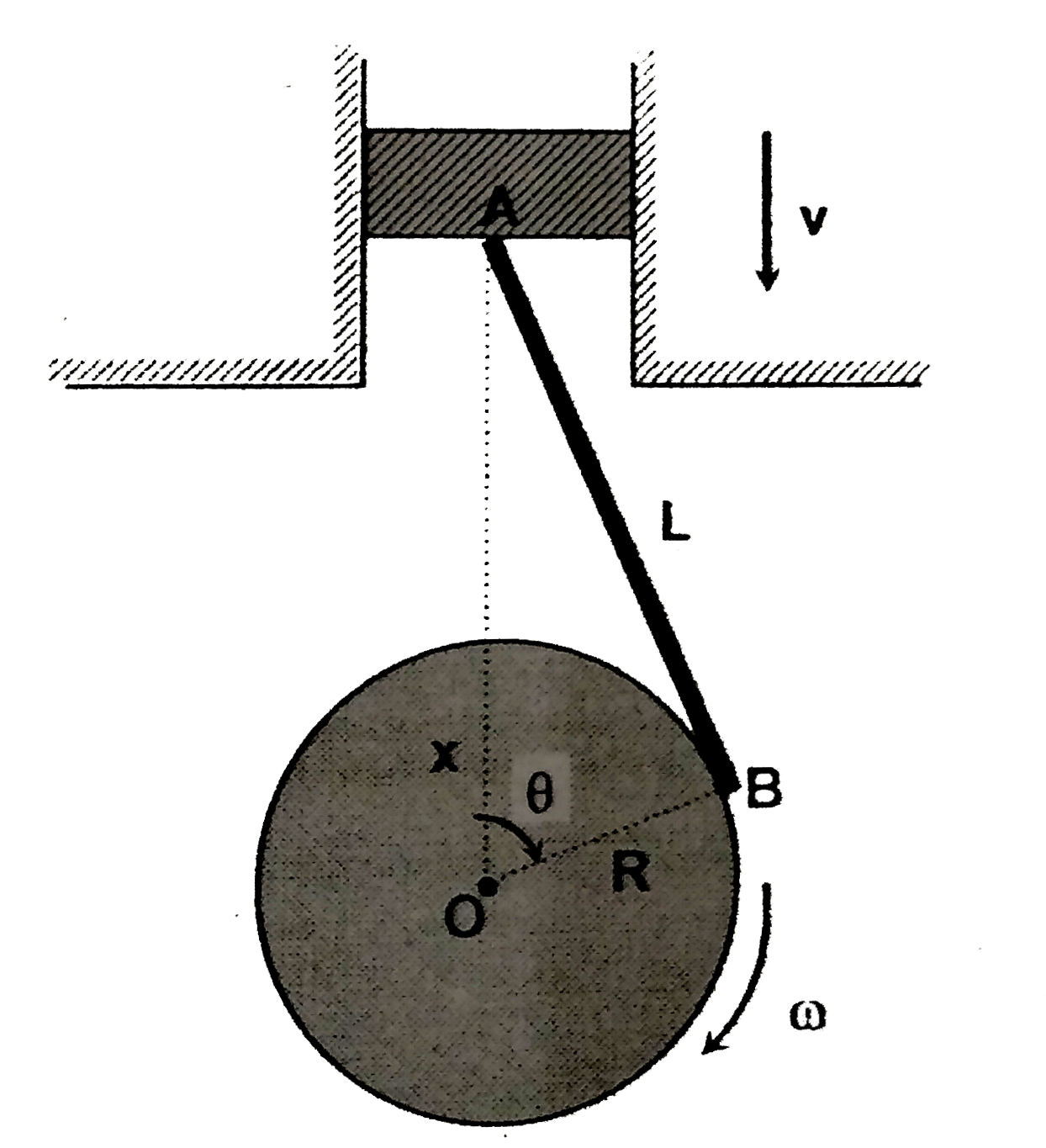
Find velocity of piston A in the given situation if angular velocity of wheel of radius R is `omega` (constant) in the clockwise sense (O is fixed point)

A

`(xRomegasintheta)/(Rcostheta+x)`

B

`(x^(2)omegasintheta)/(Rcostheta-x)`

C

`(xRomegasintheta)/(Rcostheta-x)`

D

`(R^(2)omegasintheta)/(Rcostheta-x)`

Text Solution

Verified by Experts

The correct Answer is:

C

`costheta=(x^(2)+R^(2)-L^(2))/(2xR)implies2xRcostheta=x^(2)+R^(2)+L^(2)`
`2R{-xsintheta((d theta)/(dt))+costheta((dx)/(dt))}=2x(dx)/(dt)`
`xv=Rvcostheta-Rxomegasintheta`
`impliesv=((xRomegasintheta)/(Rcostheta-x))`
Promotional Banner

Similar Questions

Explore conceptually related problems

A rod is rotating with angular velocity omega about axis AB. Find costheta .

A rod of mass m and length l is rotating about a fixed point in the ceiling with an angular velocity omega as shown in the figure. The rod maintains a constant angle theta with the vertical. What is the rate of change of angular momentum of the rod ?

two cylindrical hollow drums of radii R and 2 R, and of a common height h , are rotating with angular velocities omega (anti- clockwise ) and omega (clockwise ) , respectively , their axes , fixed are parallel and in a horizontal plane separated by by 3R + delta , they are now brought in contact (delta to0) (A) show frictional forces just after contact . (B) identify forces and torque external to the system just after contact , (c) what would be the ratio of final of final angular velocities when friction ceases ?

A rod of mass m and length l is rotating about a fixed point in the ceiling with an angular velocity omega as shown in the figure. The rod maintains a constant angle theta with the vertical. What will be the horizontal component of angular momentum of the rod about the point of suspension in terms of m , omega , l and theta .

A rod of mass m and length l is rotating about a fixed point in the ceiling with an angular velocity omega as shown in the figure. The rod maintains a constant angle theta with the vertical. What angle will the rod make with the vertical

Two cylindrical hollow drums of radii R and 2R , and of a commom height h, are rotating with angular velocities omega (anti-clockwise) and omega (clockwise), respectively. Their axes, fixed are parallel and in a horizontal plane separated by (3R + delta) . They are now brought in contact (delta rarr 0) . (a) Show the frictional forces just after contact. (b) Identify forces and torque external to the system just after contact. (c ) What would be the ratio of final angular velocities when friction ceases ?

In figure, what be the sign of the velocity of the point P', which is the projection of the velocity of the reference particle P.P is moving in a circle of radius R in anti-clockwise direction.

The linear velocity of a rotating body is given by vec(v)= vec(omega)xxvec(r ) , where vec(omega) is the angular velocity and vec(r ) is the radius vector. The angular velocity of a body is vec(omega)= hat(i)-2hat(j)+2hat(k) and the radius vector vec(r )= 4hat(j)-3hat(k) , then |vec(v)| is

A sphere is moving at some instant with horizontal velocity v_(0) in right and angular velocity omega in anti clockwise sense. If |v_(0)| = |omega R| , the instantaneous centre of rotation is

In the figure shown 'R' is a fixed conducting fixed ring of negligible resistance and radius 'a' PQ is a uniform rod of resistance r . It is hinged at the centre of the ring and rotated about this point in clockwise direction with a uniform angular velocity w . These is a uniform magnetic filled of strength 'B' ponting inwards. 'r' is a stationary resistance
