Home
Class 12
PHYSICS
A mass of mass 60 kg hangs himself from ...


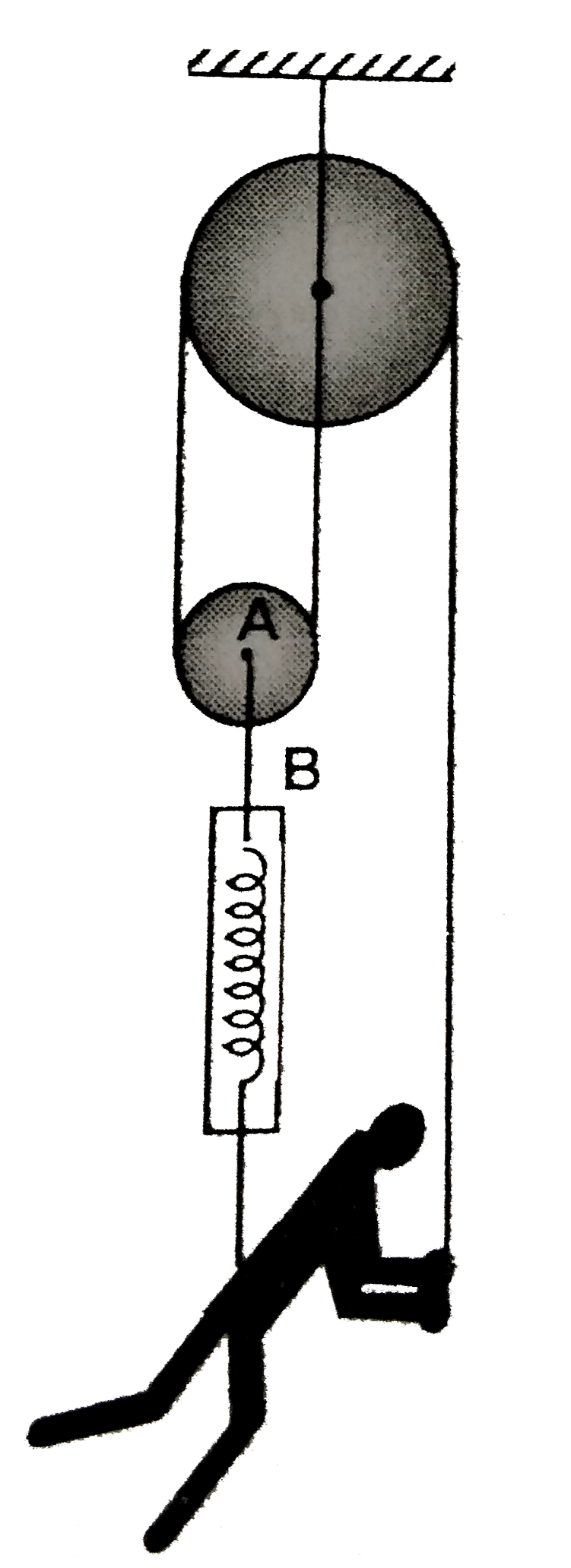
A mass of mass 60 kg hangs himself from a massless spring balance. Which itself suspneded from an ideal string-pulley system as shown in the figure. The stirng AB can bear maximum 900 N. Choose correct statement.

A

The man is never ever able to read his correct weight in the spring balance.

B

If man is able to manage himself at rest, the spring balance reads his true weight.

C

The maximum magnitude of accelerationman can manage is 12.5 `m//s^(2)` while moving upward.

D

When man moves downward with acceleration `5m//s^(2)` the spring balance will read 40 kg.

Text Solution

Verified by Experts

The correct Answer is:

C

`2T-Mg+T=MaimpliesMg-3T=Maimplies3T=M(g-a)` ..(i)
2T=kx
`T=(M(g+a))/(3)`
Reading of spring balance `=(kx)/(g)=(2T)/(g)={{:((2M(g+a))/(3g),("When moving upward")),((2M(g-a))/(3g),("When moving downward")):}`
Promotional Banner

Similar Questions

Explore conceptually related problems

An ideal string pulley system is shown in the figure and system is released from rest choose correct option

A mass of 10 kg is suspended from a spring balance. It is pulled aside by a horizontal string so that it makes an angle of 60^(@) with the vertical. The new rading of the balance is

Two block of mass 2kg are connected by a massless ideal spring of spring contant K=10N//m . The upper block is suspended from roof by a light string A . The system shown is in equilibrium. The string A is now cut, the acceleration of upper block just after the string A is cut will be (g=10m//s^(2) .

Two block of mass 2kg are connected by a massless ideal spring of spring contant K=10N//m . The upper block is suspended from roof by a light string A . The system shown is in equilibrium. The string A is now cut, the acceleration of upper block just after the string A is cut will be (g=10m//s^(2) .

A block of mass 5kg is hung with the help of light string which is passing over an ideal pulley as shown as in figure.The force is exerted by the clamp on the pulley will be (g= 10 m/s^2)

Consider the situation shown in the figure. A mass is hanging from a inextensible string which is passing over a pulley. The pulley itself is attached to a massless spring of stiffness k as shown in the figure. Find the time period of vertical oscillations of mass m if pulley is slightly displaced from its mean position. Assume that string does not slip over pulley.

Two blocks of masses 10 kg and 9 kg are connected with light string which is passing over an ideal pulley as shown in figure. If system is released from rest then the acceleration of 9 kg block at the given instant is about (Assume all the surfaces are smooth and g = 10 m/s^2 )

Three blocks A, B and C havig masses m kg, 2kg and 3 kg are attached by massless strings and ideal pulleys as shown in the figure. When the system is realeased from rest if the block A remains stationary. the mass of block A is

Two blocks of masses 5 kg and 4 kg are connected with ideal string which is passing over an ideal pulley as shown in figure. If the system is released from rest then the magnitude of acceleration of the blocks will be (Take g = 10 ms^-2 and sqrt3 = 1.7 )

A mass of mass 60 kg is pulling a mass M by an inextensible light rope passing through a smooth and massless pulley as shown in figure. The coefficient of friction between the mass and ground is mu = 1//2 find the maximum value of M that can be pulled on the ground
