Home
Class 12
PHYSICS
A two stage rocket is fired vertically u...


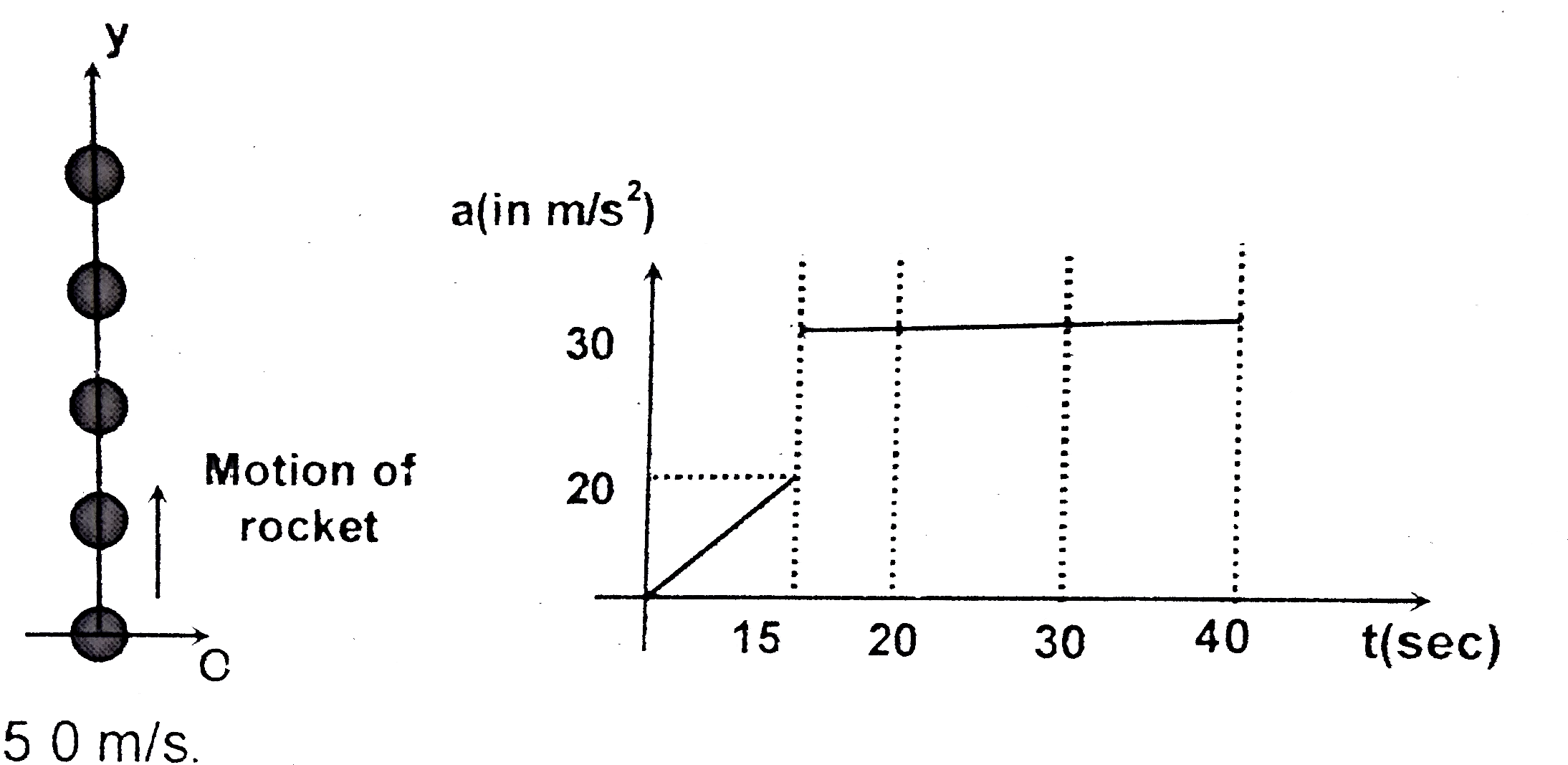
A two stage rocket is fired vertically upward from rest with acceleration as shown in a-t graphs. After 15 sec, the first stage burns out and second stage ignites. Choose the INCORRECT statement regarding motion of rocket in the time interval `0letle40s`.

A

at t=15 sec, the speed of rocket is 15.0m/s

B

At t=20 sec, the speed of rocket is 300m/s

C

In time interval t=0 sec to t=15 sec, the distance travelled by rocket is 750 m.

D

in time interval t-0 sec to t=20 sec, the distance travelled by rocket is 1500 m.

Text Solution

Verified by Experts

The correct Answer is:

D

`v{{:((2t^(2))/(9)hatj,"if "0letle15sec),(150+150(5-15)+15(t-15)^(2)hatj,"if "15sletle40s):}`
at t=15
`r=(2xx15xx15xx15)/(3xx3)=750m`
Promotional Banner

Similar Questions

Explore conceptually related problems

A rocket is fired vertically from the ground. It moves upwards with a constant acceleration 10m//s^(2) after 30 sec the fuel is finished. After what time from the instant of firing the rocket will attain the maximum height? g=10m//s^(2) :-

A rocket is fired vertically up from the ground with an acceleration 10 m//s^(2) . If its fuel is finished after 1 minute then calculate - (a) Maximum velocity attained by rocket in ascending motion. (b) Height attained by rocket fuel is finished. (c ) Time taken by the rocket in the whole motion. (d) Maximum height attained by rocket.

A particle starts from rest at t=0 and undergoes an acceleration as shown in figure. Draw the velocity-time graph of the motion of the particle during the interval from zero to 4 second.

Two bodies are projected vertically upwards from one point with the same initial velocity v_0. The second body is projected t_0 s after the first. How long after will the bodies meet?

A rocket is fired vertically upwards with a net acceleration of 4 m//s^2 and initial velocity zero. After 5s its fuel is finished and it decelerates with g. At the highest point its velocity becomes zero. Then, it accelerates downwards with acceleration g and return back to ground. Plot velocity-time and displacement -time graphs for the complete journey. Take g=10m//s^2.

In the given figure, a rocket is fired vertically upwards from its launching pad P. It first rises 40 km vertically upwards and then 40 km at 60° to the vertical. PA represents the first stage of the journey and AB the second. C is a point vertically below B on the horizontal level as P, calculate : (i) the height of the rocket when it is at point B.

In the given figure, a rocket is fired vertically upwards from its launching pad P. It first rises 40 km vertically upwards and then 40 km at 60° to the vertical. PA represents the first stage of the journey and AB the second. C is a point vertically below B on the horizontal level as P, calculate : (ii) the horizontal distance of point C from P.

A rocket with an initial mass of 1000 kg , is launched vertically upward from rest under gravity. The rocket burns fuel at the rate of 10 kg per second. The burnt matter is ejected vertically downwards with a speed of 2000 m//s relative to the rocket . Find the velocity of the rocket after 1 min of start.

A particle starts motion from rest and moves along a straight line. Its acceleration-time graph is shown. Find out speed of particle at t=2s and at t=3s.

A lift accelerates downwards from rest at rate of 2 m//s^(2) , starting 100 m above the ground. After 3 sec, an object falls out of the lift. Which will reach the ground first? What is the time interval between their striking the ground?
