Home
Class 12
PHYSICS
In the given figure, a long platform of ...


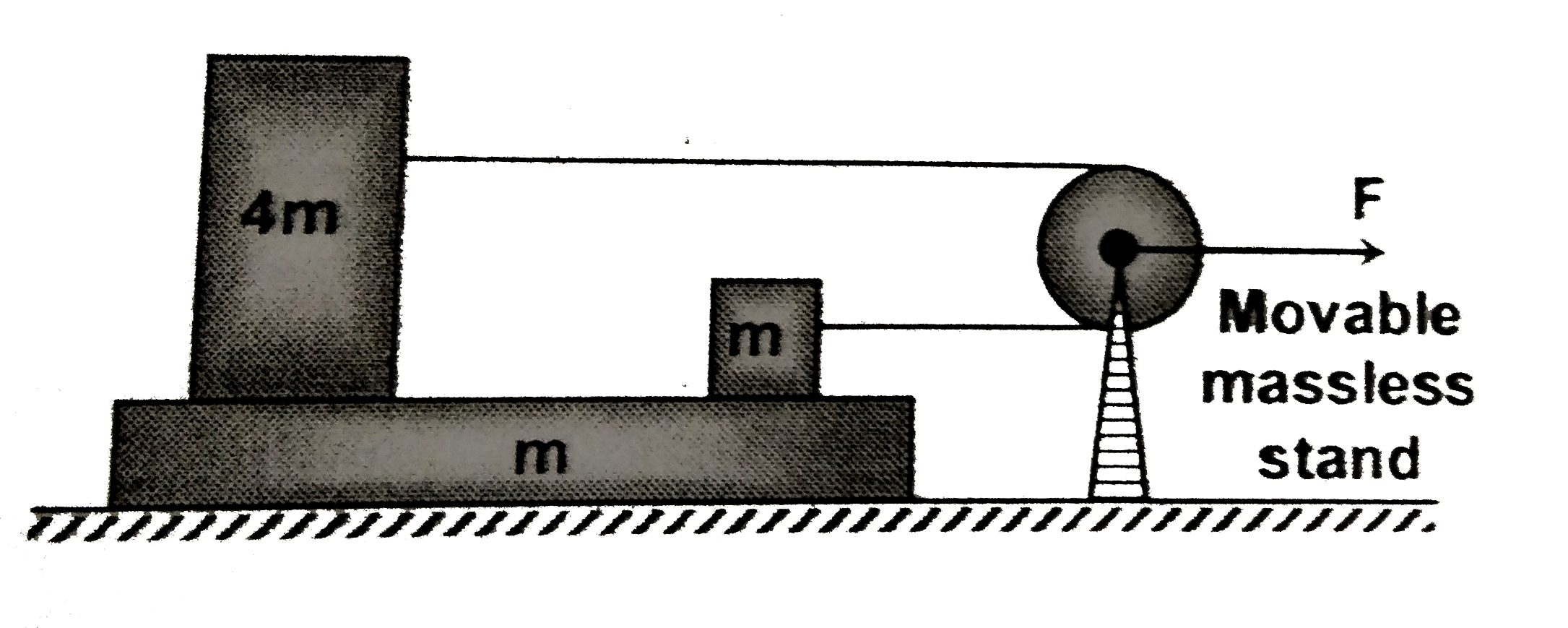
In the given figure, a long platform of mass m is placed on frictionless surface. Two blocks of masses 4 m and m (where m=10 kg) are placed on the platform. For both blocks, the coefficient of static friction with platform equal to 0.16 and the coefficient of kinetic friction equal to 0.10 the blocks are connected by a light ideal string through a light pulley (mounted at a movable massless stand). Which is acted upon by an unknown horizontal force F. if the acceleration of the platform is `2m//s^(2)`. Find the value of unknown force F and acceleration of blocks 4 m and m on `a_(1)` and `a_(2)` respectively.

A

`A. {:(F(N),,a_(1)(m//s^(2)),,a_(2)(m//s^(2))),(180N,,2m//s^(2),,8m//s^(2)):}`

B

`B. {:(F(N),,a_(1)(m//s^(2)),,a_(2)(m//s^(2))),(180N,,8m//s^(2),,2m//s^(2)):}`

C

`C. {:(F(N),,a_(1)(m//s^(2)),,a_(2)(m//s^(2))),(90N,,2m//s^(2),,8m//s^(2)):}`

D

`D. {:(F(N),,a_(1)(m//s^(2)),,a_(2)(m//s^(2))),(90N,,8m//s^(2),,2m//s^(2)):}`

Text Solution

Verified by Experts

The correct Answer is:
A


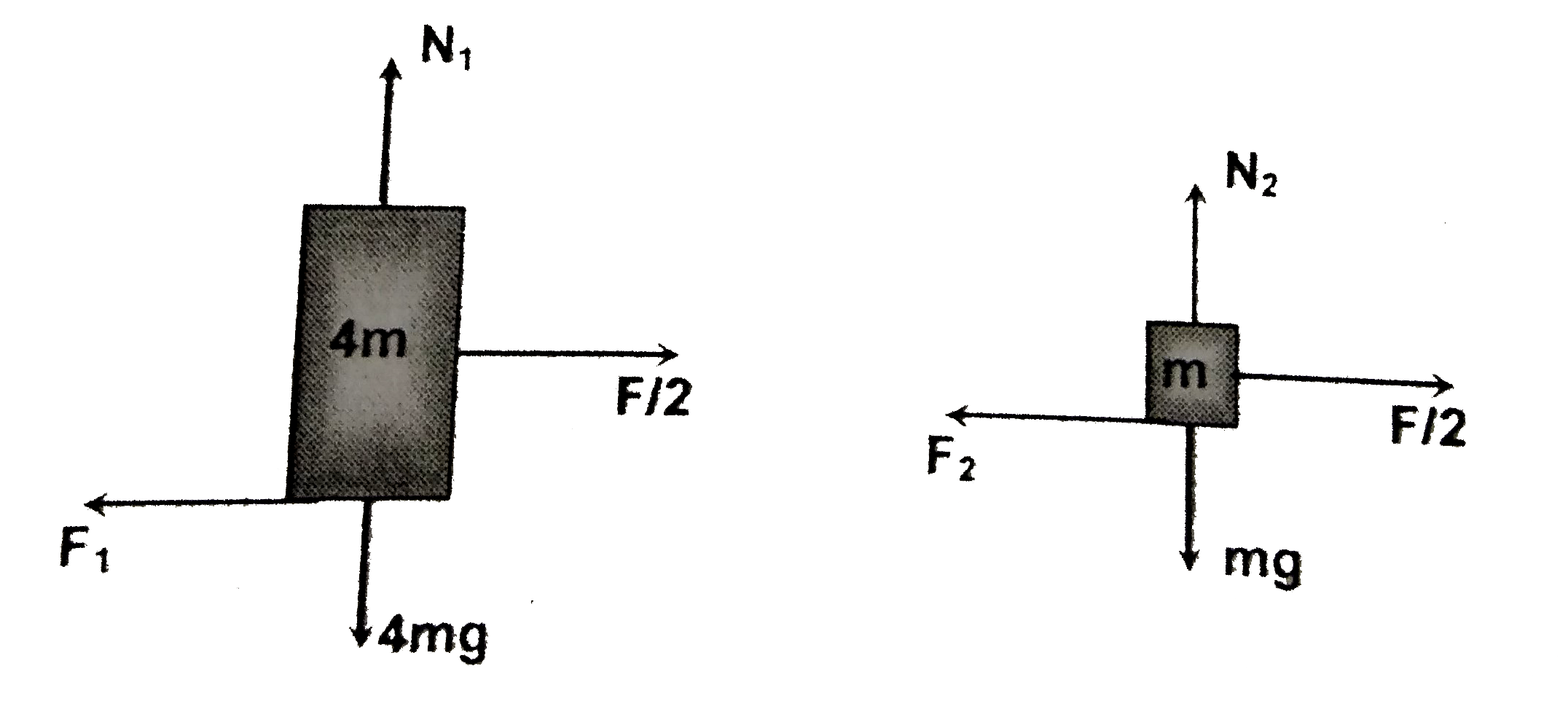
Both block 4 m and m has tendency of motion towards rightwards so friction `(F_(1)` and `F_(2))` will act on both blocks leftward, hence on the platform rightward. So
`a=(F_(1)+F_(2))/(m)=2m//s`
`F_(1)+F_(2)=20N`
`F_(1)le64N_(1)" "F_(2)le16N`
Case I: Suppose blok of mass 4 m has a relative motion with respect to platform So, `F_(1k)=40N`
`F_(2)=-20N` (not possible)
Case II: Suppose block of mass m has a relative motion with respect to platform, so, `F_(2k)=10NimpliesF_(1s)=10N` (possible)
`(F)/(2)-F_(1s)=4mxx2implies(F)/(2)=1+4xx10xx2=90`
`impliesF=180Nimplies(F)/(2)-F_(2k)=maimplies90-10=10aimpliesa=8m//s^(2)`
Promotional Banner

Similar Questions

Explore conceptually related problems

A massive platform of mass M is moving with speed v=6ms^(-1) At t = 0, at body of mass m(m lt lt M) is gently placed on the platform. If c-efficient of friction between the body and platform is mu=0.3 and g=10 m//s^(2) , then

A block of mass 2 kg is placed on the floor. The coefficient of static friction is 0.4. A force F of 3 N is applied on the block as shown in figure. The force of friction between the block and the floor is (Take g=10 m s^(-2) )

A block of mass 2 kg is placed on the floor . The coefficient of static friction is 0.4 . If a force of 2.8 N is applied on the block parallel to floor , the force of friction between the block and floor is : (Taking g = 10 m//s^(2) )

Two blocks, each having mass m, are connected with an ideal string through ideal pulleys on a frictionless fixed wedge as shown in the figure. The acceleration of the blocks is

A block rests on a rough inclined plane making an angle of 30^@ with the horizontal. The coefficient of static friction between the block and the plane is 0.8. If the frictional force on the block is 10N, the mass of the block (in kg) is

A block of mass 1 kg lies on a horizontal surface in a truck. The coefficient of static friction between the block and the surface is 0.6. If the acceleration of the truck is 5m//s^2 , the frictional force acting on the block is…………newtons.

A block of mass 1 kg lies on a horizontal surface in a truck. The coefficient of static friction between the block and the surface is 0.6. If the acceleration of the truck is 5m//s^2 , the frictional force acting on the block is…………newtons.

A block B of mass 5kg is placed on a slab A of mass 20kg which lies on a frictionless surface as shown in the figure. The coefficient of static friction between the block and the slab is 0.4 and that of kinetic friction is 0.2. If a force F = 25N acts on B, the acceleration of the slab will be:

A marble block of mass 2 kg lying on ice when given a velocity of 6m//s is stopped by friction in 10s. Then the coefficient of friction is

A marble block of mass 2 kg lying on ice when given a velocity of 6m//s is stopped by friction in 10s. Then the coefficient of friction is

