Home
Class 12
PHYSICS
A particle of charge 'q' and mass 'm' en...


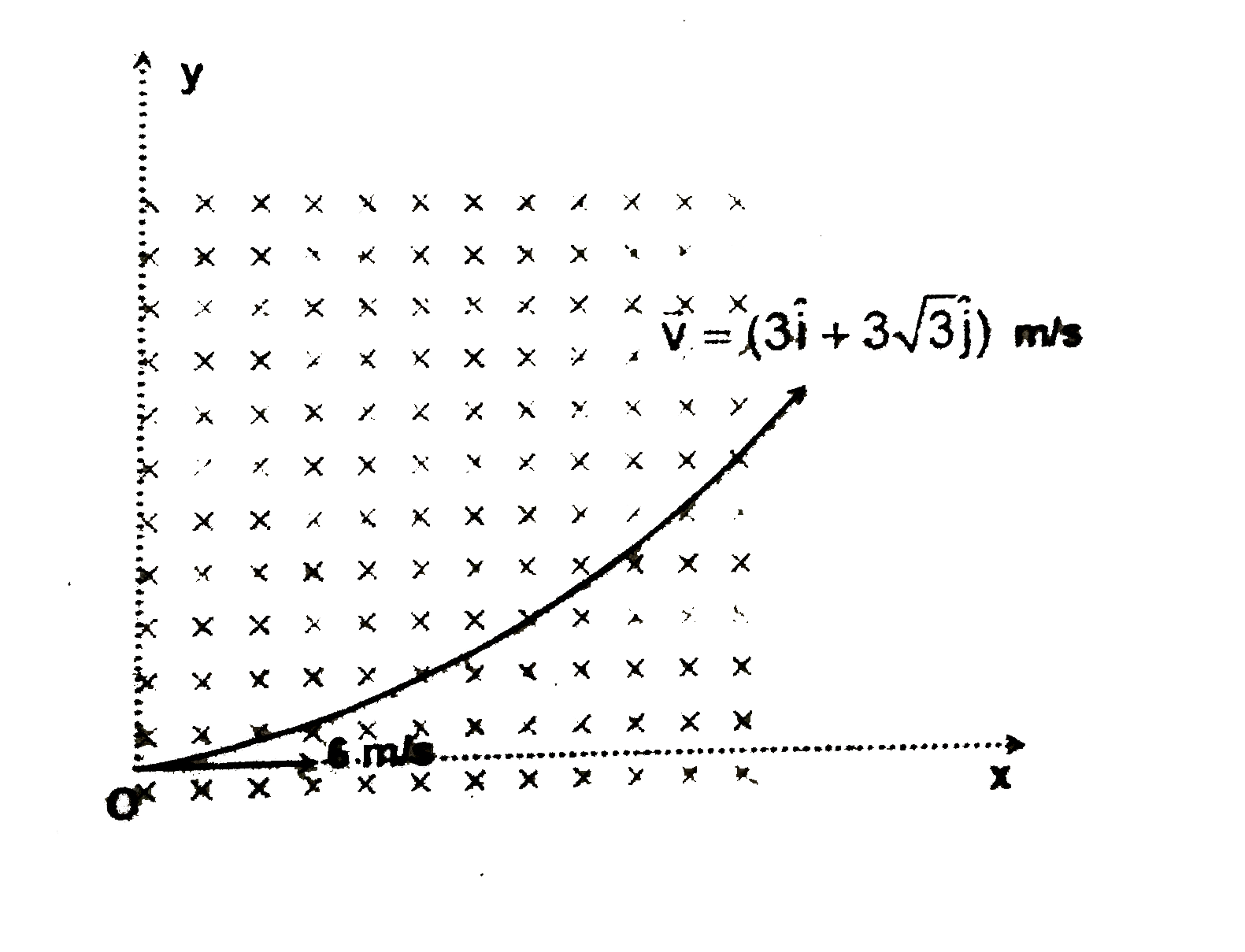
A particle of charge 'q' and mass 'm' enters a uniform magnetic field region `vecB=-Bhatk` at origin 'O' with a velocity `vecv_(0)=6hati` m/s and after some time it exist the magentic field region with a velocity `vecv=(3hati+3sqrt(3))`m/s as shown. The time interval for which the particle has moved in the magnetic field region is

A

`(pim)/(qB)`

B

`(pim)/(2qB)`

C

`(pim)/(3qB)`

D

`(pim)/(4qB)`

Text Solution

Verified by Experts

The correct Answer is:

C

Since the particle exists the magnetic field region with a velocity `vecv=(3hati+3sqrt(3)hatj)m//s`
`tantheta=(3sqrt(3))/(3)`
`thereforetheta=(pi)/(3)`
The angular displacement of the particle in the magnetic field region is `theta=(pi)/(3)`
Angular velocity `omega=(qB)/(m)`
`thereforet=(theta)/(omega)=(pim)/(3qB)`
Promotional Banner

Similar Questions

Explore conceptually related problems

A particle of charge -q and mass m enters a uniform magnetic field vecB (perpendicular to paper inward) at P with a velocity v_0 at an angle alpha and leaves the field at Q with velocity v at angle beta as shown in fig.

A proton of charge +e and mass m enters a uniform magnetic Field vecB=hatB with an intial velocity vecv=v_(0x)hati+v_(0y)hatj . Find an expression in unit-vector notation for its velocity at any later time t.

A particle of specific charge alpha enters a uniform magnetic field B=-B_0hatk with velocity v=v_0hati from the origin. Find the time dependence of velocity and position of the particle.

A particle of spectfic charge alpha enters a uniform magnetic field B=-B_(0)hatk with velocity V=v_(0)hati from the origin Find the time dependence of velocity and position of the particle

A 2.0 kg particle has a velocity of vecv_1=(2.0hati-3.0hatj) m //s , and a 3.0 kg particle has a velocity vecv_2=(1.0hati+6.0hatj)m//s . How fast is the center of mass of the particle system moving?

A proton of mass m and charge q enters a region of uniform magnetic field of a magnitude B with a velocity v directed perpendicular to the magnetic field. It moves in a circular path and leaves the magnetic field after completing a quarter of a circle. The time spent by the proton inside the magnetic field is proportional to:

The region between x=0 and x=L is filled with uniform steady magnetic field B_0hatk . A particle of mass m, positive charge q and velocity v_0hati travels along x-axis and enters the region of the magnetic field. Neglect the gravity throughout the question. a. Find the value of l if the particle emerges from the region of magnetic field with its final velocilty at an angel 30^@ to its initial velocity. b. Find the final velocity of the particle and the time spent by it in the magnetic field, if themagnetic field now extends upto 2.1 L .

In the figure shown a positively charged particle of charge q and mass m enters into a uniform magnetic field of strength B as shown in the figure.The magnetic field points inwards and is present only within a region of width d .The initial velocity of the particle is perpendicular to the magnetic field and phi=30^(@) .Find the time spent by the particle inside the magnetic field if d=0.2 m,B=1T,q=1C,m=1kg and v=1m//s .Use sin 45^(@)=0.7 if required .

If a particle of charge 1μC is projected into a magnetic field vecB = (2hati + yhatj- zhatk) T with a velocity vecV = (4hati+2hatj - 6hatk)ms^(-1) , then it passes undeviated. If it is now projected with a velocity vecV = hati + hatj , then find the force experienced by it?

A particle of mass m, charge q and kinetic energy T enters in a transverse uniform magnetic field of induction B. After the 3 s, the kinetic energy of the particle will be
