Home
Class 12
PHYSICS
A conducting rod MN of mass m and length...


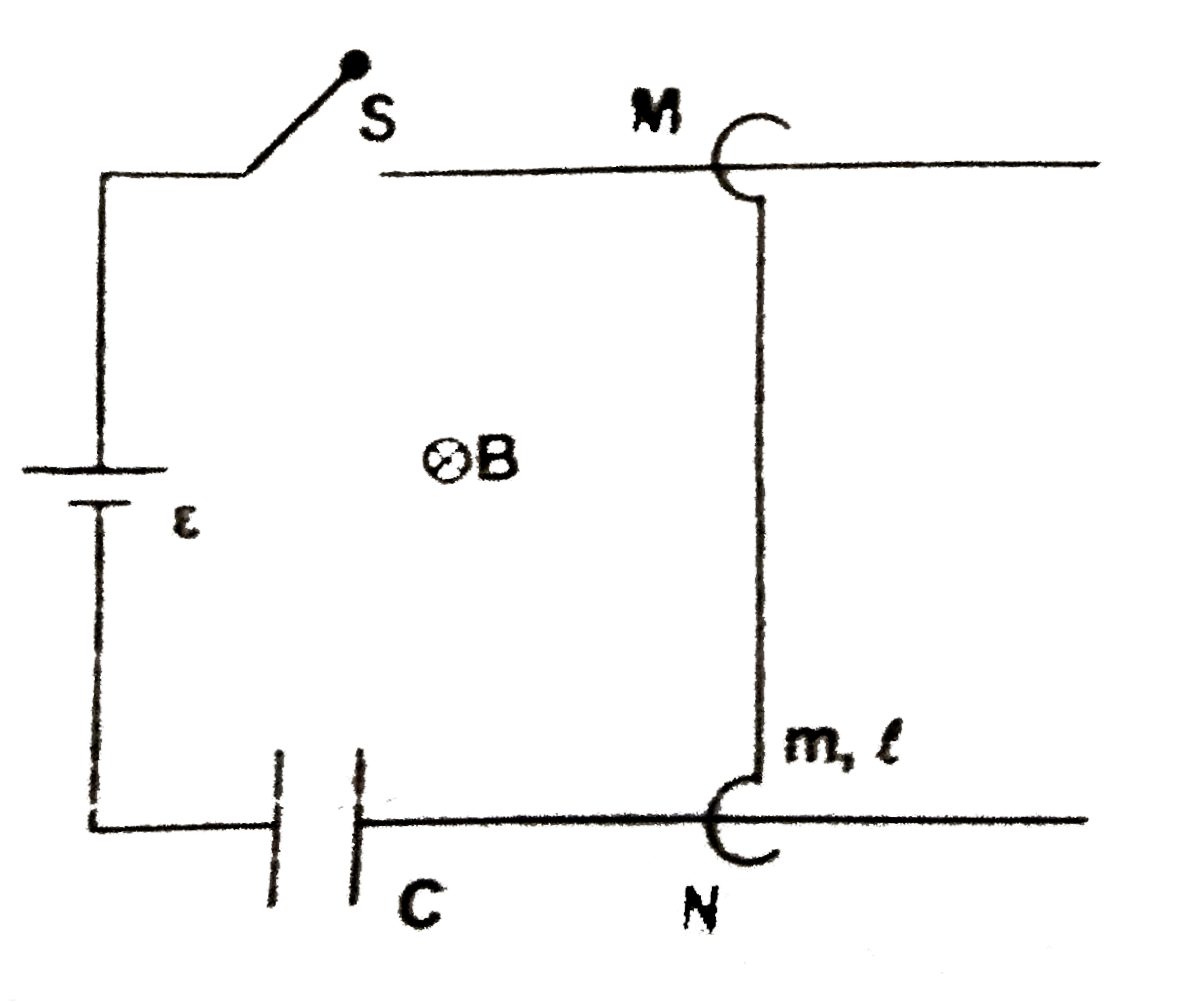
A conducting rod MN of mass m and length 'l' is placed on parallel smooth conducting rails connected to an uncharged capacitor of capacitance C and a battery of emf `epsilon` as shown. A uniform magnetic field B is existing perpendicular to the plane of the rails. The steady state velocity acquired by the conducting rod MN after closing switch S is (neglect the resistance of the parallel rails and the conducting rod)

A

`(2CBl epsilon)/((m+CB^(2)l^(2)))`

B

`(CBl epsilon)/((m+CB^(2)l^(2)))`

C

`(CBl epsilon)/(2(m+CB^(2)l^(2)))`

D

`(CBl epsilon)/(4(m+CB^(2)l^(2)))`

Text Solution

Verified by Experts

The correct Answer is:
B


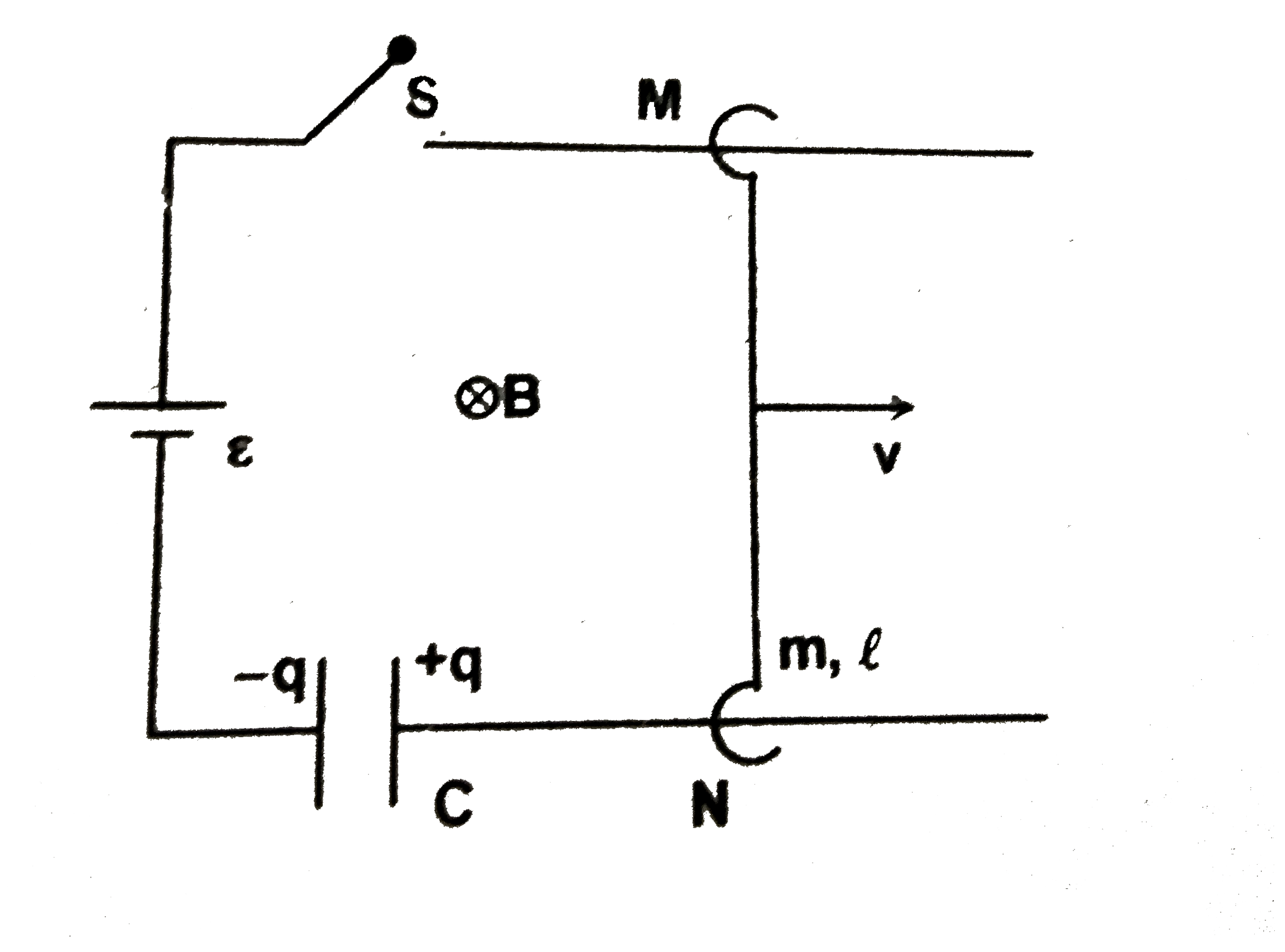
`(q)/(C)+Bvl=epsilon`
`q=C(epsilon-Bvl)`
Now, `m(dv)/(dt)=Bil`
`mdv=Blidt`
`m underset(0)overset(v)intdv=Blunderset(0)overset(q)intdq`
`mv=Blq`
`thereforeq=(mv)/(Bl)` ...(i)
From (i) and (ii)
`(mv)/(Bl)=Cepsilon-CBlv`
`impliesv=(CBl epsilon)/((m+CB^(2)l^(2)))`
Promotional Banner

Similar Questions

Explore conceptually related problems

In a cylindrical region uniform magnetic field which is perpendicular to the plane of the figure is in increasing with time and a conducting rod PQ is placed in the region.If C is the centre of the circle then

Two smooth horizontal parallel conducting rails are connected with a capacitor and a resistor at the two ends as shown. A uniform conducting rod PQ of mass 'm' and length 'l' is dragged with a constant horizontal force 'F'. The terminal velocity aquired by the conducting rod is

A conducting wire xy of lentgh l and mass m is sliding without friction on vertical conduction rails ab and cd as shown in figure. A uniform magnetic field B exists perpendicular to the plane of the rails, x moves with a constant velocity of

A conducting wire xy of lentgh l and mass m is sliding without friction on vertical conduction rails ab and cd as shown in figure. A uniform magnetic field B exists perpendicular to the plane of the rails, x moves with a constant velocity of

Figure shows a wire of resistance R sliding on two parallel, conducting fixed thick rails placed at a separation l. A magnetic fild B exist in a direction perpendicular to the plane of the rails. The wire is moving with a constant velocity v. Find current through the wire

Figure shows a wire sliding on two parallel, conducting rails placed at a separation L . A magnetic field B exists in a direction perpendicular to the plane of the rails. What force is necessary to keep the wire moving at a constant velocity V ?

A rod PQ is connected to the capacitor plates. The rod is placed in a magnetic field (B) directed downwards perpendicular to the plane of the paper. If the rod is pulled out of magnetic field with velocity vec(v) as shown in Figure.

Shows a wire sliding on two parallel, conducting rails placed at a separaton l. A magnetic feld B exists in a direction perpendicular to the plane of the rails. What force is necessary to keep the wire moving at a constatn velocity v ?

A resistance R is connected between the two ends of the parallel smooth conducting rails.A conducting rod lies on these fixed horizontal rails and a uniform constant magnetic field B exists perpendicular to the plane of the rails as shown in the figure.If the rod is given a velocity v and released as shown in figure, it will stop after some time, which option are correct:

A copper rod of mass m slides under gravity on two smooth parallel rails l distance apart set at an angle theta to the horizontal. At the bottom, the rails are joined by a resistance R . There is a uniform magnetic field perpendicular to the plane of the rails. the terminal valocity of the rod is

