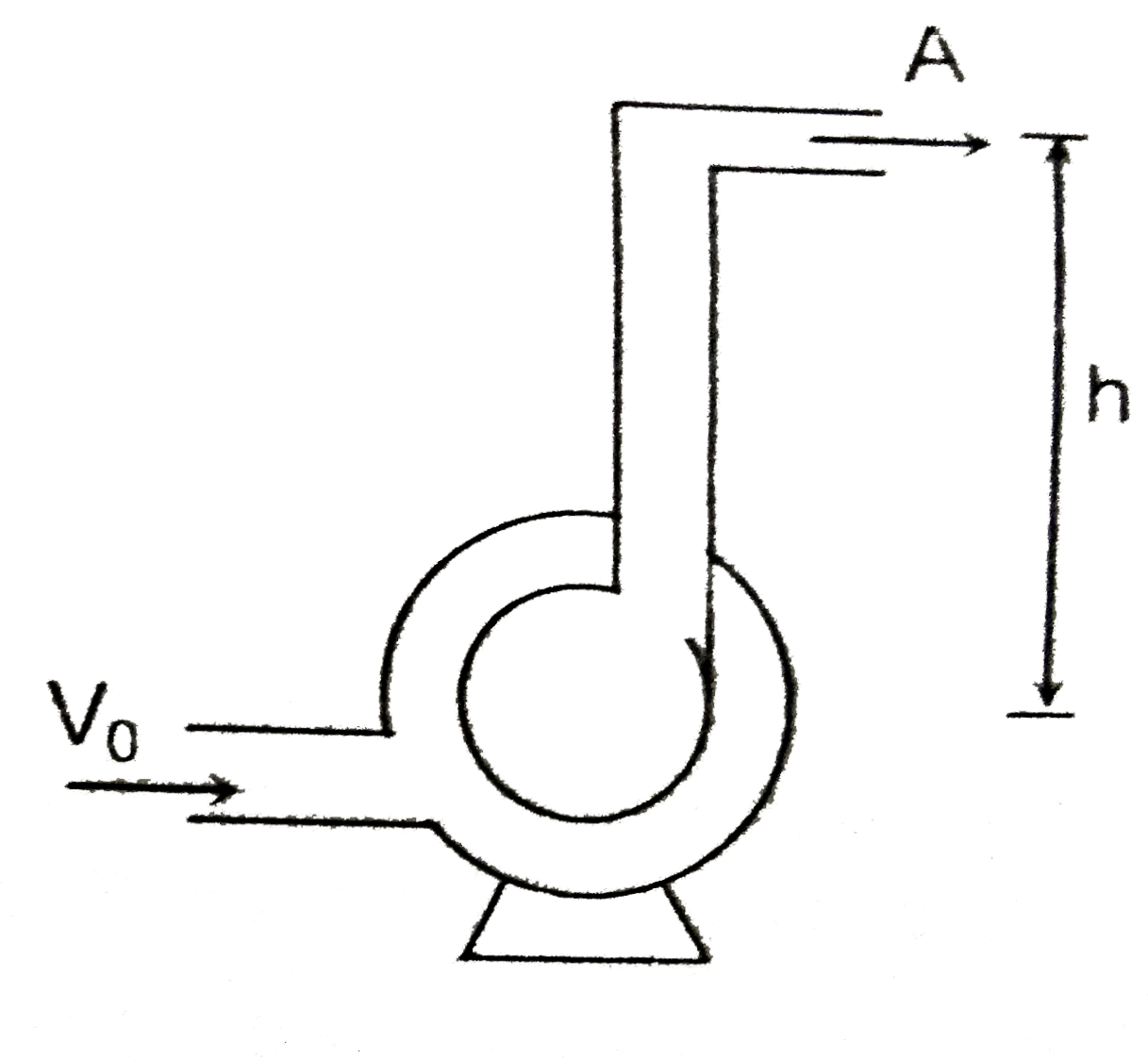
In a certain pump whose rated power is P. ideal fluid of denstiy `rho` enters with speed `V_(0)` which lifts water upto height h through a pipe of uniform cross section area without discontinuity. Volumetric flow rate of the liquid is Q. Speed of fluid when it comes out of the pipe at point A is (Assume that pump works at 100 % efficiency and flow is streamline)
In a certain pump whose rated power is P. ideal fluid of denstiy `rho` enters with speed `V_(0)` which lifts water upto height h through a pipe of uniform cross section area without discontinuity. Volumetric flow rate of the liquid is Q. Speed of fluid when it comes out of the pipe at point A is (Assume that pump works at 100 % efficiency and flow is streamline)
A
`sqrt((2P)/(Qrho)+V_(0)^(2)-2gh)`
B
`sqrt((2P)/(Qrho)+V_(0)^(2))`
C
`sqrt((2P)/(Qrho)+V_(0)^(2)+2gh)`
D
`sqrt((2P)/(Qrho)-V_(0)^(2)+2gh)`
Text Solution
Verified by Experts
The correct Answer is:
A
`P=(1)/(2)Qrho(V^(2)-V_(0)^(2))+rhoQgh`
`sqrt((2P)/(Qrho)-2gh+V_(0)^(2))=V`
`sqrt((2P)/(Qrho)-2gh+V_(0)^(2))=V`



Similar Questions
Explore conceptually related problems
A pump is used to pump a liquid of density rho continuously through a pipe of cross, sectional area A. If liquid is flowing with speed v, then average power of pump is
A pump is used to pump a liquid of density rho continuously through a pipe of cross, sectional area A. If liquid is flowing with speed v, then average power of pump is
An engine pumps liquid of density ρ continuously through a pipe of cross-section area A. If the speed with which liquid passes through the pipe is v, then the rate at which kinetic energy is being imparted to the liquid by the pump is
The pipe shows the volume flow rate of an ideal liquid at certain time and its direction. What is the value of Q in m^(3)//s ? (Assume steady state and equal area of cross section at each opening)
Assertion : When an ideal fluid flows through a pipe of non-uniform cross-section, then pressure is more at that section where area is more if the pipe is horizontal. Reason : According to Bernoulli's theorem speed at broader cross-section will be less.
The figure shows a vertical pipe of uniform cross-section in which a liquid of rho is flowing upwards. If v_A and v_B be the velocities of the fluid at points A and B separated by a distance h, p_A and p_B are the respective pressure at the two points, then select the correct option:
Fluids at rest exert a normal force to the walls of the container or to the sruface of the body immersed in the fluid. The pressure exerted by this force at a point inside the liqid is the sum of atmospheric pressure and a factor which depends on the density of the liquid, the acceleration due to gravity and the height of the liquid, above that point. The upthrust acting on a body immersed in a stationary liquid is the net force acting on the body in the upward direction. A number of phenomenon of liquids in motion can be explain by Bernoulli's theorem which relates the pressure, flow speed and height for flow of an ideal incompressible fluid. A container of large uniform cross sectional area. A resting on a horizontal surface holds two immiscible, non viscous and incompressile liquids of densities d and 2d , each of height H//2 as shown in the figure. The lower density liquid is open to the atmosphere having pressure P_(0) . Situation II: A cyliner is removed and the original arrangement is restored.A tiny hole of area s(slt ltA) is punched on the veritical sideof the containier at a height h(hltH//2) The initial speed of efflux of the liquid at the hole is
Fluids at rest exert a normal force to the walls of the container or to the sruface of the body immersed in the fluid. The pressure exerted by this force at a point inside the liqid is the sum of atmospheric pressure and a factor which depends on the density of the liquid, the acceleration due to gravity and the height of the liquid, above that point. The upthrust acting on a body immersed in a stationary liquid is the net force acting on the body in the upward direction. A number of phenomenon of liquids in motion can be explain by Bernoulli's theorem which relates the pressure, flow speed and height for flow of an ideal incompressible fluid. A container of large uniform corss sectional area. A resting on a horizontal surface holds two immiscible, non viscous and incompressile liquids of densities d and 2d , each of height H//2 as shown in the figure. The lower density liquid is open to the atmosphere having pressure P_(0) . Situation I: A homogeneous solid cylinder of length L(LltH//2) . cross sectional area A//5 is immersed such that it floats with its axis vertical at liquid -liquid interface with lenght L//4 in the denser liquid. The total pressure at the bottom of the container is
Fluids at rest exert a normal force to the walls of the container or to the sruface of the Body immersed in the fluid. The pressure exerted by this force at a point inside the liqid is the sum of atmospheric pressure and a factor which depends on the density of the liquid, the acceleration due to gravity and the height of the liquid, above that point. The upthrust acting on a body immersed in a stationary liquid is the net force acting on the body in the upward direction. A number of phenomenon of liquids in motion can be explain by Bernoulli's theorem which relates the pressure, flow speed and height for flow of an ideal incompressible fluid. A container of large uniform corss sectional area. A resting on a horizontal surface holds two immiscible, non viscous and incompressile liquids of densities d and 2d , each of height H//2 as shown in the figure. The lower density liquid is open to the atmosphere having pressure P_(0) . Situation I: A homogeneous solid cylinder of length L(LltH//2) . cross sectional area A//5 is immersed such that it floats with its axis vertical at liquid -liquid interface with lenght L//4 in the denser liquid. The density of the solid is
Fluids at rest exert a normal force to the walls of the container or to the sruface of the body immersed in the fluid. The pressure exerted by this force at a point inside the liqid is the sum of atmospheric pressure and a factor which depends on the density of the liquid, the acceleration due to gravity and the height of the liquid, above that point. The upthrust acting on a body immersed in a stationary liquid is the net force acting on the body in the upward direction. A number of phenomenon of liquids in motion can be explain by Bernoulli's theorem which relates the pressure, flow speed and height for flow of an ideal incompressible fluid. A container of large uniform corss sectional area. A resting on a horizontal surface holds two immiscible, non viscous and incompressile liquids of densities d and 2d , each of height H//2 as shown in the figure. The lower density liquid is open to the atmosphere having pressure P_(0) . Situation II: A cyliner is removed and the original arrangement is restoreed.A tiny hole of area s(slt ltA) is punched on the veritical side of the containier at a height h(hltH//2) The height h_(m) at which the hole should be punched so that the liquid travels the maximum distance is
Recommended Questions
- In a certain pump whose rated power is P. ideal fluid of denstiy rho e...
Text Solution
|
- An engine pumps liquid of density d continuosly through a pipe of cros...
Text Solution
|
- An ideal fluid flows through a pipe of circular cross section of radiu...
Text Solution
|
- Assertion : When an ideal fluid flows through a pipe of non-uniform cr...
Text Solution
|
- A pump is used to pump a liquid of density rho continuously through a ...
Text Solution
|
- A motor pump a liquid of density rho through a pipe of cross-sectional...
Text Solution
|
- A fluid is in streamline flow across a horizontal pipe of variable are...
Text Solution
|
- A pump flows water in a pipe at a fixed rate. How much velocity of wat...
Text Solution
|
- A fluid is in streamline flow across a horizontal pipe of variable are...
Text Solution
|