Home
Class 12
PHYSICS
Two blocks A and B of mass 2 m and m res...


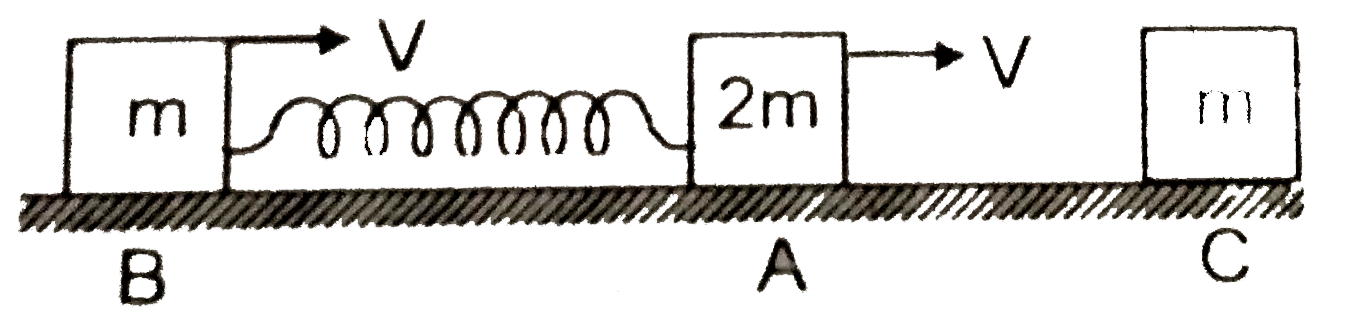
Two blocks A and B of mass 2 m and m respectively are connected to a massless spring of spring constant K. if A and B moving on the horizontal frictionless surface with velocity v to right. If A collides with C of mass m elastically and head on, then the maximum compressions of the spring will be

A

`sqrt((3)/(2)(m)/(k))V`

B

`sqrt((27m)/(8K))V`

C

`sqrt((9m)/(8K))V`

D

`sqrt((8m)/(27K))V`

Text Solution

Verified by Experts

The correct Answer is:
D

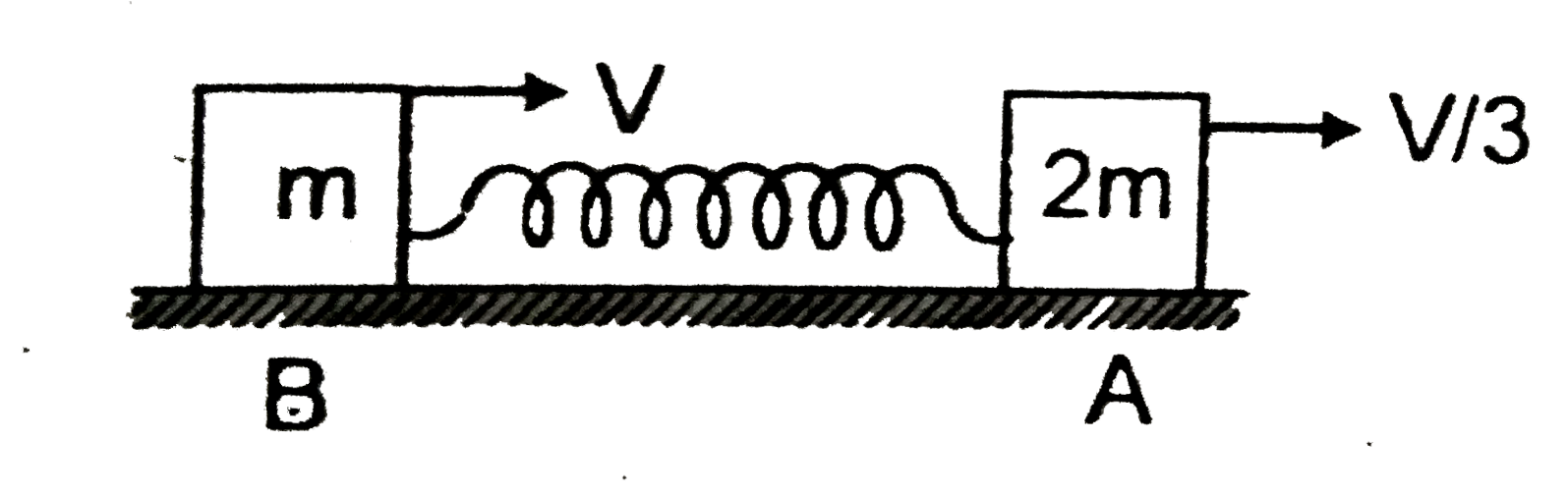
Velocity of a after the collision withh `C,V_(1)=(V)/(3)`
`therefore` velocity of each block A and B at maximum compression
`V_(2)=(5)/(9)V`
`therefore(1)/(2)kx^(2)+(1)/(2)3m((5)/(9)V)^(2)`
`=(1)/(2)mv^(2)+(1)/(2)2m((V)/(3))^(2)`
`x=sqrt((8m)/(27K))V`
Promotional Banner

Similar Questions

Explore conceptually related problems

Two blocks A and B of mass 2m and m respectively are connected to a massless spring of force constant K as shown in figure A and B are moving on the horizontal frcitionless surface with velocity v to right with underformed spring. If B collides with C elastically, then maximum compression of the spring will be

Two blocks A and B of mass m and 2m respectively are connected by a light spring of force constant k. They are placed on a smooth horizontal surface. Spring is stretched by a length x and then released. Find the relative velocity of the blocks when the spring comes to its natural length

Two block A and B of masses m and 2m respectively are connected by a spring of spring cosntant k. The masses are moving to the right with a uniform velocity v_(0) each, the heavier mass leading the lighter one. The spring is of natural length during this motion. Block B collides head on with a thrid block C of mass 2m . at rest, the collision being completely inelastic. The velocity of block B just after collision is -

Two blocks A and B of masses m and 2m , respectively are connected by a spring of force constant k . The masses are moving to the right with uniform velocity v each, the heavier mass leading the lighter one. The spring is in the natural length during this motion. Block B collides head on with a third block C of mass m , at rest, the collision being completely inelastic. Calculate the maximum compression of the spring.

A block of mass m is connected to another .block of mass M by a massless spring of spring constant k. A constant force f starts action as shown in figure, then:

Two blocks of masses m_1 and m_2 are connected by a spring of spring constant k figure. The block of mass m_2 is given a shape impulse so that it acquires a velocity v_0 towards right. Find a. the velocity of the centre of mass b. the maximum elongation that the spring will suffer.

A block of mass m is attached to one end of a mass less spring of spring constant k. the other end of spring is fixed to a wall the block can move on a horizontal rough surface. The coefficient of friction between the block and the surface is mu then the compession of the spring for which maximum extension of the spring becomes half of maximum compression is .

Two blocks A and B of masses in and 2m , respectively, are connected with the help of a spring having spring constant, k as shown in Fig. Initially, both the blocks arc moving with same velocity v on a smooth horizontal plane with the spring in its natural length. During their course of motion, block B makes an inelastic collision with block C of mass m which is initially at rest. The coefficient of restitution for the collision is 1//2 . The maximum compression in the spring is

Two blocks of masses m_1 =1kg and m_2 = 2kg are connected by a spring of spring constant k = 24 N/m and placed on a frictionless horizontal surface. The block m_(1) is imparted an initial velocity v_(0) = 12cm/s to the right. The amplitude of oscillation is

A body of mass 5 kg moving with a speed of 1.5 m/s on a horizontal smooth surface collides with a nearly weightless spring of force constant k = 5 N/m. The maximum compression of the spring would be

