Home
Class 12
PHYSICS
A block of mass is connected to an ideal...


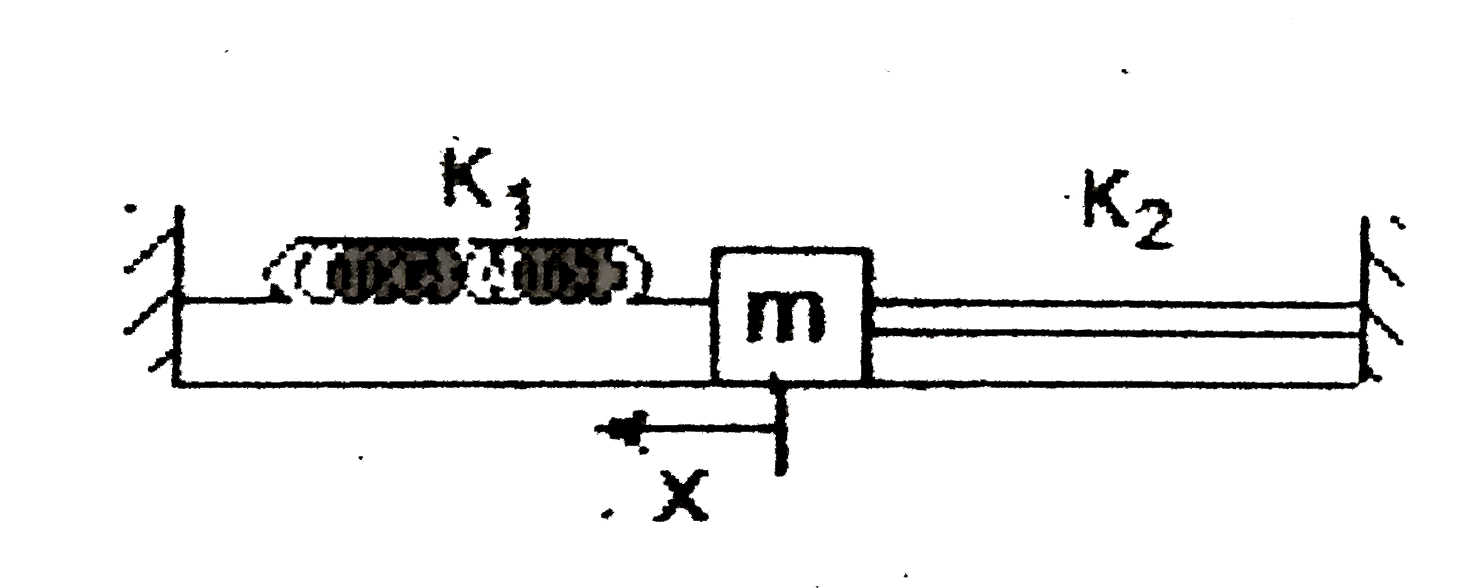
A block of mass is connected to an ideal spring of stiffness `K_(1)` on left hand side and to an elastic strig of stiffness `K_(2)` on right hand side as shown in figure the time period of motion if mass m is displaced by 'x' as shown in figure.

A

`2pisqrt(m//K_(1))`

B

`2pisqrt(m//(K_(1)+K_(2)))`

C

`2pisqrt(m(K_(1)+K_(2))//K_(1)K_(2))`

D

`pi(sqrt((m)/(K_(1)+K_(2)))+sqrt((m)/(K_(1))))`

Text Solution

Verified by Experts

The correct Answer is:

D

`T=(T_("left"))/(2)+(T_("right"))/(2)=pisqrt((m)/(K_(1)+K_(2)))+pisqrt((m)/(K_(1)))`
Note string becomes slack when mass pushes te string.
Promotional Banner

Similar Questions

Explore conceptually related problems

A massless Rod AB is hinged at point A. At point P, it is connected by a spring of stiffness K_(1) and at point B it is connected to another spring of stiffness K_(2) connected to mass m as shown in figure the length of Rod AB is l and displaced by a distance x from its mean position as shown in figure then the time period of S.H.M. of mass is

Two identical springs of spring constant k are attached to a block of mass m and to fixed supports as shown in the figure. The time period of oscillation is

A block of mass m is suspended by different springs of force constant shown in figure.

A block of mass 'm' is released on the top of a frictionless incline as shown in the figure. The time period of the oscillation of the block is

A spring of spring constant k is cut into n equal parts, out of which r parts are placed in parallel and connected with mass M as shown in figure. The time period of oscillatory motion of mass M is:

A block of mass m moving with a velocity v_(0) collides with a stationary block of mass M to which a spring of stiffness k is attached, as shown in Fig. Choose the correct alternative(s)

A rod mass (M) hinged at (O) is kept in equilibrium with a spring of stiffness (k) as shown in figure. The potential energy stored in the spring is .

Three arrangements are shown in figure. (a) A spring of mass m and stiffness k (b) A block of mass m attached to massless spring of stiffness k ( c) A block of mass (m)/(2) attached to a spring of mass (m)/(2) and stiffness k If T_(1) , T_(2) and T_(3) represent the period of oscillation in the three cases respectively, then identify the correct relation.

A disk of mass m is connected to two springs of stiffness k_(1) and k_(2) as shown in the figure. Find the angular frequency of the system for small oscillation. Disc can roll on the surface without slipping

Two blocks each of mass m are connected with springs each of force constant K as shown in fig. The mass A is displaced to the left & B to the right by the same amount and released then the time period of oscillation is -
