Home
Class 12
PHYSICS
A planet of mass m moves in an elliptica...


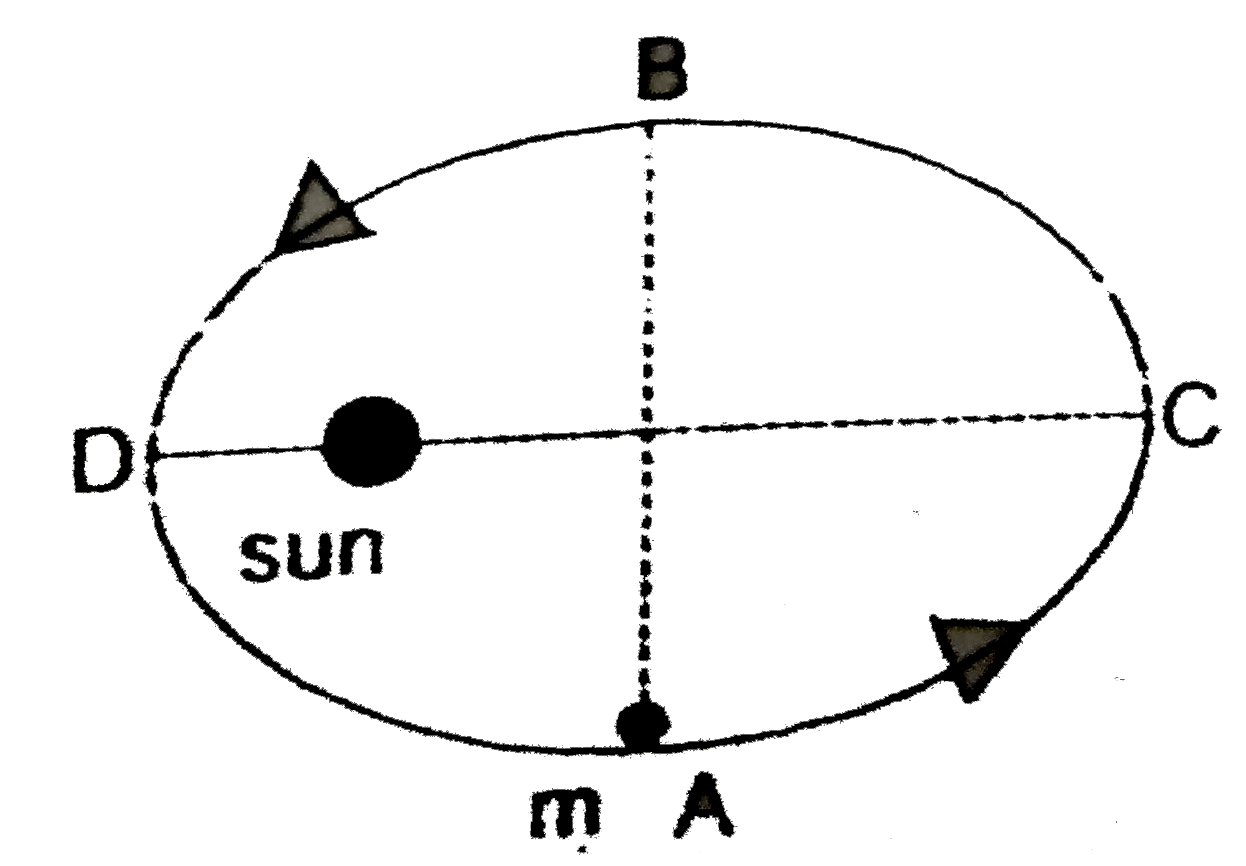
A planet of mass m moves in an elliptical orbit around sun with sun at its Focus. (e=eccentricity of ellipse). Then `T_(ACB)//T_(BDA)` is `[T_(ACB)` is time taken to travel from A to C B & `T_(BDA)` is time taken to travel from B to D to A]

A

`(pi+2e)//(pi-2e)`

B

`1`

C

`(pi+e)//(pi-e)`

D

`pi//(pi-1)`

Text Solution

Verified by Experts

The correct Answer is:
A

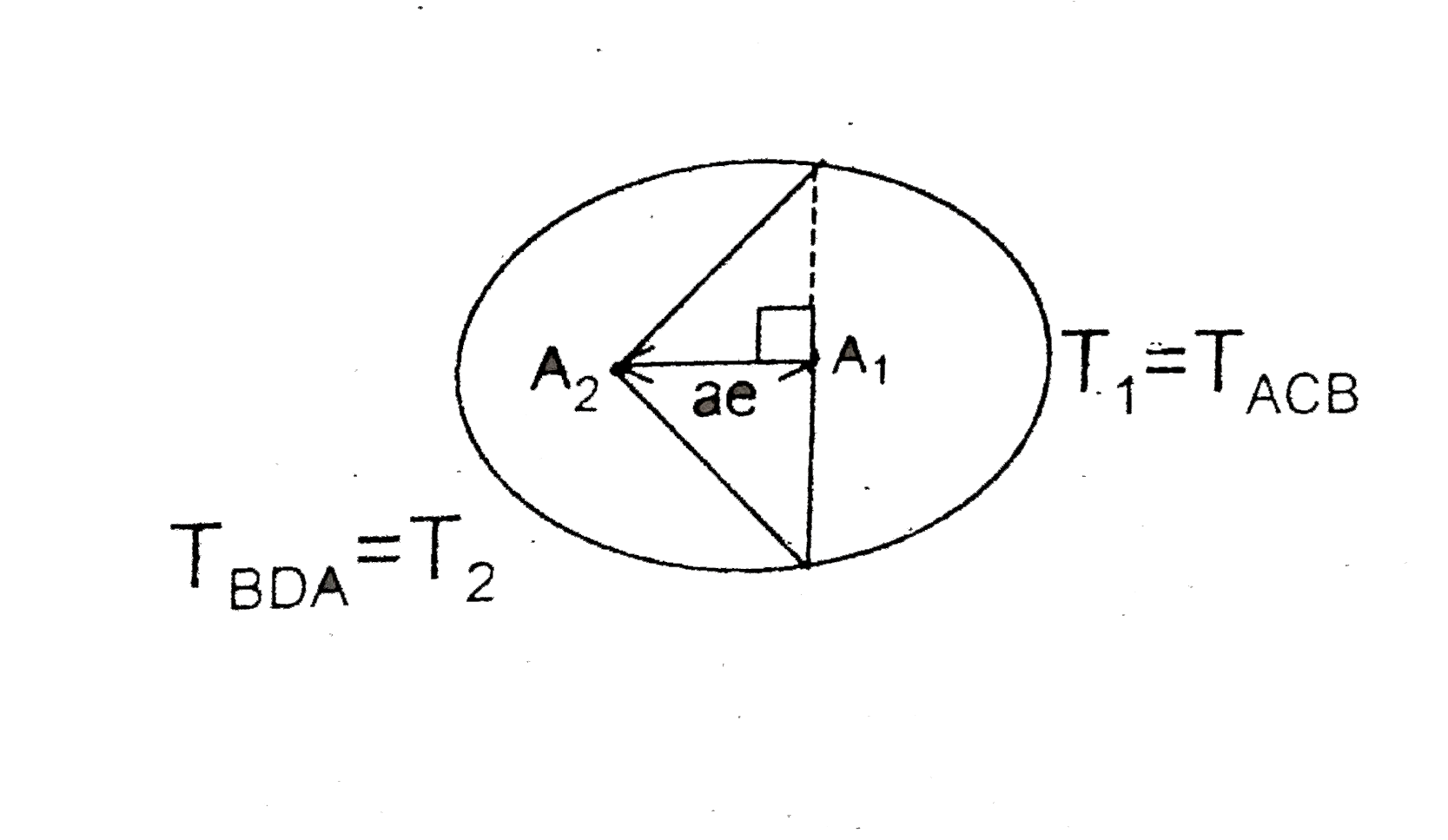
`because(dA)/(dt)={"Kepler's 2nd law"]`
`therefore(T_(1))/(T_(2))=(A_(1))/(A_(2))=((piab)/(2)+(1)/(2)xx2bxxae)/((piab)/(2)-(1)/(2)xx2bxxae)`
or `(T_(1))/(T_(2))=((pi+2e))/((pi-2e))`
Promotional Banner

Similar Questions

Explore conceptually related problems

A planet is moving round the sun in an elliptical orbit as shows. As the planet moves from A to B

The time taken by light to travel from sun to earth is approximately

A planet of mass m is in an elliptical orbit about the sun with an orbital period T . If A be the area of orbit, then its angular momentum would be

In the time taken by the projectile to reach from A to B is t . Then the distance AB is equal to. .

The figure shows elliptical orbit of a planet m about the sun S. the shaded area SCD is twice the shaded area SAB. If t_(1) be the time for the planet to move from C to D and t_(2) is the time to move from A to B, then:

The figure shows elliptical orbit of a planet m about the sun S. the shaded area SCD is twice the shaded area SAB. If t_(1) be the time for the planet to move from C to D and t_(2) is the time to move from A to B, then:

A planet of mass m revolves in elliptical orbit around the sun of mass M so that its maximum and minimum distance from the sun equal to r_(a) and r_(p) respectively. Find the angular momentum of this planet relative to the sun.

A planet of mass m is moving in an elliptical orbit about the sun (mass of sun = M). The maximum and minimum distances of the planet from the sun are r_(1) and r_(2) respectively. The period of revolution of the planet wil be proportional to :

Figure shows the motion of a planet around the Sun S in an elliptical orbit with the Sun at the focus. The shaded areas A and B are also shown in the figure which can be assumed to be equal. If t_(1) and t_(2) represent the time taken for the planet to move from a to b and c to d , respectively then

Figure shows the motion of a planet around the Sun S in an elliptical orbit with the Sun at the focus. The shaded areas A and B are also shown in the figure which can be assumed to be equal. If t_(1) and t_(2) represent the time taken for the planet to move from a to b and c to d , respectively then

