Home
Class 12
PHYSICS
Two trains A and B each of mass m are mo...


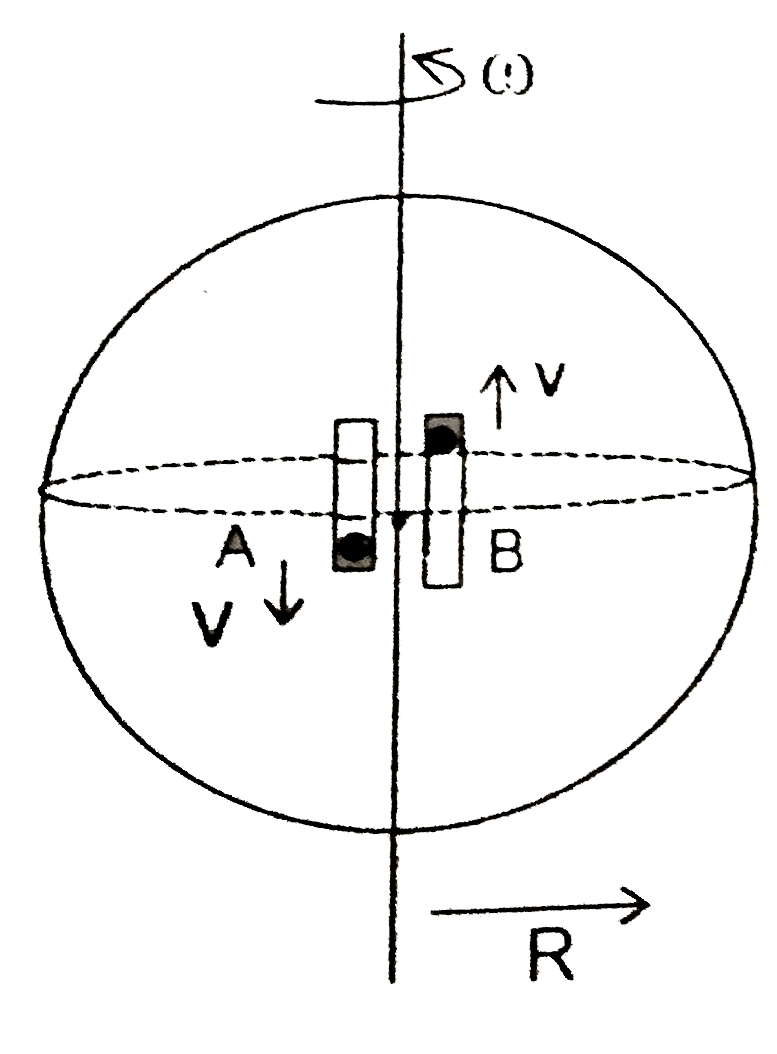
Two trains A and B each of mass m are moving on a longitude of a spherical planet of mass M and radius R with velocity v relative to to planet. Train A & B presses thhe rail track with forces `N_(A)` & `N_(B)` respectively. [`omega` is angular velocity of planet about its vertical axis] Then

A

`N_(A)=N_(B)=(GmM)/(R^(2))-momega^(2)R`

B

`N_(A)=(GmM)/(R^(2))-momega^(2)R+(mv^(2))/(R)`

C

`N_(B)=(GmM)/(R^(2))-momega^(2)R-(mv^(2))/(R)`

D

`N_(B)=(GmM)/(R^(2))+momega^(2)R-(mv^(2))/(R)`

Text Solution

Verified by Experts

The correct Answer is:

C

`N_(A)=N_(B)=(GmM)/(R^(2))-momega^(2)R-(mv^(2))/(R)`
`((GmM)/(R^(2))-momega^(2)R-N_(A)=(mv^(2))/(R))`
Promotional Banner

Similar Questions

Explore conceptually related problems

The work done by gravitational force on a point mass m_0 in moving from the surface of a planet off mass M and radius R to a height R/2 is

A body is moving in a low circular orbit about a planet of mass M and radius R. The radius of the orbit can be taken to be R itself. Then the ratio of the speed of this body in the orbit to the escape velocity from the planet is :

Two objects A and B are moving in opposite directions with velocities v_(A) and v_(B) respectively, the magnitude of relative velocity of A w.r.t. B is

A small bead of mass m moving with velocity v gets threaded on a stationary semicircular ring of mass m and radius R kept on a horizontal table. The ring can freely rotate about its centre. The bead comes to rest relative to the ring. What will be the final angular velocity of the system?

The escape velocity corresponding to a planet of mass M and radius R is 50 km s^(-1) . If the planet's mass and radius were 4M and R , respectively, then the corresponding escape velocity would be

A train of mass M is moving on a circular track of radius R with constant speed v . The length of the train is half of the perimeter of the track. The linear momentum of the train will be

A train of mass M is moving on a circular track of radius R with constant speed v . The length of the train is half of the perimeter of the track. The linear momentum of the train will be

Two trains A and B 100 m and 60 m long are moving in opposite direction on parallel tracks. The velocity of the shorter train is 3 times that of the longer one. If the trains take 4s to cross each other, the velocities of the trains are

Two balls A and B of masses m and 2 m are in motion with velocities 2v and v, respectively. Compare: Their momentum.

Two balls A and B of masses m and 2 m are in motion with velocities 2v and v, respectively. Compare: Their inertia.
