Home
Class 12
PHYSICS
If a polarised light of intensity l(0)//...


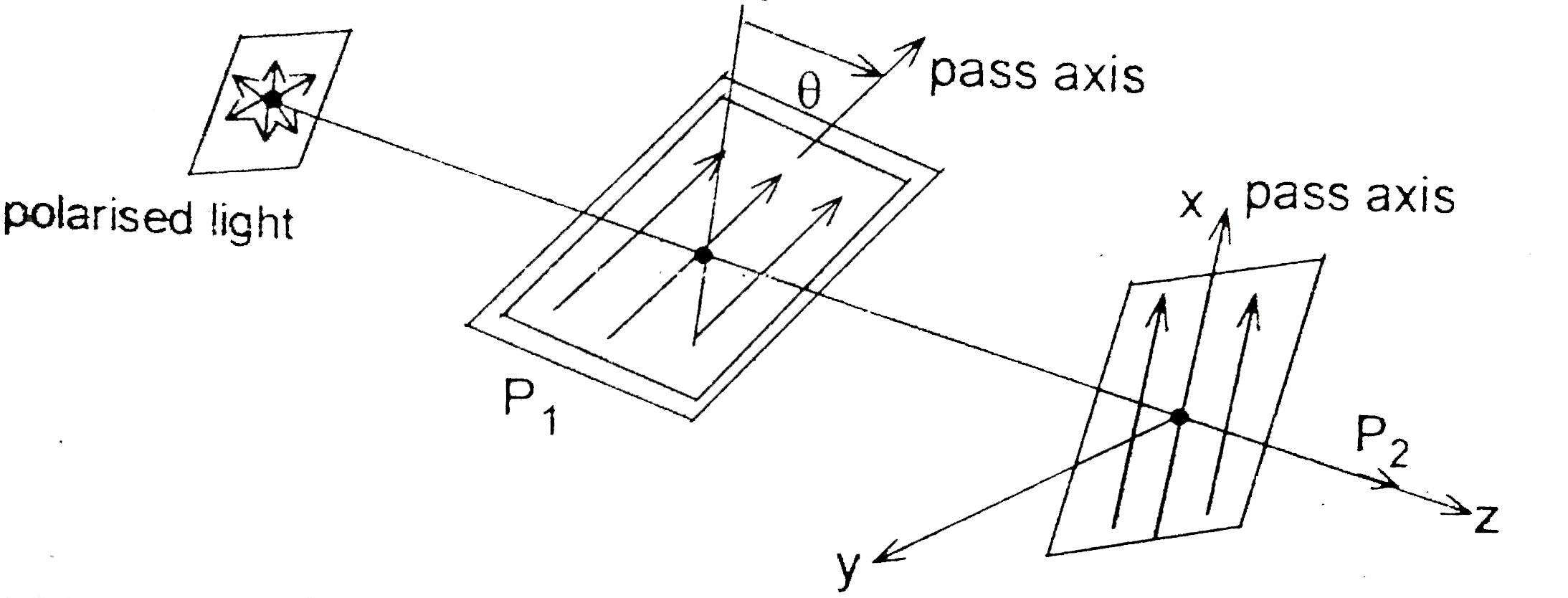
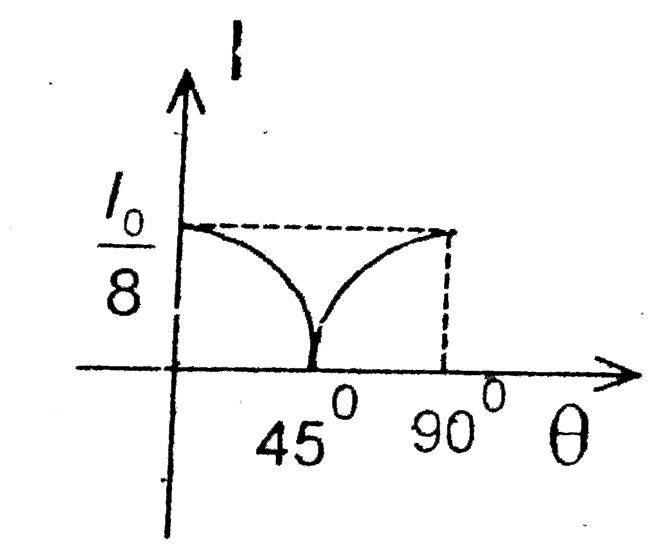
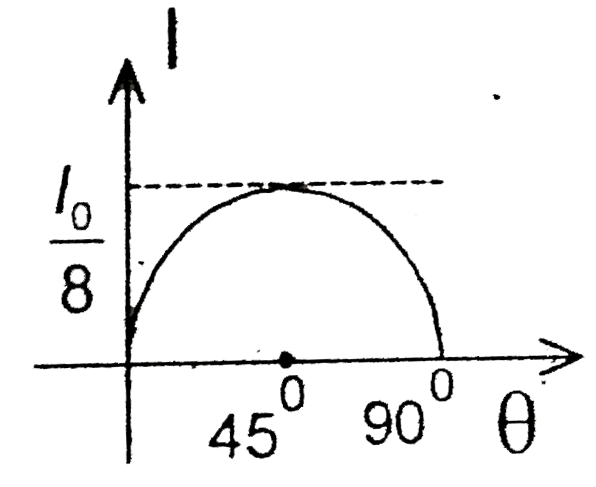
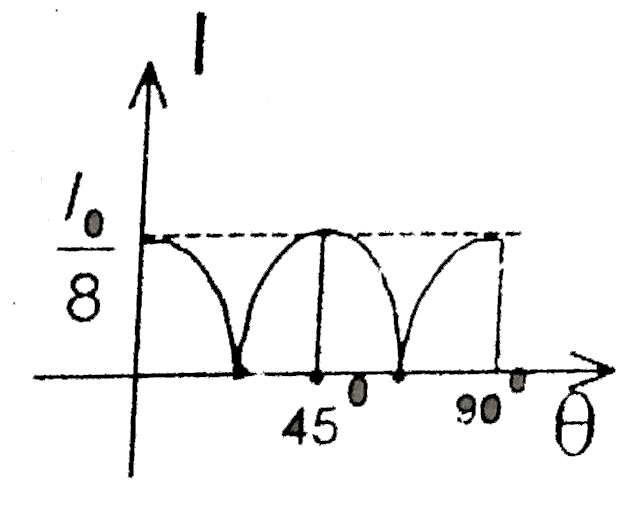
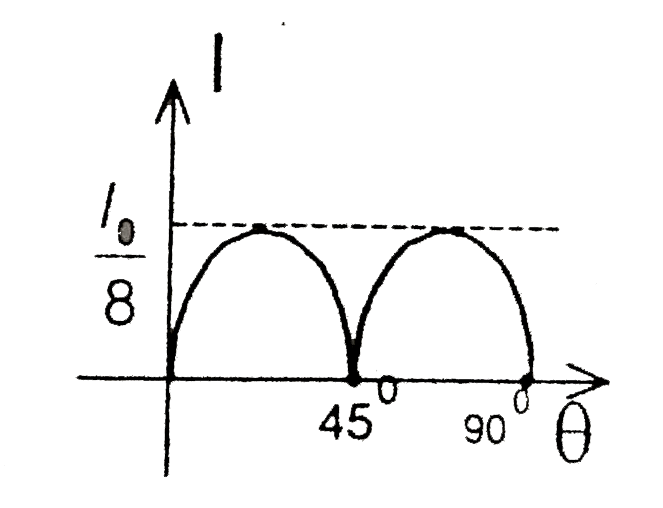
If a polarised light of intensity `l_(0)//2` is passed through two polariods `P_(1)` and `P_(2)` as shown in figure. Then the intensity of light observed by an observer on other side of `P_(2)` (if the polaroid `P_(1)` is rotated clockwise) as a funtion of angle `theta`.

A

B

C

D

Text Solution

Verified by Experts

The correct Answer is:

D

`l=((l_(0))/(2))cos^(2)theta.sin^(2)theta=(l_(0))/(2)[(sin2theta)/(2)]^(2)=(l_(0))/(8)sin^(2)2theta`
Promotional Banner

Similar Questions

Explore conceptually related problems

An unpolarized light with intensity 2I_(0) is passed through a polaroid. The resultant intensity of the transmitted light will be

An upolarised beam of intensity 2a^(2) passes through a thin polarioid. Assuming zero absorption in the polariod, the intensity of emergent plane polarised light is

Unpolarized light with intensity I_(0) is incident on combination of two polarizers as shown . The intensity of the light after passage through both the polaroids will be.

A polarised light intensity I_(0) is passed through another polariser whose pass axis makes an angle of 60^(@) with the pass axis of the former, What is the intensity of emergent polarised light from second polarised?

(a) When an unpolarized light of intensity I_(0) is passed through a polaroid , what is the intensity of the linearly polarized light ? Does it depend on the orintation of the polaroid ? Explain your answer. (b) A plane polarized beam of light is passed through a polaroid . Show graphically the variation of the intensity of the transmitted light with angle of rotation of the polaroid in complete one rotation.

Unpolarised ligh of intensity 32 W"/"m^(2) passes through a polariser and analyer which are at ain angle of 30^(@) with respect to each other. The intensity of the light coming from analyser is

An unpolarised light of intensity 64 Wm^(-2) passes through three polarisers such that the transmission axis of the last polariser is normal to first. If the intensity of emerging light is 6 Wm(-2),then angle between first two polariser may be

Unpolarised light of intensity I passes through an ideal polariser A. Another identical polariser B is placed behind A. The intensity of light beyond B is found to be (I)/(2) . Now another identical polariser C is placed between A and B. The intensity beyond B is now found to be (I)/(8) . the angle between polariser A and C is

For an ideal gas V - T curves at constant pressure P_(1) & P_(2) are shown in figure, from the figure

Blocks of mass M_(1) and M_(2) are connected by a cord which passes over the pulleys P_(1) and P_(2) as shown in the figure. If there is no friction, the acceleration of the block of mass M_(2) will be
