Home
Class 12
PHYSICS
Liquid is filled in a vessel of square b...

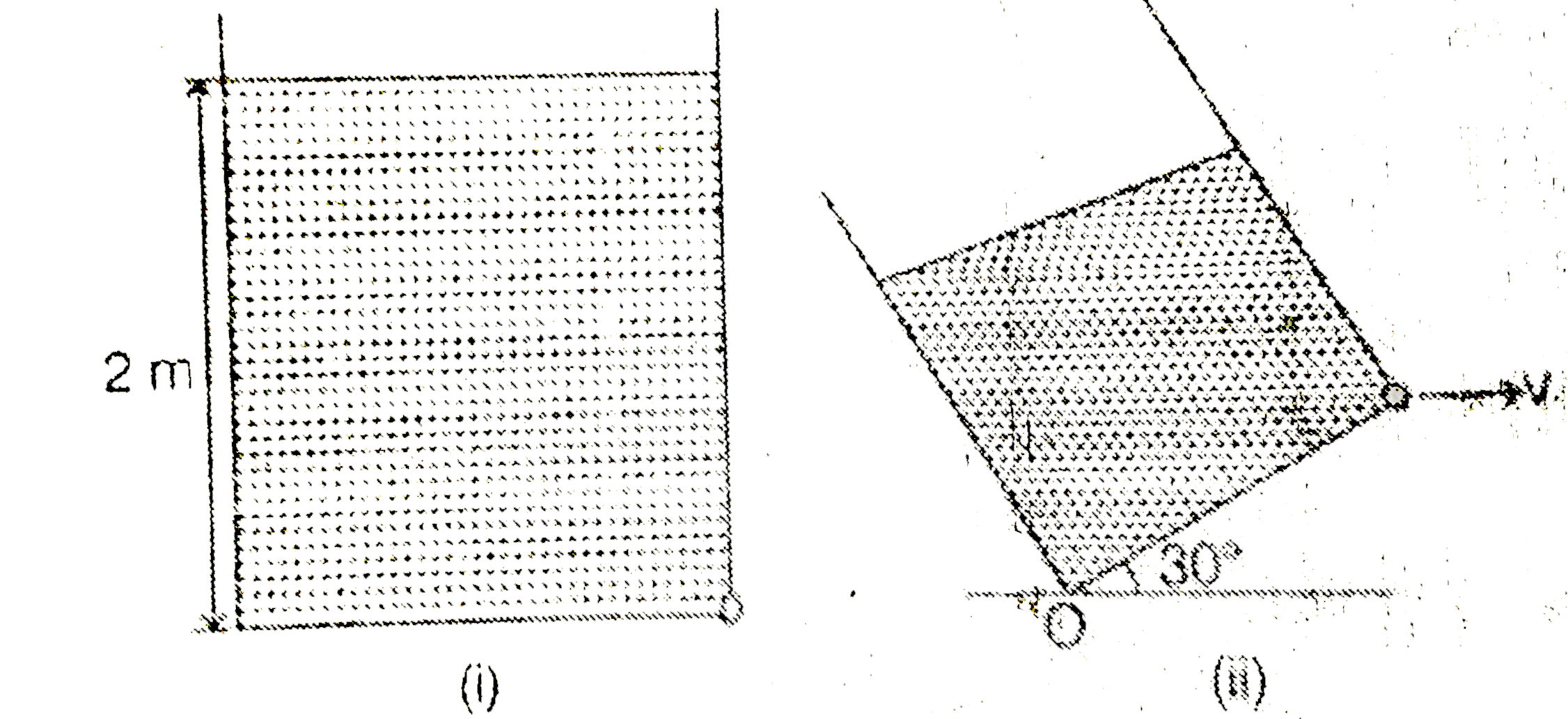
Liquid is filled in a vessel of square base `(2mxx2m)` upto a height of 2m as shown in figure (i). In figure (ii) the vessel is tilted from horizontal at `30^(@)`.

What is the velocity of efflux in this case. Liquid does not spills out?

A

3.29m/s

B

4.96m/s

C

5.67m/s

D

2.68m/s

Text Solution

Verified by Experts

The correct Answer is:

B

The volume of liquid should remain unchanged.
Hence, `2xx2xx2=2xx(1)/(2)[x+x+(2)/(sqrt(3))]xx2`
`thereforexapprox1.42m`
now, `h=xsin60^(@)=1.23m`
`thereforev=sqrt(2gh)=sqrt(2xx10xx1.23)=4.96m//s`
Promotional Banner

Similar Questions

Explore conceptually related problems

Liquid is filled in a vessel of square base (2mxx2m) upto a height of 2m as shown in figure (i). In figure (ii) the vessel is tilted from horizontal at 30^(@) . What is time of fall of liquid on the ground?

Liquid is filled in a vessel of square base (2mxx2m) upto a height of 2m as shown in figure (i). In figure (ii) the vessel is tilted from horizontal at 30^(@) . At what distance from point O, will the liquid strike on the ground?

An open vessel containing the liquid upto a height of 15 m. A small hole is made at height of 10 m from the base of the vessel then the initial velocity of efflux is (g = 10 m/ s^2 )

A liquid is filled in a vessel and a hole is made at a depth h below the free surface of the liquid. Statement-1 : Greater is the distance of the hole form the free surface of liquid, greater will be the velocity of efflux. And Statement-2 The speed of the liquid coming out of the orifice depends on the quantity of liquid in the vessel.

A syringe of diameter D = 8 mm and having a nozzie of diameter d = 2 mm is placed horizontally at a height of 1.25 m as shown in the figure . An incompressible and non - viscous liquid is filled in syringe and the piston is moved at speed of 0.25 m/s .Find the range of liquid jet on the ground.

Statement I: In the three cases shown in the figure, force exerted by liquid on three vessels is the same. Statement II: Pressure at the bottom in each case is same.

Two liquids of densities p_(1) and p_(2) (p2_= 6 p1 ) are filled up behind a square wall of side 8 m as shown in figure. The liquids have height as shown. The ratio of the forces due to these liquids exerted on upper part MN to that at the lower part NO is (Assume that the liquids are not mixing)

A container of large uniform cross sectonal area A , resting on horizontal surface, holds two immiscible non viscous and incompresible liquids of density d and 2d , each of height H/2 as shown in the figure. The lower density liquid is open to the atmosphere having pressure P_(0) . A tiny hole of area s(s a.the initial speed of efflux of the liquid at the hole b. the horizontal disance x travelled by the liquid initially c. the height h_m at which at the hole should be punched so that the liquid travels the maximum distance x_(m) initially. also calculate x_(m) (neglect air resistance inte calculations).

Curved surface of a vessel has shape of truncated cone having semi-vertex angle 37^(@) . Vessel is full of water (density rho=1000kg//m^(3) ) upto a height of 13 cm and is placed on a smooth horizontal plane. Upper surface is opened to atmosphere. A hole of 1.5cm is made on curved wall of a height of 8cm from bottom as shown in figure. Area of water surface in the vessel is large as compared to the area of the hole. The initial horizontal range of water from point B is

Two liquids of densities rho_1 and rho_2(rho_2 = 3 rho_1) are filled up behind a square wall of side 6 m as shown in figure. Each liquid has a height of 3 m. The ratio of the forces due to these liquids exerted on upper part MN to that at the lower part NO is (Assume that the liquids are not mixing)2
