Home
Class 12
PHYSICS
A force F acts tangentially on a part of...

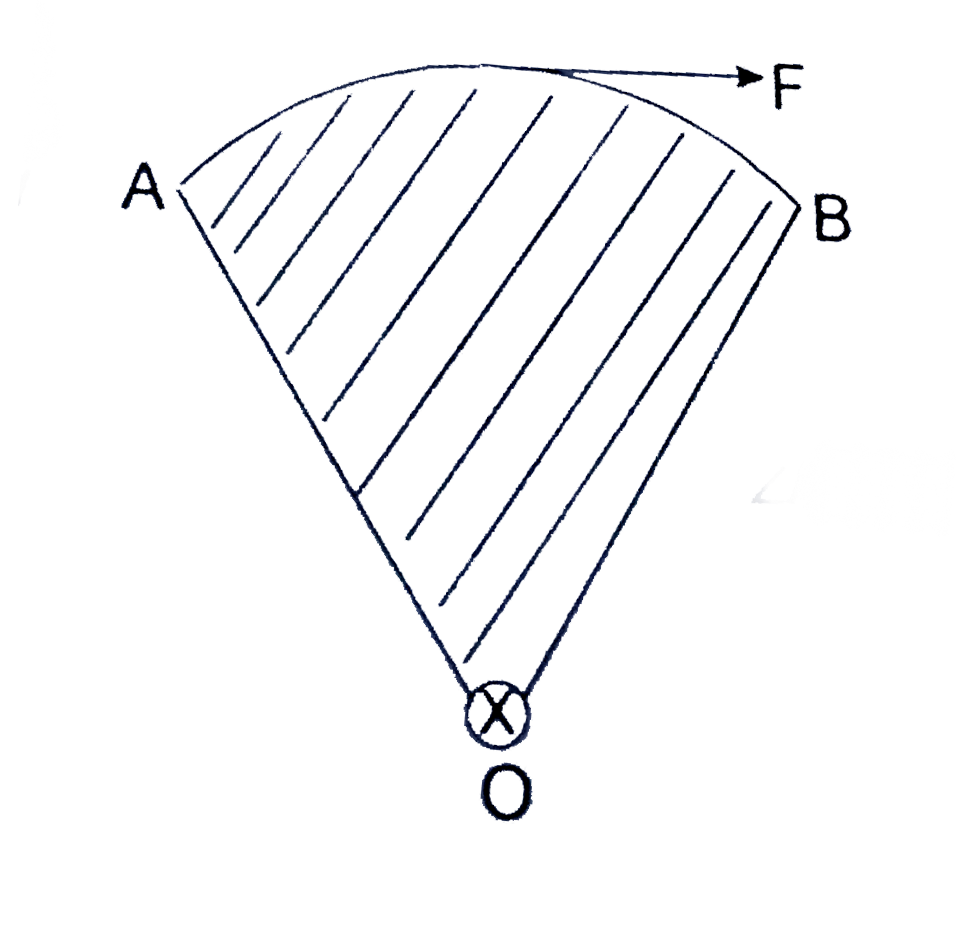
A force F acts tangentially on a part of a uniform disc of mass 'm' and radius 'R' hinged at point O. The force exerted by hinge on the portion of disc initially.

A

`((4-pi)/(pi))F`

B

`(4F)/(pi)`

C

`F((pi-2)/(pi))`

D

`(F)/(2)`

Text Solution

Verified by Experts

The correct Answer is:
A

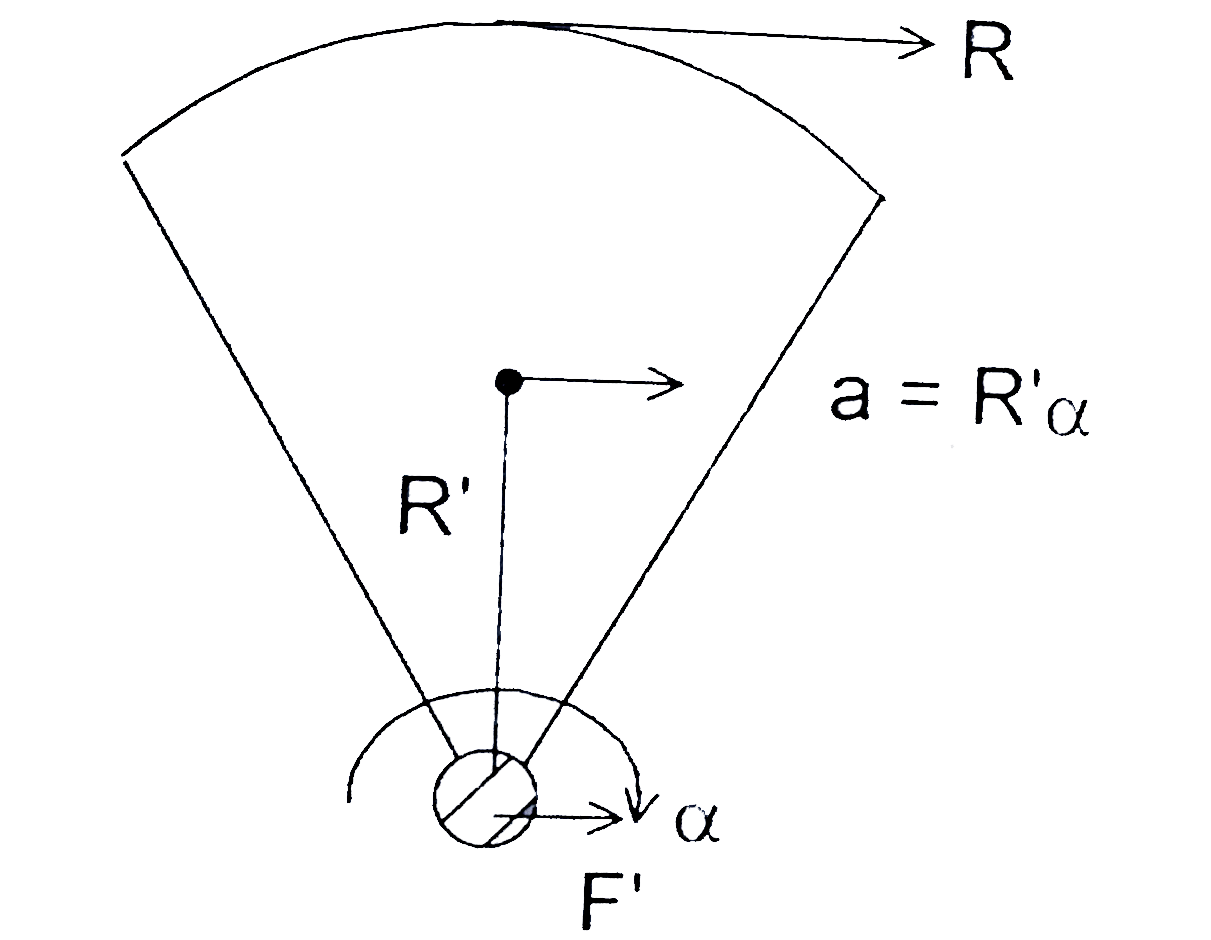
`tau= Ialpha rArr alpha = (FR)/(mR^(2))2= (2F)/(mR)`

Position of C.O.M `= (2R)/(3)(sin((pi)/(6)))/(((pi)/(6))) = (2R)/(pi)=R`
Acceleration of C.O.M `= (4F)/(mpi)`
Hence `F+F' = (4R)/(mpi)m`
`F' = ((4-pi)/(pi))F`
Promotional Banner

Similar Questions

Explore conceptually related problems

Two equal and opposite forces F are allplied tangentially to a uniform disc of mass M and radius R . If the disc is pivoted at its centre and free to rotate in its plane, the angular acceleration of the disc is :

A force F acts tangentially at the highest point of a disc of mass m kept on a rough horizontal plane. If the disc rolls without slipping, the acceleration of centre of the disc is:

If a tangential force mg is applied to a disc of mass m and radius r, the angular acceleration produced in it is?

A uniform dics of mass m and radius R=(80)/(23pi^2) m is pivoted smoothly at P . If a uniform disc of mass m and radius R is welded at the lowest point of the disc, find the period of SHM of the system (disc + ring). (in seconds)

A circular disc of mass M_(1) and radius R , initially moving, With a constant angular speed omega is gently placed coaxially on a stationary circular disc of mass M_(2) and radius R , as shown in Fig. There is a frictional force between the two discs. If disc M_(2) is placed on a smooth surface, then 'determine' the final angular speed of each disc. b. Determine the work done by friction. c. Determine the fractional loss in kinetic energy. i.e. /_\K//K_(i)

A uniform disc of mass M and radius R is liffted using a string as shown in the figure. Then choose incorrect option(s),

When a body is hinged at a point and a force is acting on the body in such a way that the line of action of force is at some distance from the hinged point, the body will start rotating about the hinged point. The angular acceleration of the body can be calculated by finding the torque of that force about the hinged point. A disc of mass m and radius R is hinged at point A at its bottom and is free to rotate in the vertical plane. A force of magnitude F is acting on the ring at top most point. Tangential acceleration of the centre of mass is

When a body is hinged at a point and a force is acting on the body in such a way that the line of action of force is at some distance from the hinged point, the body will start rotating about the hinged point. The angular acceleration of the body can be calculated by finding the torque of that force about the hinged point. A disc of mass m and radius R is hinged at point A at its bottom and is free to rotate in the vertical plane. A force of magnitude F is acting on the ring at top most point. Component of reaction at the hinge in the horizontal direction is

When a body is hinged at a point and a force is acting on the body in such a way that the line of action of force is at some distance from the hinged point, the body will start rotating about the hinged point. The angular acceleration of the body can be calculated by finding the torque of that force about the hinged point. A disc of mass m and radius R is hinged at point A at its bottom and is free to rotate in the vertical plane. A force of magnitude F is acting on the ring at top most point. Component of reaction at the hinge in the vertical direction is

Three forces of magnitude F, F and sqrt(2F) are acting on the periphery of a disc of mass m and radius R as shown in the figure. The net torque about the centre of the disc is

