Home
Class 12
PHYSICS
One mole of a monoatomic gas undergoes a...

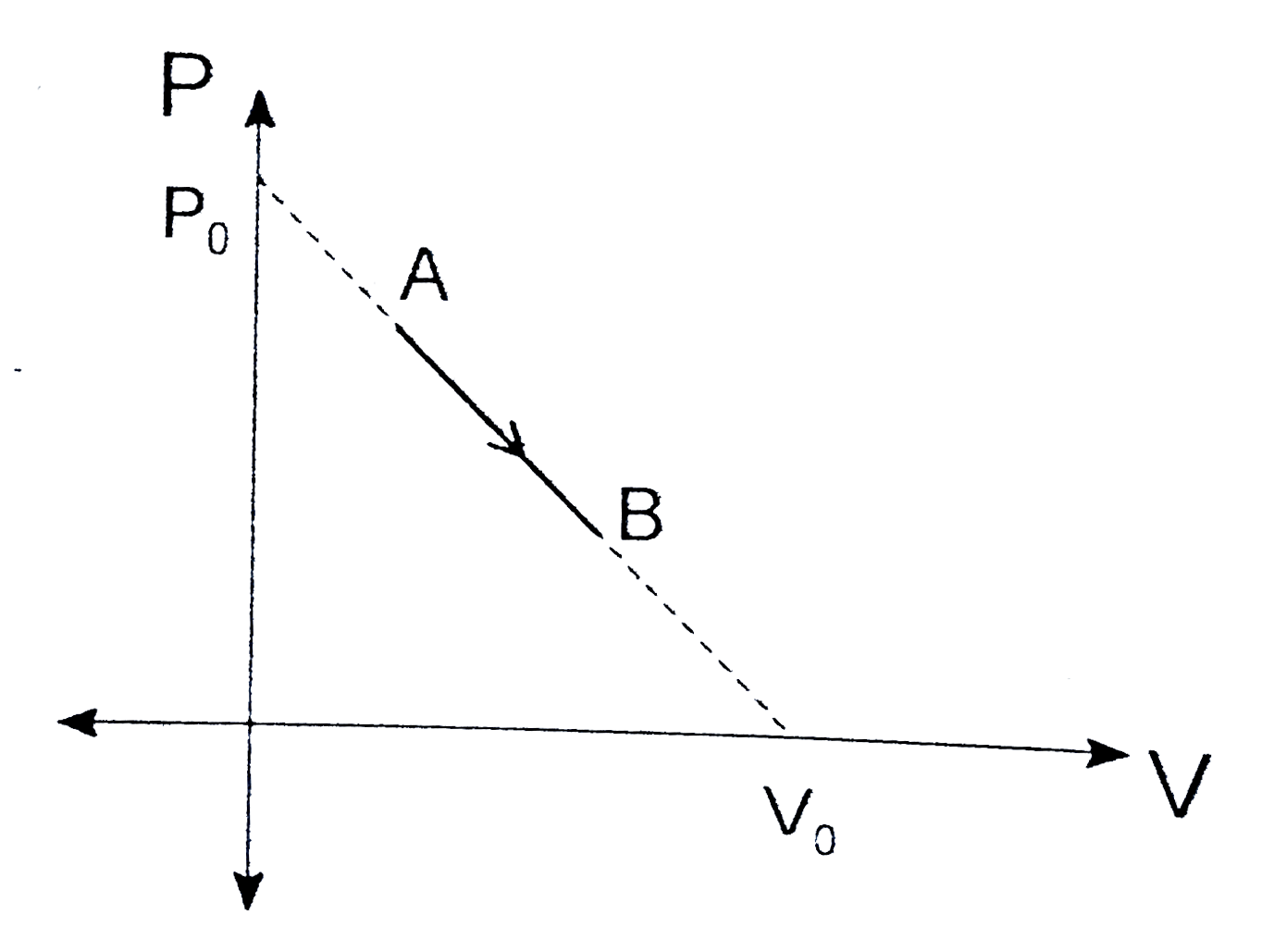
One mole of a monoatomic gas undergoes a linear process `A rarr B` in `P - v` diagram. The volume of the gas when the process turns from an endothermic to an exothermic one is

A

`(5)/(8)v_(0)`

B

`(v_(0))/(2)`

C

`(8v_(0))/(15)`

D

`(3v_(0))/(5)`

Text Solution

Verified by Experts

The correct Answer is:
A

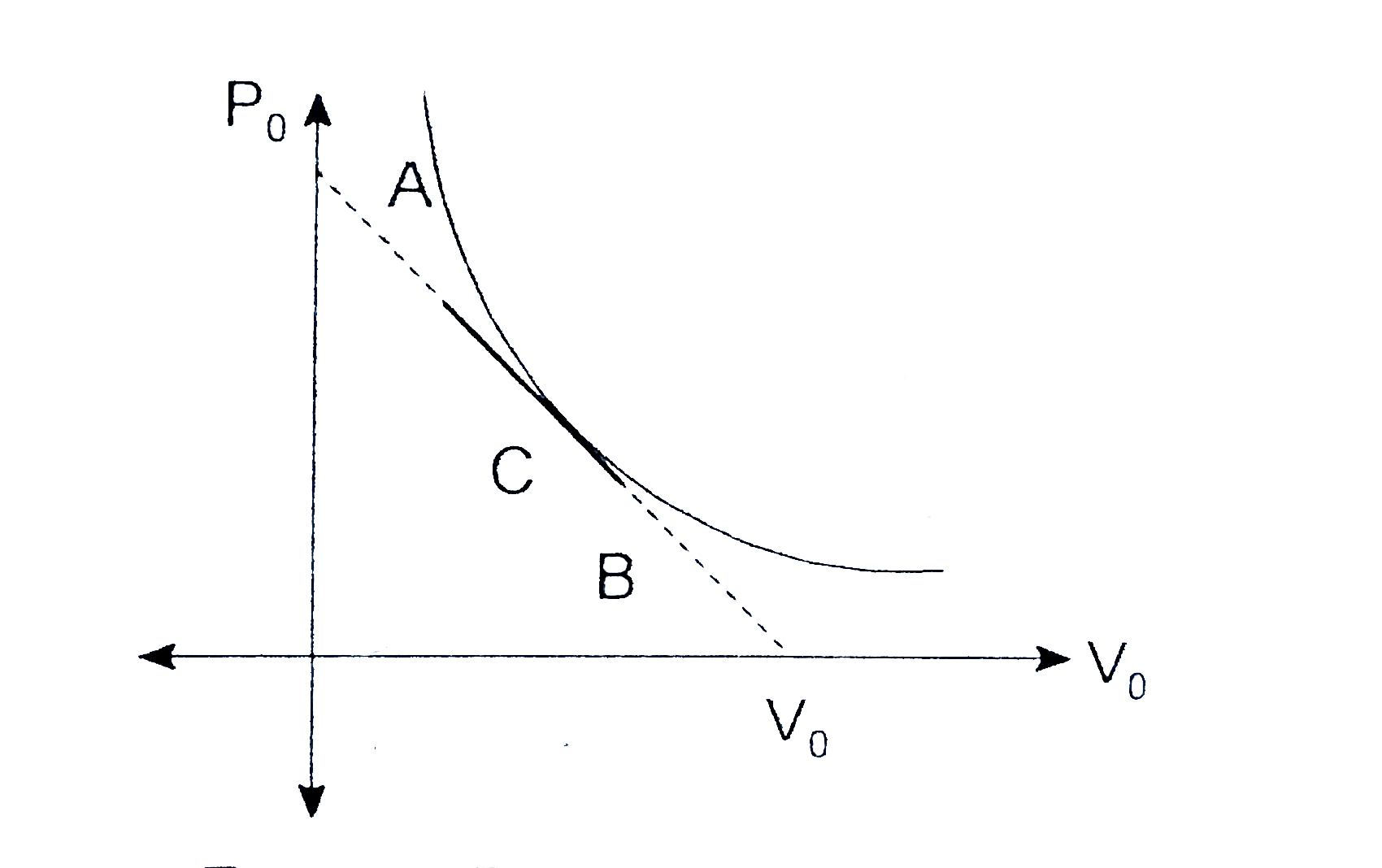
the point where adiabatic curve touch the line AB the nature of process will change from endo thermic to exothermic.

`-(P_(0))/(v_(0))=-gamma(P)/(V)`
`-m=-(gamma(-mv+P_(0)))/(V) m =+(P_(0))/(V_(0))`
`mv(1+gamma)=gammaP_(0) " " V=(gammaP_(0))/(m(1+gamma))=(5)/(8)V_(0)`
Promotional Banner

Similar Questions

Explore conceptually related problems

One mole of a monoatomic ideal gas undergoes the process ArarrB in the given P-V diagram. What is the specific heat for this process?

Two moles of a monoatomic ideal gas undergoes a process AB as shown in the figure. Then, find the work done during the process in Joule.

One mole of monoatomic ideal gas undergoes a process ABC as shown in figure. The maximum temperature of the gas during the process ABC is in the form (xPV)/(R) . Find x .

One mole of an ideal gas undergoes a cyclic process ABCDA as shown in the P-V diagram, The net work done in the process is (1 atm=10^(6) dyne cm^(-2))

n' moles of an ideal gas undergoes a process AtoB as shown in the figure. The maximum temperature of the gas during the process will be:

For one mole of a monoatomic gas match the following.

An ideal gas undergoes cyclic process ABCDA as shown in given p-V diagram. The amount of work done by the gas is

One mole of an ideal monotomic gas undergoes a linear process from A to B in which its pressure p and its volume V change as shown in figure. The maximum temperature of the gas during this process is

One mole of a monoatomic gas is carried along process ABCDEA as shown in the diagram. The net work done by gas is (0.x)J . Find value of x.

0.5 moles of an ideal monoatomic gas undergoes a thermodynamic process from A to B as shown in figure. The change in internal energy of the gas during the process from A to B is

