Home
Class 12
PHYSICS
A thermometer uses density of water as t...

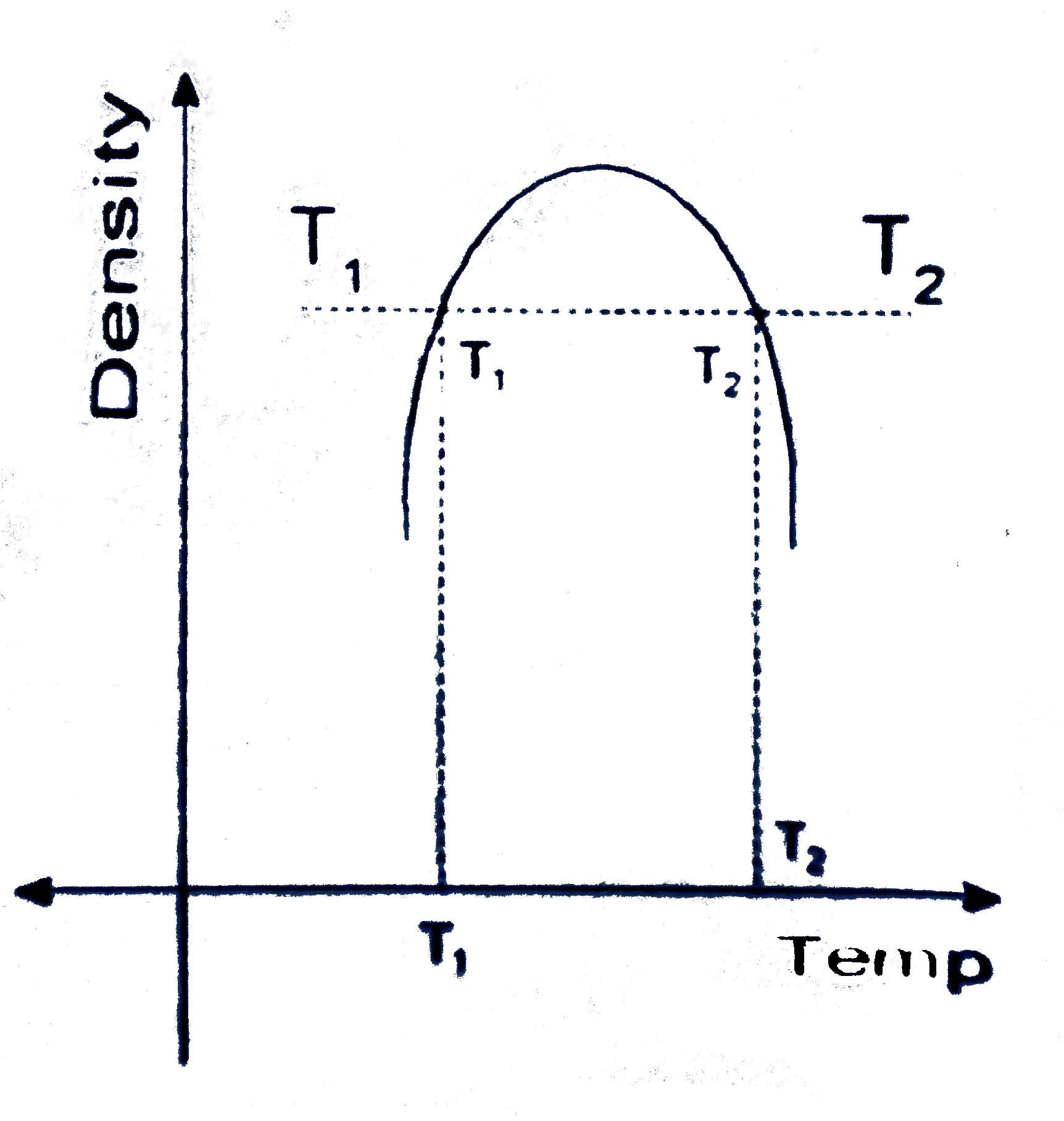
A thermometer uses density of water as thermometric property. Actual reading in thermometer is height of water `(h)` which inversely proportional to the density of water `(d)`. In certain temp range is symmetrical ablout maximum.
Two identical bodies (of same mass and specific heat) at different temp `T_(1)` and `T_(2)` show the same reading of height `h_(1)=h_(2)` in the thermometer. The bodies are brought in contact and allowed to reach the equilibrium. The thermometric reading height of water for final equilibrium state `h_(f)` satisfies

A

`h_(f)=(h_(1)+h_(2))/(2)=h_(1)=h_(2)`

B

`h_(f) gt h_(1) = h_(2)`

C

`h_(f),h_(1) = h_(2)`

D

`h_(f)` may be greater or less than `h_(1)-h_(2)`

Text Solution

Verified by Experts

The correct Answer is:

A

Since mass and specific heat of two different bodies are same
`h_(f)=(h_(1)+h_(2))/(2)=h_(1)=h_(2)`
Promotional Banner

Similar Questions

Explore conceptually related problems

A mercury thermometer makes use of the property of expansion of liquids on heating.

Water is not considered suitable for use in thermometers. Give the reason for the same.

State some objections to using water-in-glass as a thermometer is mercury-in-glass an improvement

Two bolcks to the same metal having same mass and at temperature T_1 and T_2 respectively ,are brought in contact with each other and allowed to attain thermal equilibrium at constant pressure .The change in entropy , Delta S for this process is :

Two bolcks to the same metal having same mass and at temperature T_1 and T_2 respectively ,are brought in contact with each other and allowed to attain thermal equilibrium at constant pressure .The change in entropy , Delta S for this process is :

Differentiate between a laboratory thermometer and a clinical thermometer

Two bodies of masses m _(1) and m _(2) fall from heights h _(1) and h _(2) respectively. The ratio of their velocities when the hit the ground is

Two identical long, solid cylinders are used to conduct heat from temp T_(1) to Temp T_(2) . Originally the cylinders are connected in series and the rate of heat transfer is H. If the cylinders are connected in parallel then the rate of heat transer would be:

The range R of projectile is same when its maximum heights are h_(1) and h_(2) . What is the relation between R, h_(1) and h_(2) ?

Thermometers which are not kept in touch with the body to measure temperatures are
