Home
Class 12
PHYSICS
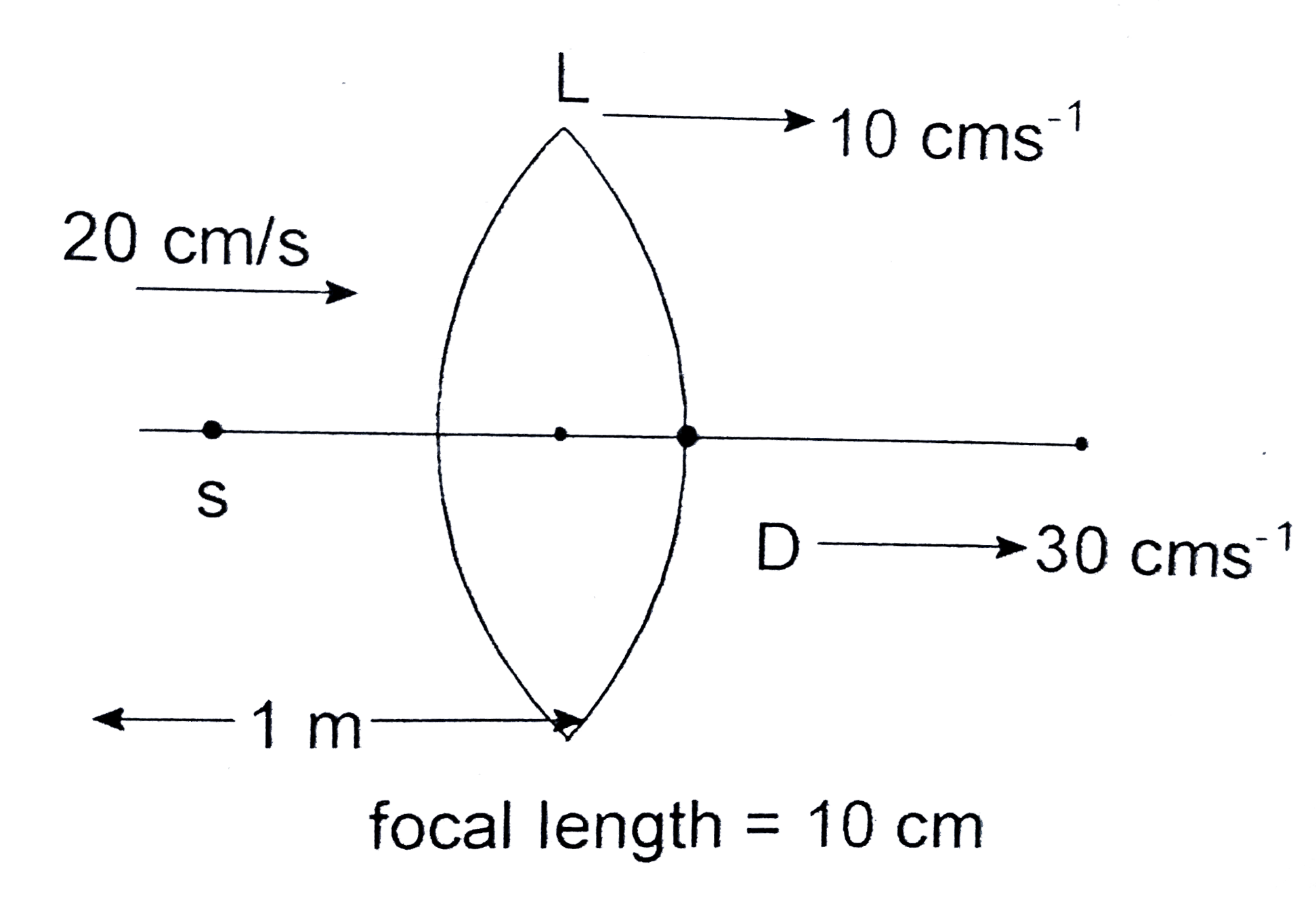
The figure shows the initial position of...

The figure shows the initial position of a point source of light s, a detector D and lens L. Now at `t = 0` all three starts moving toward right with different velocity as shown in figure. The times at which detector receives the maximum light.

A

`0.56s` and `8.94s`

B

`3.8s`

C

`8.94s` and `19.62s`

D

`0.56s`

Text Solution

Verified by Experts

The correct Answer is:

A
Promotional Banner

Similar Questions

Explore conceptually related problems

The acceleration-time (a-t) graph of a particle moving along straight line is as shown in figure. The time at which velocity of particle becomes equal to its initial velocity is

A source of sound and detector are arranged as shown in Fig. The detector is moving along a circle with constant angular speed omega . It start from the shown location in anticlockwise direction at t=0 (Take velocity of sound in air as v) Q. Find the time at which the detector will hear the maximum frequency for the first time.

The figure shows the location of a source and detector at time t = 0. The source and detector are moving with velocities v_s = 5hati m s^(-1) and v_D = 10 hatj ms^(-1) respectively . The frequency of signals received by the detector at the moment when the source cros the origin is (the frequency of the source is 100 Hz . Velocity bof sound 330 m s^(-1) .)

A detector at x=0 receives waves from three sources each of amplitude A and frequencies f + 2,f and f-2 . The time at which intensity is maximum, is

Two coherent sound sources A and B produce a sound of wavelength lambda. If at t=0 a detector starts moving with constant velocity v_(0) from point O along y - direction, then the minimum time, after which it detects the sound of maximum intensity, is (D gt gt lambda)

A luminous point source s is placed between a plane mirror and a screen in the situation as shown in figure. Then the length of screen which will receive direct light as well as reflected light is

A particle is projected from the ground and simultaneously a wedge starts moving towards the right, as shown in the figure. The maximum height of the wedge for which the particle will not hit the wedge is [g=10ms^(-2)]

The diagram shows a point source of light S, a convex lens L and plane mirror M. These are placed such that rays of light from S return to it after reflection from M. To which point (left of S or right of S) will the rays return, if M is moved to the left and brought in contact with L?

The figure shows the v - t graph of a particle moving in a straight line. Starting from rest, the time after which the particle returns to its starting position is

The position - time graph for a particle moving along a straight line is shown in figure. The total distance travelled by it in time t = 0 to t = 10 s is
