Home
Class 12
CHEMISTRY
For the following elementary first order...

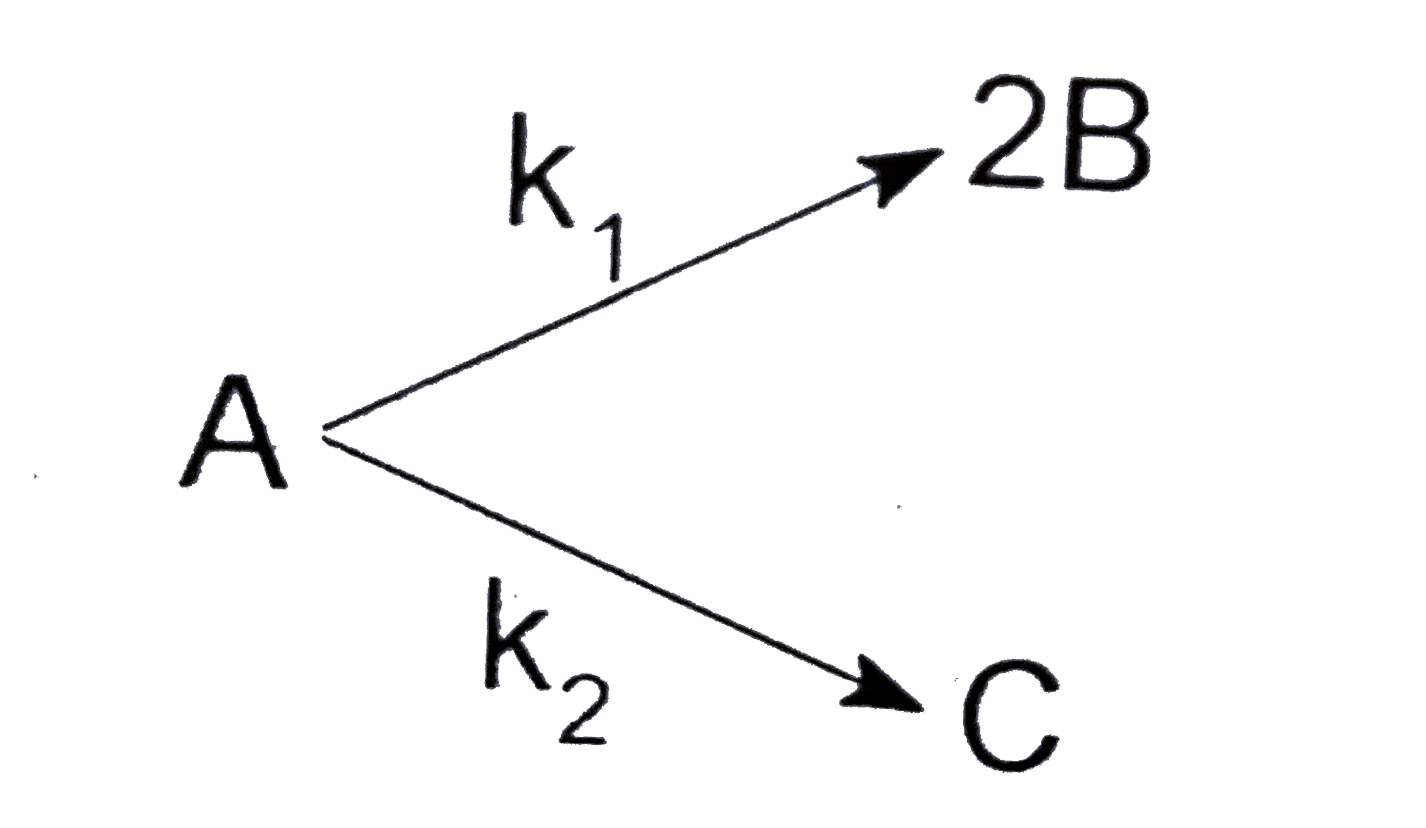
For the following elementary first order reaction:

If `k_(2)=2k_(1)`, then `%` of B in overall product is:

A

`25%`

B

`50%`

C

`75%`

D

`100%`

Text Solution

Verified by Experts

The correct Answer is:

B

`(1)/(2)(d[B])/(dt)=k_(1)[A] rArr (d[B])/(dt)=2k_(1)[A]`
`(d[C])/(dt)=k_(2)[A]`
`rArr([B])/([C])=(2k_(1))/(k_(2))=1`
`rArr %[B]=(1)/(1+1)xx100=50%`
Promotional Banner

Similar Questions

Explore conceptually related problems

For a first order reaction, A rarr B , the rate = k xx…………. .

Conisder a mechanism in which a single reactant profuces several Products by the following parallel first order reactions : A overset(k_(1))rarrB, A overset(k_(2))rarrC A overset(k_(3))rarrD Write the rate expresison for [A] .

Order of basic nature is A gt B gt C . Order of % of A, B and C in overall product is:

Write the rate law units of rate constant for the following elementary reactions. (a) A+ B to Products . (b) 2A to Products , (c) 2A + B to Products and (d) A + 2 B to Products.

For the reaction: 2H_2 + 2NO Calculate the following: (1) The overall order of reaction. (2) The rate law. (3) The value of rate constant (k).

For and elementary reaction 2A underset(k_(2))overset(k_(1))hArr B , the rate of disappearance of A iss equal to (a) (2k_(1))/(k_(2))[A]^(2) (b) -2k_(1)[A]^(2) + 2k_(2)[B] ( c) 2k_(1)[A]^(2) - 2k_(2)[B] (d) (2k_(1) - k_(2))[A]

In the following first order competing reactions A overset(k_(1))rarr B, C overset(k_(2)) rarr D . If only 50% of A have been reacted whereas 94% of C has been reacted in the same time interval then find the ratio of (k_(2))/(k_(1)) .

Rate law for the elementary reaction 2AB to^(k_1) A_2+B_2 will be:

At a certain temperature, the first order rate constant k_(1) is found to be smaller than the second order rate constant k_(2) . If E_(a)(1) of the first order reaction is greater than E_(a)(2) of the second order reaction, then as temperature is raised:

If K_(1)= Rate constant at temperature T_(1) and k_(2) rate constant at temperature T_(2) for a first order reaction, then which of the following relation is correct ?
