Home
Class 12
PHYSICS
An infinite thread of charge density lam...

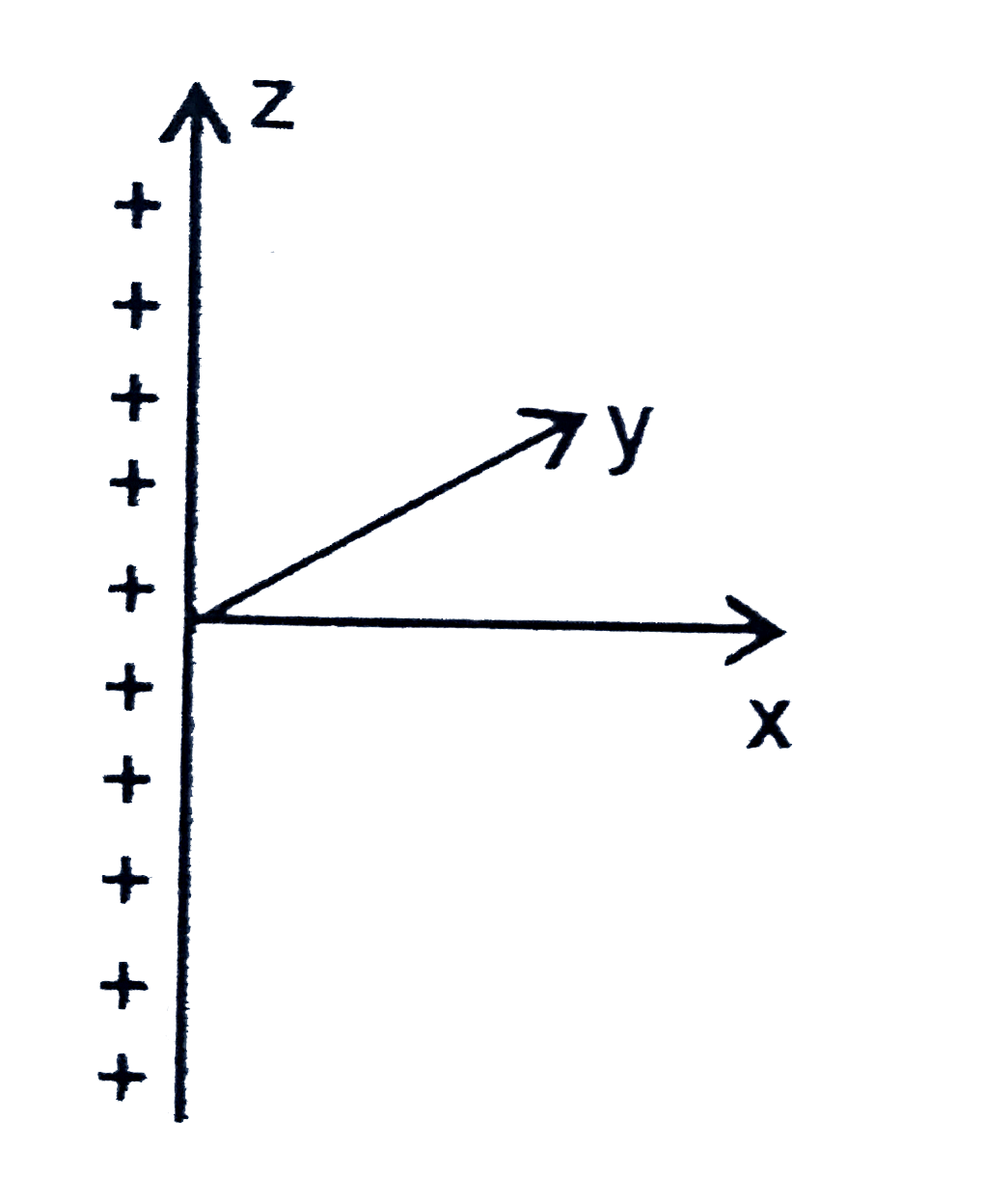
An infinite thread of charge density `lambda` lies along z-axis. The potential difference between points `A (4, 3, 4)` and `(3, 4, 0)` is

A

`(lambda)/(2pi in_(0))In((sqrt41)/(5))`

B

`(lambda)/(2pi in_(0))In(5)`

C

zero

D

`(lambda)/(2pi in_(0))`

Text Solution

Verified by Experts

The correct Answer is:

C

Equipotential surfaces are coaxial cylinders, therefore `(4, 3, 4)` and `(3, 4, 0)` lie on equipotential surface.
Promotional Banner

Similar Questions

Explore conceptually related problems

An infinitely long line of linear charge density lambda is shown in the figure. The potential difference V_(A)-V_(B) between the two points A and B is

A uniform electric field is along x-axis. The potential difference V_(A)-V_(B)=10 V is between two points A (2m, 3m) and (4m, 8m). Find the electric field intensity.

The point (-2, 3, 4) lies in

A uniform surface charge of density sigma is given to a quarter of a disc extending upto infinity in the first quadrant of x-y plane. The centre of the disc is at the origin O. Find the z-component of the electric field at the point (0, 0, z) and the potential difference between the points (0, 0, d) & (0, 0, 2d) .

A uniform surface charge of density sigma is given to a quarter of a disc extending up to infinity in the first quadrant of x-y plane. The centre of the disc is at the origin O . Find the z-component of the electric field at the point (0,0,z) and the potential difference between the point (0,0,d) and (0,0,2d)

For an infinite line of charge having linear charge density lambda lying along x-axis the work done in moving a charge q form C to A along CA is

Electric field in a region is given by E=(2hati+3hatj-4hatk)V//m . Find the potential difference between points (0, 0, 0) and (1,2,3) in this region.

Two identical point charges are placed at A and B. The potential difference V_0-V_C is ( k= 1/4π epsilon_0 )

An infinite conducting sheet has surface charge density sigma . The distance between two points is r. The potential difference (V_A - V_B) between these point is

Find the equation of the ellipse, with major axis along the x-axis and passing through the points (4, 3) and (-1, 4) .
