Home
Class 12
PHYSICS
A body is moving under the acton of cent...

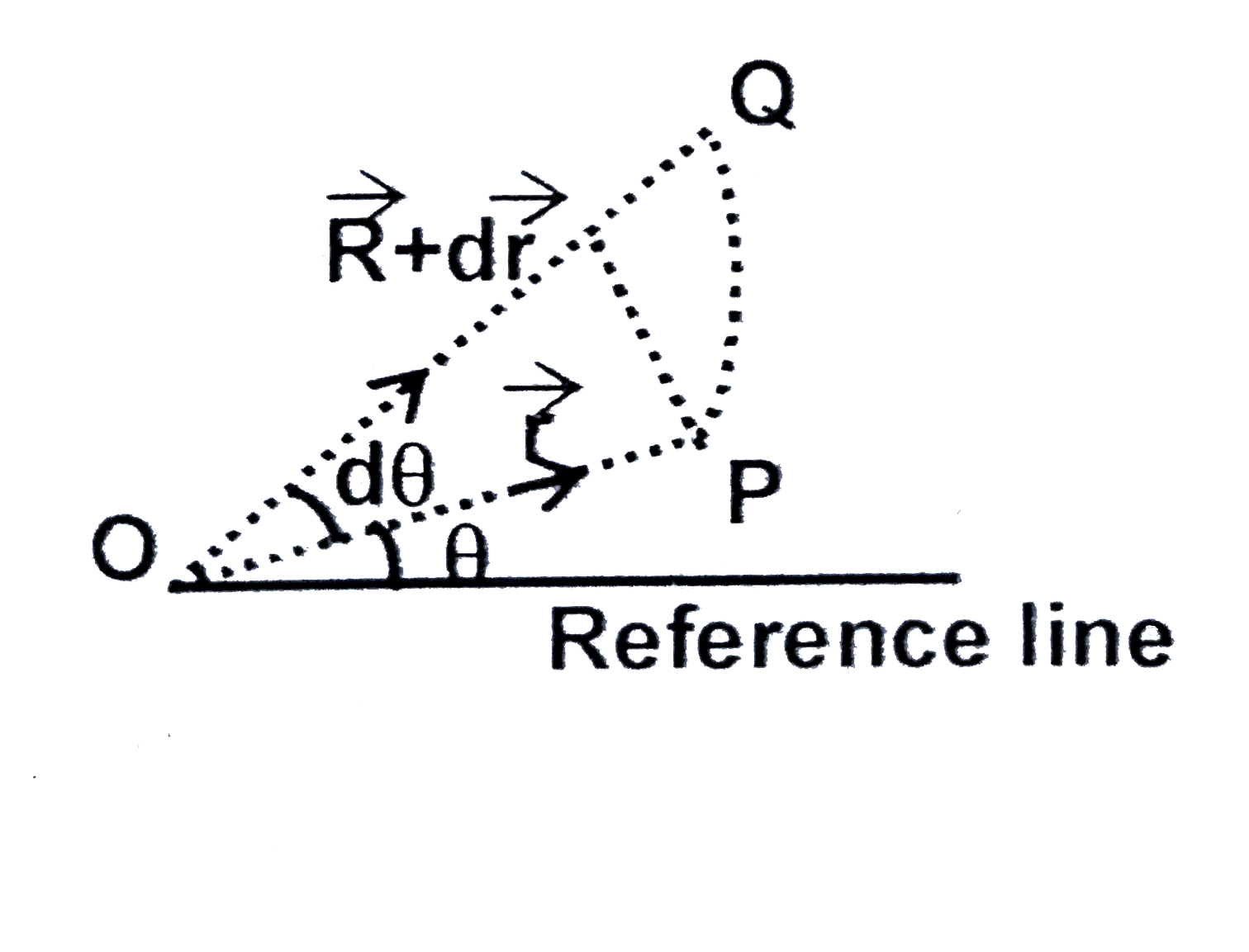
A body is moving under the acton of central force `vrc(F)(r ) hat(e )`. Then, choose the correct statement (symbols are having usual meaning and `hat(e ), hat(e )`, denote unit vectors along the radial and tangential direction, respectively ) from the following.

A

`vec(v) = (dr)/(dt) hat(e)_(r ) + r(d theta)/(dt) hat(e)_(theta), vec(a) = [(d^(2)r)/(dt^(2)) - r ((d theta)/(dt))^(2)] hat(e)_(r )+ [2(dr)/(dt) (d theta)/(dt) + r (d^(2)theta)/(dt^(2))]hat(e)_theta `

B

`vec(v) = (dr)/(dt) hat(e)_(r ) + r(d theta)/(dt) hat(e)_(theta), vec(a) = [(d^(2)r)/(dt^(2)) + r ((d theta)/(dt))^(2)] hat(e)_(r )+ [2(dr)/(dt) (d theta)/(dt) - r (d^(2)theta)/(dt^(2))]hat(e)_theta `

C

`vec(v) = (dr)/(dt) hat(e)_(r ) - r(d theta)/(dt) hat(e)_(theta), vec(a) = [(d^(2)r)/(dt^(2)) + r ((d theta)/(dt))^(2)] hat(e)_(r )+ [2(dr)/(dt) (d theta)/(dt) + r (d^(2)theta)/(dt^(2))]hat(e)_theta`

D

`vec(v) = (dr)/(dt) hat(e)_(r ) - r(d theta)/(dt) hat(e)_(theta), vec(a) = [(d^(2)r)/(dt^(2)) - r ((d theta)/(dt))^(2)] hat(e)_(r )+ [2(dr)/(dt) (d theta)/(dt) + r (d^(2)theta)/(dt^(2))]hat(e)_theta`

Text Solution

Verified by Experts

The correct Answer is:

A

Use `(dhat(e)_(r ))/(dt) = (d theta)/(dt) hat(e)_(theta)`. and `(dhat(e)_(theta))/(dt) = -(dtheta)/(dt) hat(e)_(r )`
Promotional Banner

Similar Questions

Explore conceptually related problems

The position vector of a particle vec(R ) as a funtion of time is given by: vec(R )= 4sin(2pit)hat(i)+4cos(2pit)hat(j) Where R is in meters, t is in seconds and hat(i) and hat(j) denote until vectors along x-and y- directions, respectively Which one of the following statements is wrong for the motion of particle ?

An aeroplane is flying in vertical plane at an angle of 30^(@) with the horizontal (north) and wind is is blowing from west.A package is dropped from an aeroplane. The velocity of the wind if package hits a kite flying in the space with a position vector vec(R) = (400 sqrt(3) hat(i) + 80 hat(j) + 200 hat(k)) m with respect to the point of dropping. (Here hat(i) and hat(j) are the unit vectors along north and vertically up respectively and hat(k) be the unit vector due east. Assume that the bag is light enough to get carried away by the wind)

A body of mass 1 kg begins to move under the action of a time dependent force vec F = (2 t hat i + 3 t^(2) hat j) N , where hat i and hat j are unit vectors along x-and y-axes. What power will be developed by the force at the time t ?

A body of mass 1 kg begins to move under the action of a time dependent force F=(2that(i)+3t^(2)hat(j))N, "where" hat(i)and hat(j) are unit vector along x and y axis. What power will be developed by the force at the time?

(a) Derive an expression for unit vector along reflected ray (hat r) if unit vectors hat i and hat n represents unit vectors along incident light ray and normal (at point of reflection and outward from surface) respectively. (b) If vector along the incident ray on a mirror is -2 hat i+ 3 hat j + 4 hat k . Considering the x-axis to be along the normal. Then, find the unit vector along the reflected ray.

A body constrained to move along the z-axis of a co-ordinate system, is subjected to a constant force vec(F) given by vec(F)=-hat(i)+2hat(j)+3hat(k) Newton where hat(i),hat(j) and hat(k) represent unit vectors along x-,y-,and z-axes of the system, respectively. Calculate the work done by this force in displacing the body through a distance of 4m along the z-axis.

According to C.F.T, attraction between the central metal ion and ligands in a complex is purely electrostatic. The transition metal which forms the central atom cation in the complex is regarded as a positive ion. It is surrounded by negative ligands or neutral molecules which have a lone apir of electrons, if the ligand is a neutral molecule such as NH_(3) , the negative and of the dipole in the molecule is directed towards the metal cation. the electrons on the central metal ion are under repulsive forces from those on the ligands. thus the electrons occupy the d-orbitals remain away from the direction of approach ligands. ltBrgt Q. Correct relationship between pairing energy (P) and C.F.S.E. (Delta_(o)) in

The position vectors of the vertices A ,B ,a n dC of a triangle are hat i+ hat j , hat j+ hat ka n d hat i+ hat k , respectively. Find the unite vector hat r lying in the plane of A B C and perpendicular to I A ,w h e r eI is the incentre of the triangle.

The angles of triangle, two of whose sides are represented by vectors sqrt(3)( vec axx vec b) \a n d \ vec b-( hat adot vec b) hat a ,w h e r e vec b is a non zero vector and hat a is unit vector in the direction of vec a , are

A small objected of mas m moves in a circular orbit under an attractive central force kr^(3) ( i.e., vec( F) = - kr^(3) hat( r )) . The radius of the orbit is a_(0) . Take the potential energy to be zero at the origin i.e., r = 0. The total mechanical energy of the object is
