Home
Class 12
PHYSICS
Two identical blocks are attached by a m...

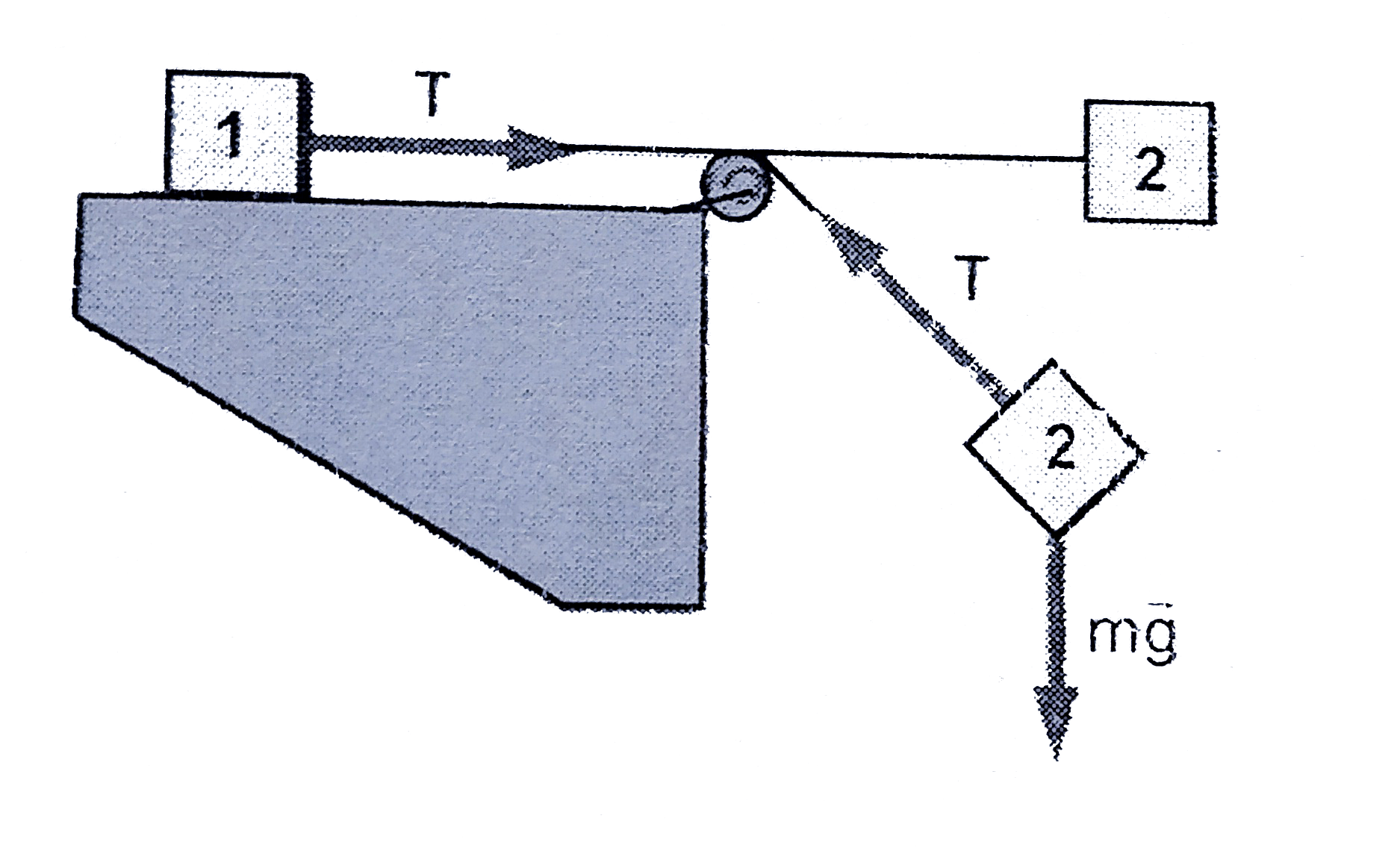
Two identical blocks are attached by a massless string running over a pulley as shown in figure. The rope initially runs over the pulley at its (the rope's) midpoint, and the surface that block 1 rests on is frictionless. Blocks 1 and 2 are initially at rest when block 2 is released with the string taut and horizontal. Assume that the initial distance from block 1 to the pulley is the same as the initial distance from block 2 to the wall.

A

Block 1 hits the pulley before Block 2 hits the way

B

Block 2 hits the wally before block 1 hits the pulley

C

block 1 hits pulley simultaneously with block 2 hitting the wall

D

which block hits the obstruction first depends on the actual mass of the blocks and its length of the sring

Text Solution

Verified by Experts

The correct Answer is:

A

The horizontal acceleration of Block 1 is always greater than that of block 2.
Promotional Banner

Similar Questions

Explore conceptually related problems

Two identical masses are attached by a light string that passes over a small pulley, as shown . The table and the pulley are frictionless. The hanging block is moving

Two blocks are connected by a long inextensible string passing over an ideal pulley as shown in the figure. If the system is released from rest then the common speed of blocks when block m_2 moves a distance I will be

Three blocks A, B and C havig masses m kg, 2kg and 3 kg are attached by massless strings and ideal pulleys as shown in the figure. When the system is realeased from rest if the block A remains stationary. the mass of block A is

Two blocks of masses of 40 kg and 30 kg are connected by a weightless string passing over a frictionless pulley as shown in the figure.

In the following arrangement, the system is initially at rest. The 5-kg block is now released. Assuming the pulley and string to be massless and smooth, the acceleration of block C will be

Two blocks A and B are joined by means of a slacked string passing over a massless pulley as shown in Figure. The system is released from rest and it becomes taut when B falls a distance 0.5 m . a. Find the common velocity of the two blocks just after the string becomes taut. b. Find the magnitude of impulse on the pulley by the clamp during the small interval while string becomes taut.

Two blocks are connected over a massless pulley as shown in figure. The mass of block A is 10 kg and the coefficient of kinetic friction is 0.2 Block A sliders down the incline at constant speed. The mass of block B in kg is

A block of mass m is attached at the end of an inextensible string which is wound over a rough pulley of mass M and radius R figure a. Assume the string does not slide over the pulley. Find the acceleration of the block when released.

Two unequal masses of 1 kg and 2 kg are attached at the two ends of a light inextensible string passing over a smooth pulley as shown in figure. If the system is released from rest, find the work done by string on both the blocks in 1 s. (Take g = 10 ms^(-2) )

In the situations shown in the figure surfaces are frictionless. Find the maximum extension of the springs if blocks are initially at rest and springs are initially in natural lengths.
