Home
Class 12
PHYSICS
The Earth has a circular orbit of radiu...

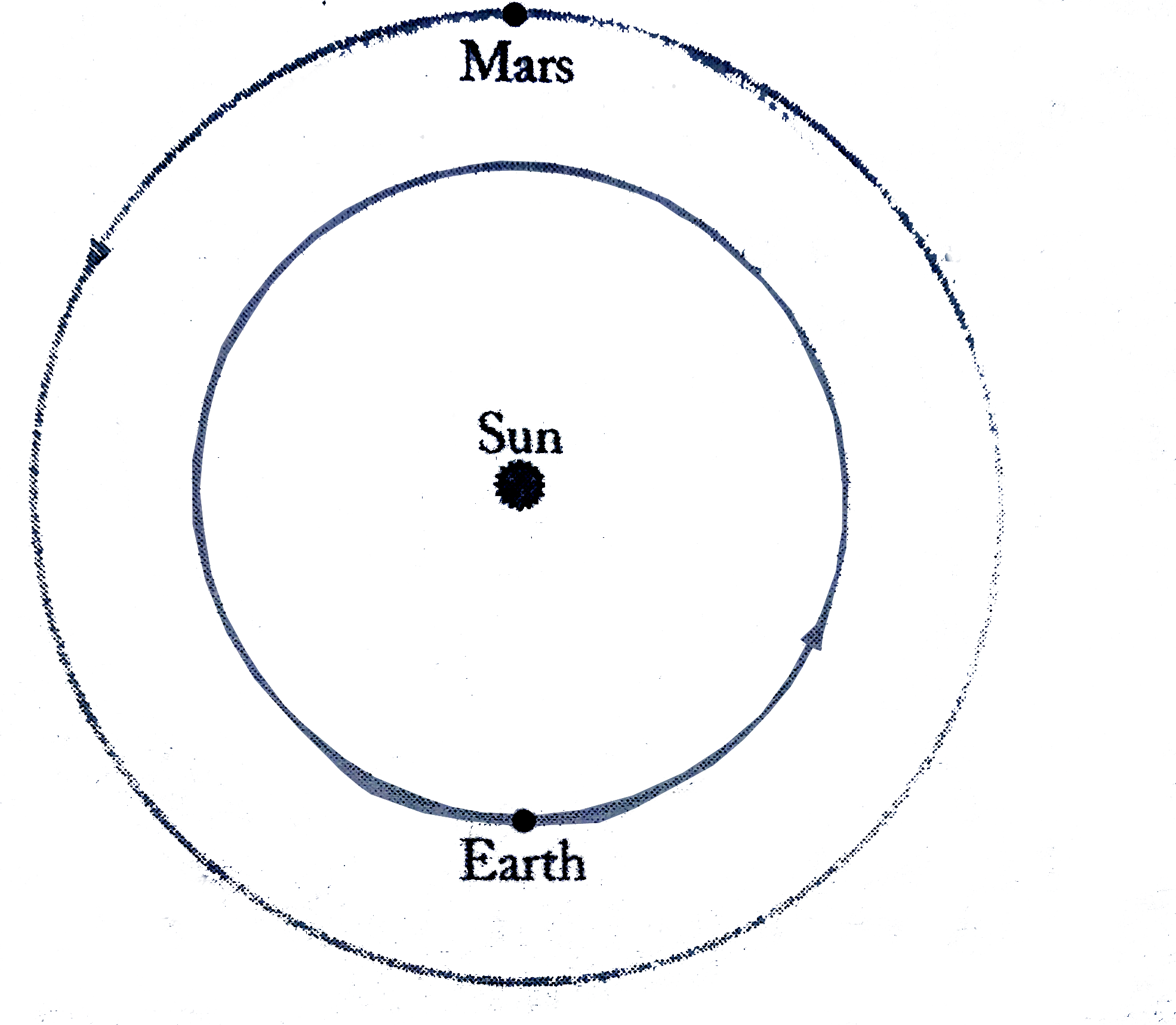
The Earth has a circular orbit of radius r and period t around the sum, Mars has a circular orbit of radius R and period T. In order to send a spacecraft from the Earth to Mars, it is convenient to launch the spacecraft inot an elliptical orbit whose perihelion coincides with the orbit of the Earth and whose aphelion coincides with the orbit of Mars, this orbit requires the least amount of energy for a trip to Mars. The time t' taken by a spacecraft to reach Mars from the Earth satisfies:

A

`t' = (t + T)//2`

B

`t'^(2) = (t^(2) + T^(2))//2`

C

`t'^(2//3) = (t^(2//3) + T^(2//3))//2`

D

`(2t)^(2//3) = (t^(2///3) + T^(2//3))//2`

Text Solution

Verified by Experts

The correct Answer is:

D

Use Kepler's Law of Periods
Promotional Banner

Similar Questions

Explore conceptually related problems

The period of a satellite in a circular orbit of radius R is T. What is the period of another satellite in a circular orbit of radius 4 R ?

A satellite is orbiting the earth in a circular orbit of radius r . Its

A satellite is revolving round the earth in circular orbit

A satellite is revolving round the earth in circular orbit

In order to shift a body of mass m from a circular orbit of radius 3R to a higher orbit of radius 5R around the earth, the work done is

A satellite is launched into a circular orbit of radius R around the earth. A second satellite is launched into an orbit of radius (1.02)R. The period of the second satellite is larger than the first one by approximately

A satellite is launched into a circular orbit of radius R around the earth. A second satellite is launched into an orbit of radius (1.01) R. The period of the second satellite is larger than the first one by approximately

A satellite is orbiting the Earth in a circular orbit of radius R. Which one of the following statement it is true?

If L is the angular momentum of a satellite revolving around earth is a circular orbit of radius r with speed v , then

Consider a planet moving around a star in an elliptical orbit with period T. Area of elliptical orbit is proportional to
