Home
Class 12
PHYSICS
Two strings A and B of equal lenth but u...

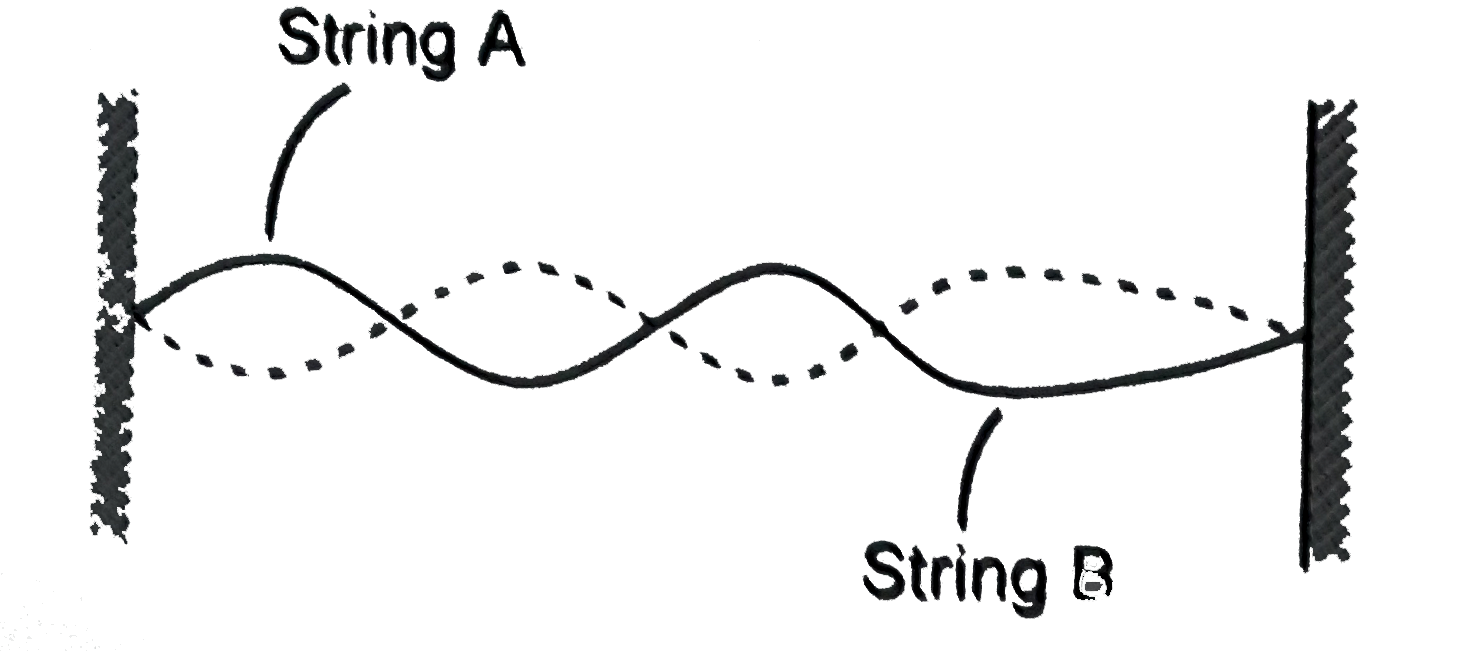
Two strings A and B of equal lenth but un equal linear mass density are tied together with a knot and stretched between two supports. A particular frquency happens to produce a standing wave on each part, with node at the knot as shown. If linear mass density of the two strings A and B are `mu_(1)` and `mu_(2)` respectively, then

A

`mu_(1) = mu_(1)`

B

`mu_(1) lt mu_(2)`

C

`mu_(1) gt mu_(2)`

D

can't be decided

Text Solution

Verified by Experts

The correct Answer is:
C

`f_(1) = f_(2)`
`D_(1) lt D_(2)`
`C = fD`
`:. C_(1) lt C_(2)`
but `C = sqrt((T)/(mu))`
`:. Mu_(1) gt mu_(2)`
Promotional Banner

Similar Questions

Explore conceptually related problems

Two balls, each of radius R, equal mass and density are placed in contact, then the force of gravitation between them is proportional to

Two balls, each of radius R, equal mass and density are placed in contact, then the force of gravitation between them is proportional to

Two strings, A and B , of lengths 4L and L respectively and same mass M each, are tied together to form a knot 'O' and stretched under the same tension. A transverse wave puise is sent along the composite string from the side A , as shown to the right. Which of the following diagrams correctly shows the reflected and transmitted waves pulses near the knot 'O' ?

If equal masses of two liquids of densities d_(1) and d_(2) are mixed together, the density of the mixture is

Two long strings A and B, each having linear mass density 1.2×10⁻²kgm−1, are stretched by different tensions 4.8 N and 7.5 N respectively and are kept parallel to each other with their left ends at x = 0. Wave pulses are produced on the strings at the left ends at t = 0 on string A and at t = 20 ms on string B. When and where will the pulse on B overtake that on A ?

Blocks A and B shown in the figure are having equal masses m. The system is released from rest with the spring unstretched. The string between A and ground is cut, when there is maximum extension in the spring. The acceleration of centre of mass of the two blocks at this instant is

Two wires of different linear mass densities are soldered together end to end and then stretched under a tension F . The wave speed in the first wire is thrice that in the second. If a harmonic wave travelling in the first wire is incident on the junction of the wires and if the amplitude of the incident wave is A = sqrt(13) cm , find the amplitude of reflected wave.

A sting of length 1m and linear mass density 0.01 kg//m is stretched to a tension of 100 N. When both ends of the string are fixed, the three lowest frequencies for standing wave are f_1, f_2 and f_3 . When only one end of the string is fixed, the three lowest frequencies for standing wave are n_1, n_2 and n_3 . Then,

What is the ratio of the escape velcoities from two planets of equal densities but different masses M_(1) and M_(2) ?

Two strings of the same length but different mass per unit length are used to suspend a rod whose density varies as rho=rho_(0)[1+alphax] as shown in the figure. The frequency of standing waves produced in the string is in the ratio n : 1 , when both the strings are vibrating in their fundamental mode. If the mass per unit length of string (l) is mu_(0) , calculate the mass per unit length of the other string.

