Home
Class 12
PHYSICS
Figure shown variation of magnetic field...

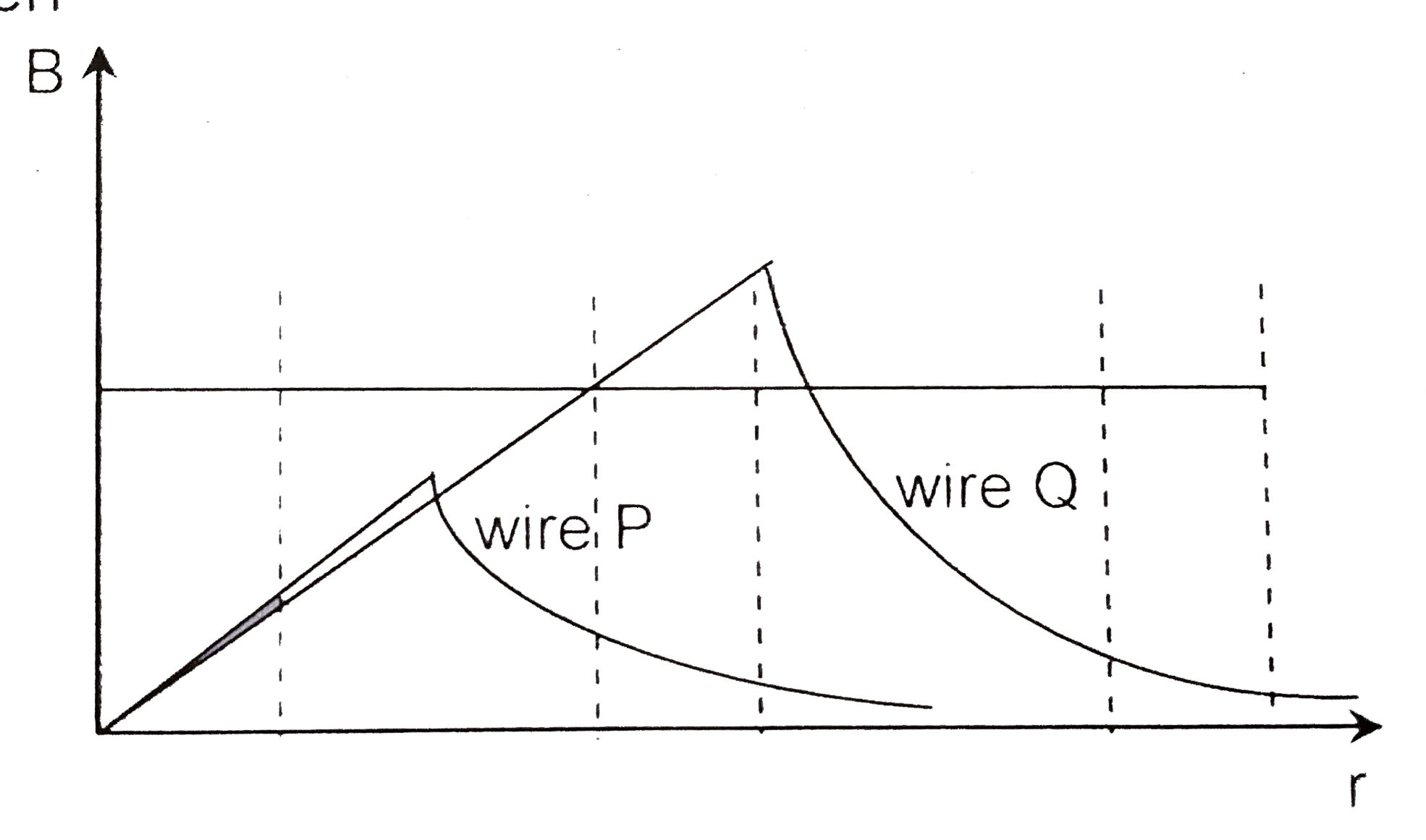
Figure shown variation of magnetic field inside and outside two cylindrical wires P and Q carrying currents that are uniformly distributed across the cross section of wires. If current density for two wires are `J_(P)` and `J_(Q)` then

A

`J_(P) = J_(Q)`

B

`J_(P) lt J_(Q)`

C

`J_(P) gt J_(Q)`

D

can't be decided

Text Solution

Verified by Experts

The correct Answer is:

C

At the surface of a current carrying wire
`B = (1)/(2)mu_(o) Jr`
`J prop (B)/(r )`
`:.` as slope of wire `P gt` slope of wire Q
Promotional Banner

Similar Questions

Explore conceptually related problems

Curves in the graph shown in Fig. give, as function of radius distance r, the magnitude B of the magnetic field inside and outside four long wire a,b,c and d, carrying currents that are uniformly distributed across the cross sections of the wires. Overlapping portions of the plots are indicated by double labels. The current density in wire a is

Curves in the graph shown in Fig. give, as function of radius distance r, the magnitude B of the magnetic field inside and outside four long wire a,b,c and d, carrying currents that are uniformly distributed across the cross sections of the wires. Overlapping portions of the plots are indicated by double labels. Which wire has the greatest radius?

Curves in the graph shown in Fig. give, as function of radius distance r, the magnitude B of the magnetic field inside and outside four long wire a,b,c and d, carrying currents that are uniformly distributed across the cross sections of the wires. Overlapping portions of the plots are indicated by double labels. Which wire has the greatest radius?

Curves in the graph shown in Fig. give, as function of radius distance r, the magnitude B of the magnetic field inside and outside four long wire a,b,c and d, carrying currents that are uniformly distributed across the cross sections of the wires. Overlapping portions of the plots are indicated by double labels. The current density in wire a is A. greater than in wire c . B. less than in wire c . C. equal to that in wire c . D. not comparable to that of in wire c due to lack of information

Curves in the graph shown in Fig. give, as function of radius distance r, the magnitude B of the magnetic field inside and outside four long wire a,b,c and d, carrying currents that are uniformly distributed across the cross sections of the wires. Overlapping portions of the plots are indicated by double labels. which wire has the greatest magnitude of the magnetic field on the surface?

Curves in the graph shown in Fig. give, as function of radius distance r, the magnitude B of the magnetic field inside and outside four long wire a,b,c and d, carrying currents that are uniformly distributed across the cross sections of the wires. Overlapping portions of the plots are indicated by double labels. Which wire has the greatest radius? A. a B. b C. c D. d

A cylindrical long wire of radius R carries a current I uniformly distributed over the cross sectional area of the wire. The magnetic field at a distance x from the surface inside the wire is

A uniform current I is flowing in a long wire of radius R . If the current is uniformly distributed across the cross-sectional area of the wire, then

A long straight wire of radius a carries a steady current i . The current is uniformly distributed across its cross section. The ratio of the magnetis field at (a)//(2) and (2a) is

Figure shows a long straight wire of a circular cross-section (radius a) carrying steady current l. The current l is uniformly distributed across this cross-section. Calculate the magnetic field in the region r lt a and r gt a
