Home
Class 12
PHYSICS
A capacitor is made of two concentric sp...

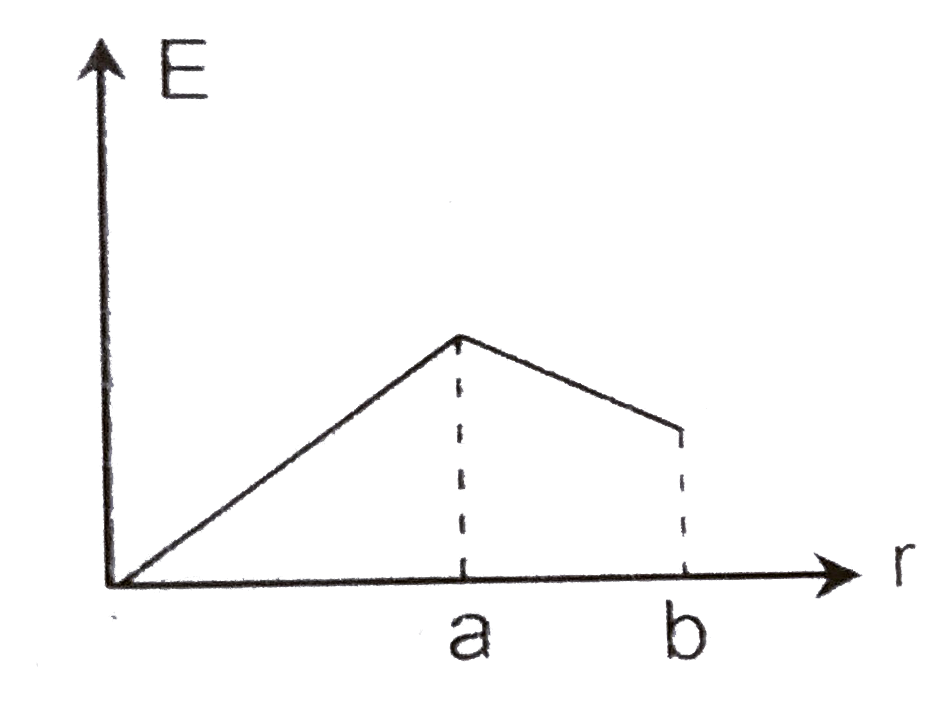
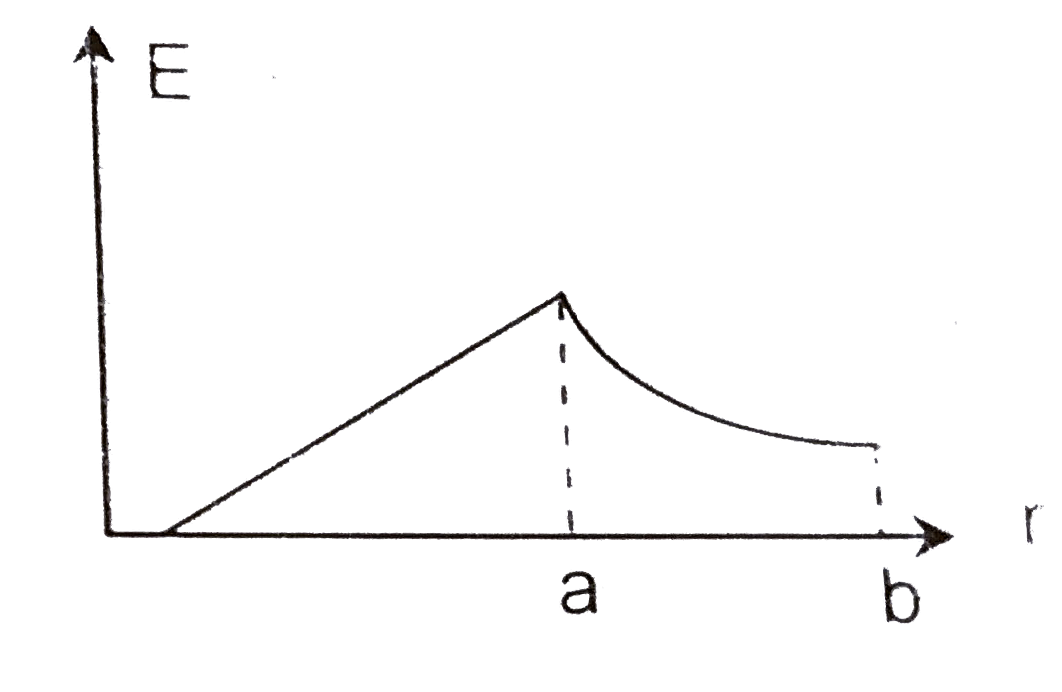
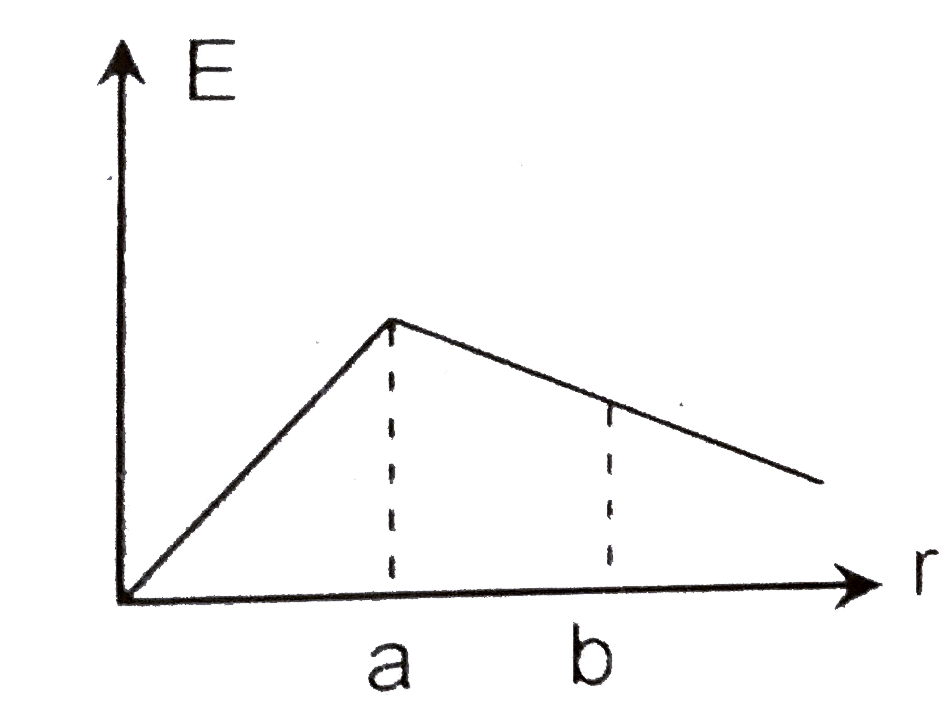
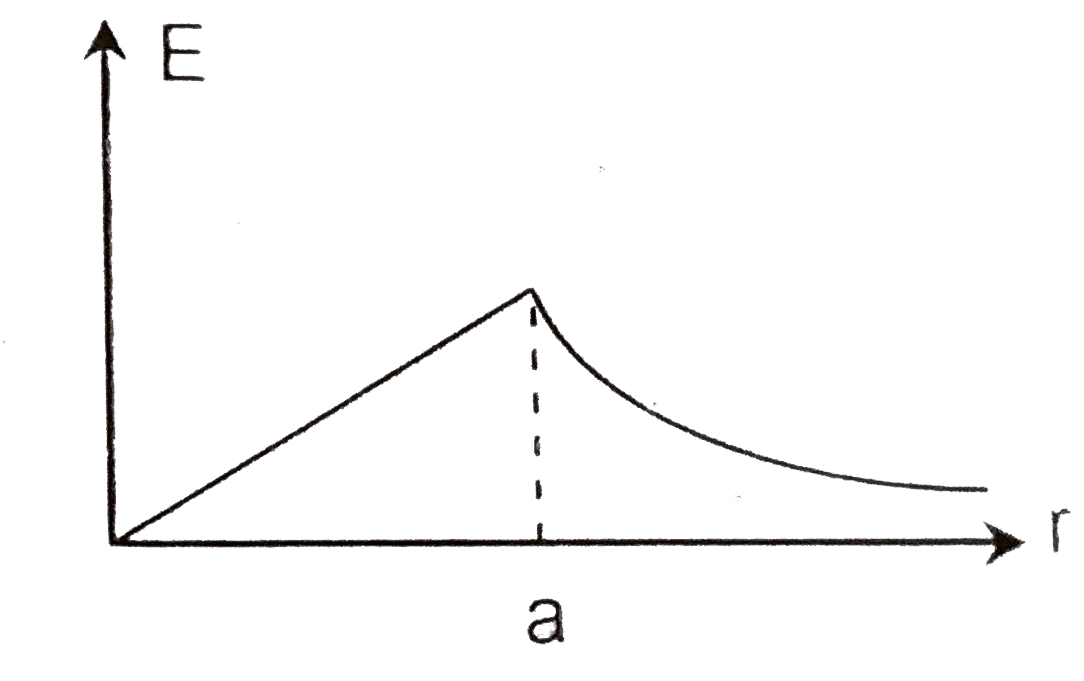
A capacitor is made of two concentric spherical shells A and B of radii a and b respectively. Where `a lt b`. The external shell B is grounded `(V_(B) = 0)` Inner shel i.e `(r le a )` is filled with a uniform positive charge of density `rho`. Variation of electric field versus distance from the centre.

A

B

C

D

Text Solution

AI Generated Solution

The correct Answer is:

To solve the problem of finding the variation of the electric field versus distance from the center for the given capacitor made of two concentric spherical shells, we can follow these steps: ### Step-by-Step Solution: 1. **Understanding the Configuration**: - We have two concentric spherical shells: inner shell A with radius \( a \) and outer shell B with radius \( b \). - The outer shell B is grounded, meaning its potential \( V_B = 0 \). - The inner shell A is filled with a uniform positive charge density \( \rho \). 2. **Applying Gauss's Law**: - To find the electric field \( E \) at a distance \( r \) from the center, we can use Gauss's law, which states: \[ \oint \mathbf{E} \cdot d\mathbf{A} = \frac{Q_{\text{enc}}}{\epsilon_0} \] - Here, \( Q_{\text{enc}} \) is the charge enclosed by a Gaussian surface of radius \( r \). 3. **Case 1: Inside the Inner Shell ( \( r < a \) )**: - For \( r < a \), there is no charge enclosed within this Gaussian surface, so: \[ Q_{\text{enc}} = 0 \implies E = 0 \] 4. **Case 2: Within the Inner Shell ( \( a \leq r < b \) )**: - For \( a \leq r < b \), we need to calculate the charge enclosed within a sphere of radius \( r \): \[ Q_{\text{enc}} = \rho \cdot \text{Volume of sphere with radius } r = \rho \cdot \frac{4}{3} \pi r^3 \] - Applying Gauss's law: \[ E \cdot 4 \pi r^2 = \frac{\rho \cdot \frac{4}{3} \pi r^3}{\epsilon_0} \] - Simplifying this gives: \[ E = \frac{\rho r}{3 \epsilon_0} \] 5. **Case 3: Outside the Outer Shell ( \( r \geq b \) )**: - For \( r \geq b \), since the outer shell B is grounded, the electric field outside the shell will be zero: \[ E = 0 \] 6. **Summary of Electric Field Variation**: - For \( r < a \): \( E = 0 \) - For \( a \leq r < b \): \( E = \frac{\rho r}{3 \epsilon_0} \) (linear increase with \( r \)) - For \( r \geq b \): \( E = 0 \) ### Final Result: The electric field \( E \) varies as follows: - \( E = 0 \) for \( r < a \) - \( E = \frac{\rho r}{3 \epsilon_0} \) for \( a \leq r < b \) - \( E = 0 \) for \( r \geq b \)

To solve the problem of finding the variation of the electric field versus distance from the center for the given capacitor made of two concentric spherical shells, we can follow these steps: ### Step-by-Step Solution: 1. **Understanding the Configuration**: - We have two concentric spherical shells: inner shell A with radius \( a \) and outer shell B with radius \( b \). - The outer shell B is grounded, meaning its potential \( V_B = 0 \). - The inner shell A is filled with a uniform positive charge density \( \rho \). ...
Promotional Banner

Similar Questions

Explore conceptually related problems

The equivalent capacitance between A and B, where two concentric spherical shells having radius a and b are connected as shown in the figure.

A sphercial capacitor is made of two conducting spherical shells of radii a and b.The space between the shells is filled with a dielectric constant K up to a radius c as shown in figure. Calculate the capacitance .

Figure shows three concentric thin spherical shells A, B and C of radii a, b, and c. The shells A and C are given charge q and -q, respectively, and shell B is earthed. Then,

A and B are two concentric spherical shells. If A is given a charge +q while B is earthed as shown in figure then

A and B are two concentric spherical shells. If A is given a charge +Q while B is earthed as shown in figure then

Figure shows a system of three concentric metal shells, A, B and C with radii a, 2a and 3a respectively. Shell B is earthed and shell C is given a charge Q. Now if shell C is connected to shell A, then find the final charge on the shell B

Four concentric conducting spherical shells A, B, C and D of radii a, 2a, 3a and 4a respectively. Shell B and D are given charges q and -q respectively. If shell C is grounded then potential difference (VA — VC) is

There are two concentric metallic spherical shells of radii a and b such that a < b. An ideal cell of emf is connected across the two shells. The medium between the sheets is filled with a dielectric of dielectric constant and resistivity p. For a point P at a distance from the common centre C where a < r< b. Now choose INCORRECT option.

Figure shows three concentric thin spherical shells A, B and C of radii a, b and c respectively. The shells A and C are given charges q and -q respectively and the shell B is earthed. Find the charges appearing on the surfaces of B and C.

Figure shows three concentric thin spherical shells A, B and C of radii a, b and c respectively. The shells A and C are given charges q and -q respectively and the shell B is earthed. Find the charges appearing on the surfaces of B and C.
