Home
Class 12
PHYSICS
A hollow circular tube of radius R and n...

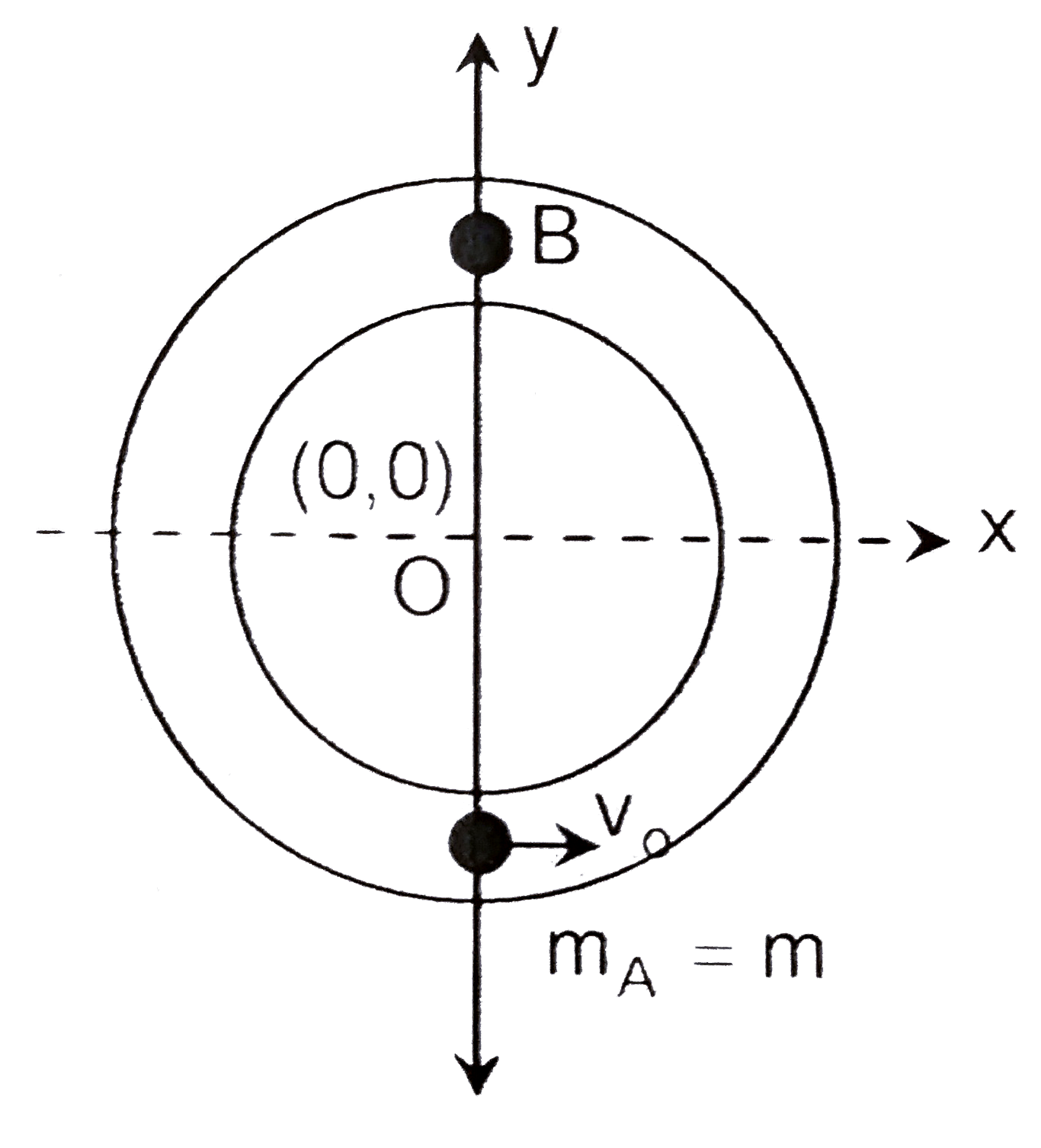
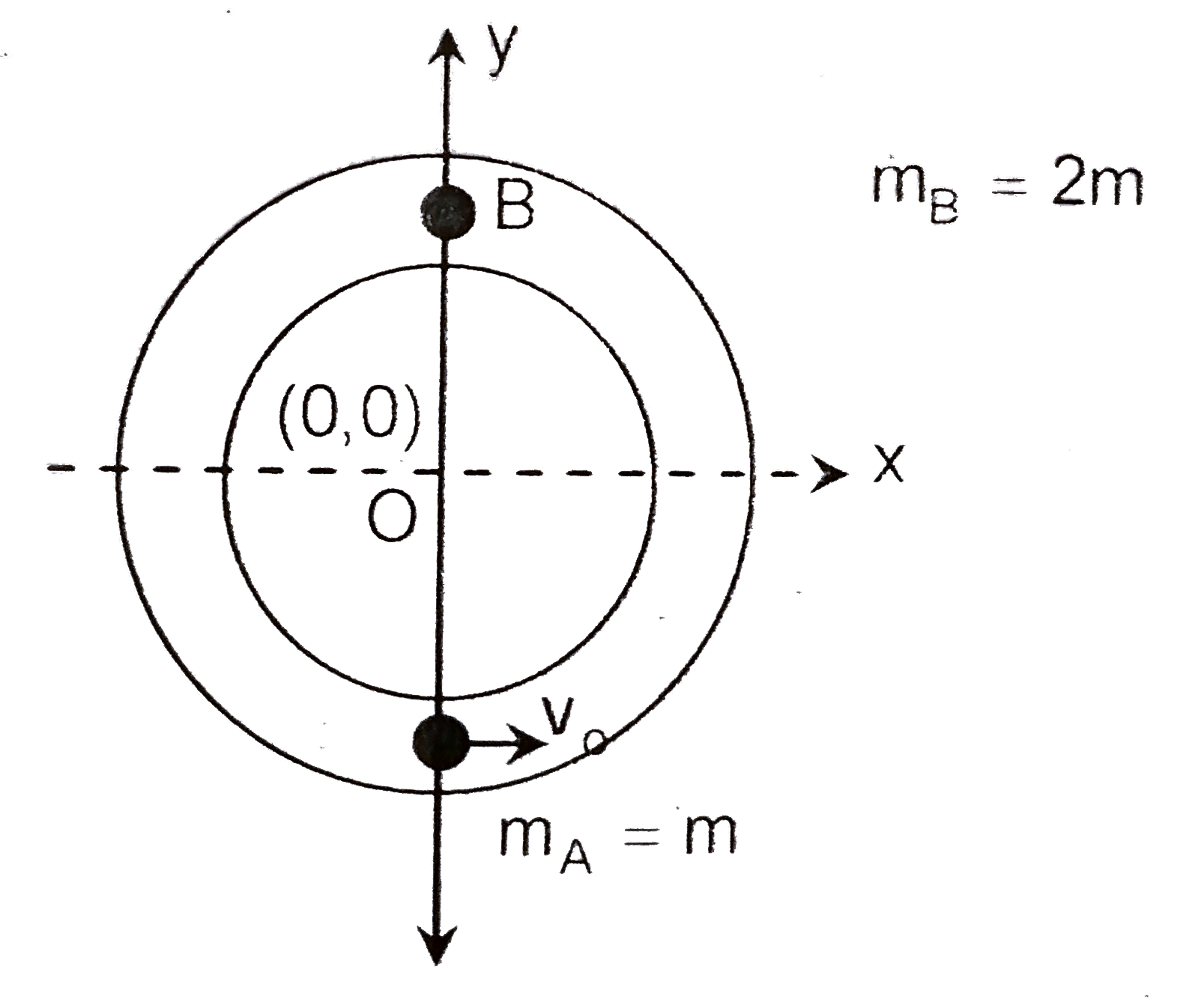
A hollow circular tube of radius R and negligible internal diameter is fixed on horizontal surface ball A of mas m is given velocity `v_(o)` in the shown direction. It collides with ball B of mass `2 m`. Collision is perfectly elastic. If centre of loop is origin of co-ordinates system, then co-ordinate of next collision is

A

`((sqrt3)/(2)R, (- R)/(2))`

B

`((- sqrt3)/(2)R, (R )/(2))`

C

`((R )/(2), (- sqrt3)/(2)R)`

D

`((R )/(2), (R )/(2))`

Text Solution

Verified by Experts

The correct Answer is:
C

`-mv_(o) + o = mv_(1) + 2mv_(2)`
`-v_(o) = v_(1) + 2v_(2)`….(i) & `e = (v_(2) - v_(1))/(-v_(o)) = 1`
`:. V_(2) - v_(1) = -v_(o)`…. (ii) from (i) & (ii) `v_(1) = (v_(o))/(3), v_(2) = (-2v_(o))/(3)`
`:. T = (2piR)/(v_(o))`
Angle rotated by by `A = (2pi)/(3)`, Angle rotated by `B = (4pi)/(3)`rad.
Promotional Banner

Similar Questions

Explore conceptually related problems

Two identical balls, each of mass m , are tied with a string and kept on a frictionless surface. Initially, the string is slack. They are given velocities 2u and u . in the same direction. Collision between the balls is perfectly elastic. What is the impulse generated in the string during the first collision?

Two identical balls, each of mass m , are tied with a string and kept on a frictionless surface. Initially, the string is slack. They are given velocities 2u and u . in the same direction. Collision between the balls is perfectly elastic. After the first collision, what is the total loss in kinetic energy of the balls?

A ball of mass m is dropped onto a smooth fixed wedge of inclination theta The collision is perfectly elastic . If after the collision, the x component of the velocity of the block is sqrt(2 gh) , then theta is

Two identical balls, each of mass m , are tied with a string and kept on a frictionless surface. Initially, the string is slack. They are given velocities 2u and u . in the same direction. Collision between the balls is perfectly elastic. What is the final loss in kinetic energy of the balls?

A ball of mass m moving with velocity v collides head on elastically with another identical ball moving with velocity - V. After collision

A particle A of mass m and initial velocity v collides with a particle of mass m//2 which is at rest. The collision is head on, and elastic. The ratio of the de-broglie wavelength lambda_(A) and lambda_(B) after the collision is

A point mass m collides with a disc of mass m and radius R resting on a rough horizontal surface as shown . Its collision is perfectly elastic. Find angular velocity of the disc after pure rolling starts

Two balls A and B each of mass m are placed on a smooth ground as shown in the figure. Another ball C of mass M arranged to the right of ball B as shown. If a velocity v_(1) is given to ball A in rightward direction, consider two cases. Case-I M gt m and case-II M lt m . Take all the collisions perfectly elastic ( e = 1 ), find the number of collision in case-I and case-II.

A ball of mass m moving with velocity v collides head-on which the second ball of mass m at rest. I the coefficient of restitution is e and velocity of first ball after collision is v_(1) and velocity of second ball after collision is v_(2) then

A ball of mass m moving with velocity u collides head-on which the second ball of mass m at rest. If the coefficient of restitution is e and velocity of first ball after collision is v_(1) and velocity of second ball after collision is v_(2) then

