Home
Class 12
PHYSICS
An ideal mono atomic gas is taken throug...

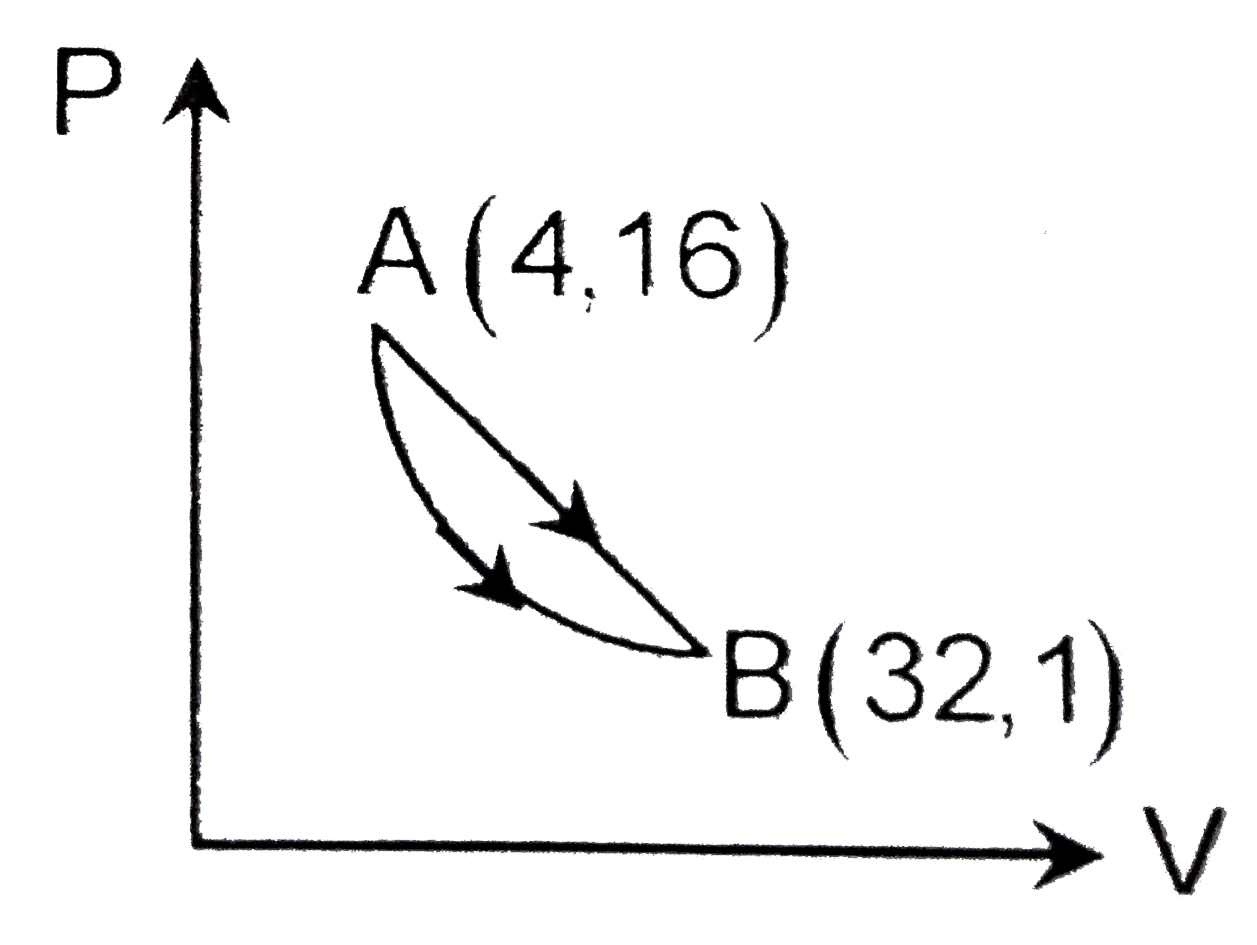
An ideal mono atomic gas is taken through the cyclic process shown in fig. Linear expansion from A to B following by adiabatic compression back to original state

A

Efficiency of cyclic process is zero

B

During process A to B heat is released only

C

During process A to B heat is absorbed only

D

During linear process heat enters and leaves the process

Text Solution

Verified by Experts

The correct Answer is:

D

Since `P_(1)V_(1) gt P_(2)V_(V) rArr T_(A) gt T_(B)` work done is `+ve` and efficiency is positive quantity
`eta = ("work done")/("Heat given") = 1 - (Q_("released"))/(Q_("absorbed"))`
Therefore there must be some heat absorbed in the process. During adiabatic process `DeltaQ = 0`, therefore during linear process heat will entre and leaves system at different times.
Promotional Banner

Similar Questions

Explore conceptually related problems

Ideal gas is taken through the process shown in the figure :

Ideal gas is taken through the process shown in the figure :

One mole of an ideal monoatomic gas is taken through a cyclic process as shown. Choose the correct option(s).

One mole of a monoatomic ideal gas is taken through the cycle shown in Fig: AtoB : adiabatic expansion BtoC : cooling at constant volume CtoD : adiabatic compression DtoA : heating at constant volume The pressure and temperature at A,B,etc. are denoted by P_A, T_A,P_B,T_B etc. respectively. Given that T_A=1000K , P_B=(2//3)P_A and P_C=(1//3)P_A , calculate the following quantities: (i) The work done by the gas in the process AtoB (ii) The heat lost by the gas in the process BtoC . (iii) The temperature T_D . [Given : (2//3)^(2//5)=0.85 ]

One mole of a monatomic ideal gas is taken through the cycle shown in the figure: A to B adiabatic expansion B to C: cooling at constant volume C to D adiabatic compression D to C: heating at constant volume. The pressure and temperature at P_A, P_B etc. T_A , T_B etc. are denoted etc. respectively. Given that T_A = 1000 K, P_B =(2 //3)P_A and P_C = (t //3)P_A Calculate the following quantities. The heat lost by the gas in process B to C (in J)

One mole of a monatomic ideal gas is taken through the cycle shown in the figure: A to B adiabatic expansion B to C: cooling at constant volume C to D adiabatic compression D to C: heating at constant volume. The pressure and temperature at P_A, P_B etc. T_A , T_B etc. are denoted etc. respectively. Given that T_A = 1000 K, P_B =(2 //3)P_A and P_C = (1 //3)P_A Calculate the following quantities. The work done by the gas in process A to B (in J)

One mole of an ideal mono-atomic gas is taken round cyclic process ABC as shown in figure below. Calculate work done

One mole of an ideal mono-atomic gas is taken round cyclic process ABC as shown in figure below. Calculate work done

One mole of a diatomic ideal gas (gamma=1.4) is taken through a cyclic process starting from point A. The process AtoB is an adiabatic compression, BtoC is isobaric expansion, CtoD is an adiabatic expansion, and DtoA is isochoric. The volume ratios are V_A//V_B=16 and V_C//V_B=2 and the temperature at A is T_A=300K . Calculate the temperature of the gas at the points B and D and find the efficiency of the cycle.

One mole of an ideal mono-atomic gas is taken round cyclic process ABCD as shown in figure below. Calculate work done by the gas.
