Home
Class 12
PHYSICS
A conducting rod of mass 50 gm and lengt...

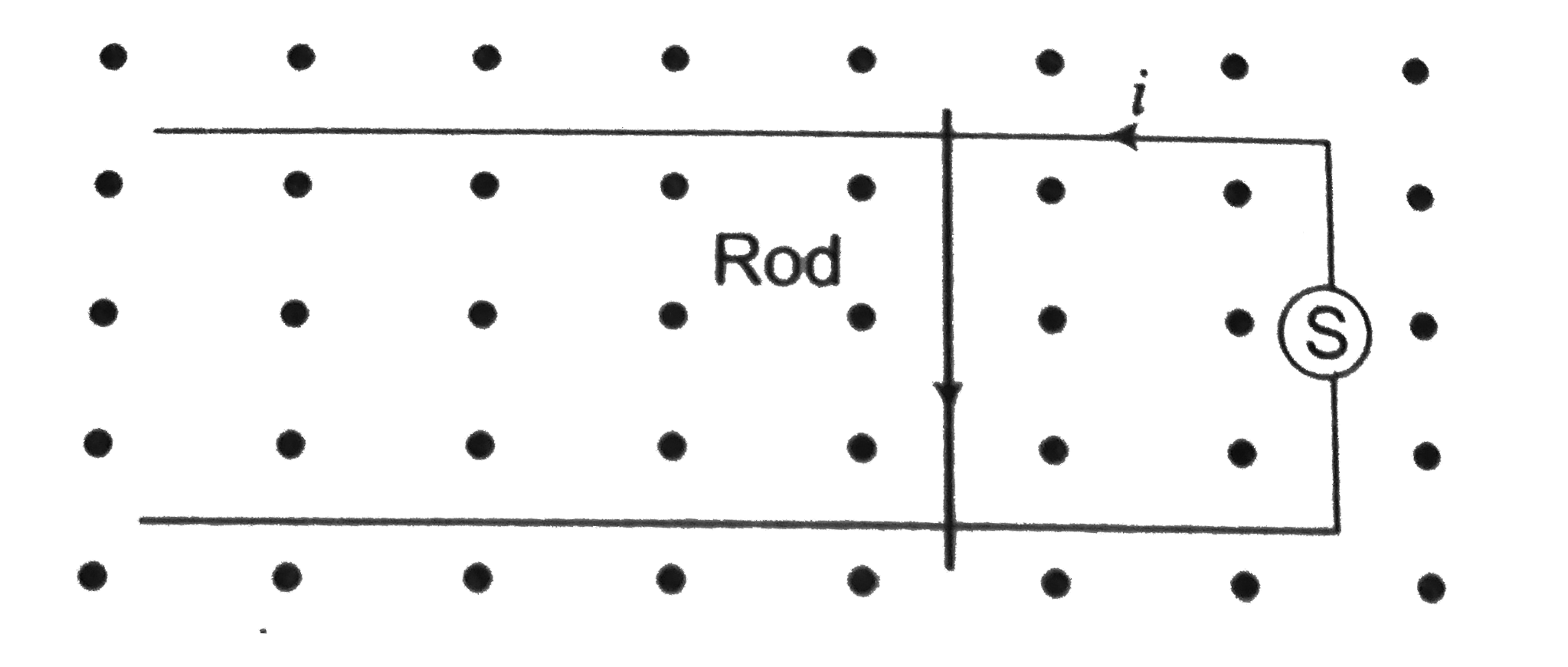
A conducting rod of mass `50 gm` and length `10 cm` can slide without friction on two long, horizontal rails. A uniform magnetic field of magnitude `5 mT` exists in the region as shown. A source `S` is used to maintain a constant current `2 A` through the rod. If motion of the rod starts from the rest, its speed after `10 s` from the start of the motion will be

A

`2 cm//s`

B

`8 cm//s`

C

`12 cm//s`

D

`20 cm//s`

Text Solution

Verified by Experts

The correct Answer is:

D

`a = (iBl)/(m)`
and `v = ((iBl)/(m)) t`
`:. V = 20 cm//s`
Promotional Banner

Similar Questions

Explore conceptually related problems

A conducting rod of mass 200 gm and length 10 cm can slide without friction on two long, horizontal rails. A uniform magnetic field of magnitude 5 m T exists in the region as shown. A source S is used to maintain a constant current 2 A through the rod. If motion of the rod starts from the rest, find its speed (in cm/s) after 10 s from the start of the motion

A conducting wire of length l and mass m can slide without friction on two parallel rails and is connected to capacitance C . Whole system lies in a magnetic field B and a constant force F is applied to the rod. Then

A conducting wire of length l and mass m can slide without friction on two parallel rails and is connected to capacitance C . The whole system lies in amagnetic field B and a constant force F is applied to the rod . Then

A 20 cm long conducting rod is set into pure translation with a uniform velocity of 10cm s ^(-1) perpendicular to its length. A uniform magnetic field of magnitude 0.10 T exists in a direction perpendicular to the plane of motion. Find emf developed in the rod.

Two identical conductors P and Q are placed on two friction less rails R and S in a uniform magnetic field directed into the plane. If P is moved in the direction shown in figure with a constant speed, then rod Q

A conducting rod of resistance r moves uniformly with a constant speed v in a uniform magnetic field. If the rod keeps moving uniformly, then the amount of force required is

A small conducting rod of length l, moves with a uniform velocity v in a uniform magnetic field B as shown in fig __

Two long parallel horizontal rails a, a distance d aprt and each having a risistance lambda per unit length are joing at one end by a resistance R. A perfectly conduction rod MN of mass m is free to slide along the rails without friction (see figure). There is a uniform magnetic field of induction B normal to the plane of the paper and directed into the paper. A variable force F is applied to the rod MN such that, as the rod moves a constant current flows through R. (i) Find the velocity of the rod and the applied force F as function of the distance x of the rod from R. (ii) What fraction of the work done per second by F is converted into heat?

A rod of mass m , length l and resistance R is sliding down on a smooth inclined parallel rails with a cinstant velocity v . If a uniform horizontal magnetic field B exists, then find thevalue of B .

A conducting wire of length l is placed on a rough horizontal surface, where a uniform horizontal magnetic field B perpendicular to the length of the wire exists. Least values of the forces required to move the rod when a current I is established in the rod are observed to be F_1 and F_2 (lt F_1) for the two possible directions of the current through the rod, respectively. Find the weight of the rod and the coefficient of friction between the rod and the surface.
