Home
Class 12
PHYSICS
Choose the correct option: A particle o...

Choose the correct option:
A particle of charge per unit mass `alpha` is released from origin with a velocity `vecv=v_(0)hati` in a magnetic field
`vec(B)=-B_(0)hatk` for `xle(sqrt(3))/2 (v_(0))/(B_(0)alpha)`
and `vec(B)=0` for `xgt(sqrt(3))/2 (v_(0))/(B_(0)alpha)`
The `x`-coordinate of the particle at time `t((pi)/(3B_(0)alpha))` would be

A

`(sqrt3)/(2) (v_(o))/(B_(o)alpha) + (sqrt3)/(2)v_(o) (t - (pi)/(B_(o)alpha))`

B

`(sqrt3)/(2) (v_(o))/(B_(o)alpha) + v_(o) (t - (pi)/(3B_(o)alpha))`

C

`(sqrt3)/(2) (v_(o))/(B_(o)alpha) + (v_(o))/(2) (t - (pi)/(3B_(o)alpha))`

D

`(sqrt3)/(2) (v_(o))/(B_(o)alpha) + (v_(o)t)/(2)`

Text Solution

Verified by Experts

The correct Answer is:
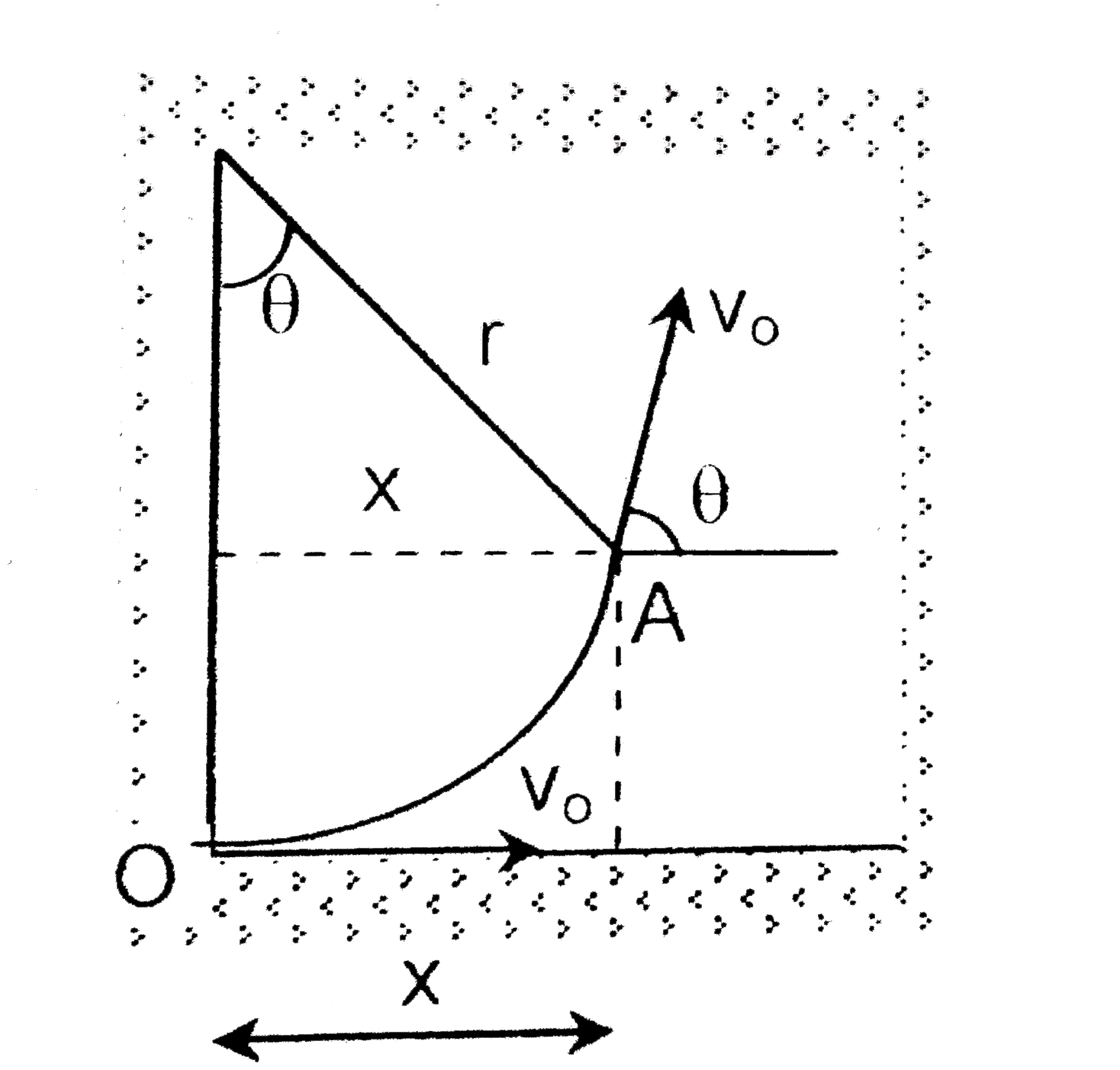
C

`r = (mv_(o))/(B_(o)q) = (v_(o))/(B_(o)alpha)`
`(x)/(r ) = (sqrt3)/(2) = sin theta :. theta = 60^(@)`
`t_(oA) = (T)/(6) = (pi)/(3B_(o)alpha)` Therefore `x -` coordinate of particle at any time `t gt (pi)/(3B_(o)alpha)` will be
`x = (sqrt3)/(2) (v_(o))/(B_(o)alpha) + v_(o) (t - (pi)/(3B_(o)alpha)) cos 60^(@) So x = ((sqrt3)/(2) (v_(o))/(B_(o)alpha)) + (v_(o))/(2) (t - (pi)/(3B_(o)alpha))`
Promotional Banner

Similar Questions

Explore conceptually related problems

A particle of charge per unit mass alpha is released from origin with a velocity vecv=v_(0)hati uniform magnetic field vecB=-B_(0)hatk . If the particle passes through (0,y,0) , then y is equal to

A charged particle (q.m) released from origin with velocity v=v_(0)hati in a uniform magnetic field B=(B_(0))/(2)hati+(sqrt3B_(0))/(2)hatJ . Z-component of velocity is (sqrt3v_(0))/(2) after in t=……….

A charged particle (q.m) released from origin with velocity v=v_(0)hati in a uniform magnetic field B=(B_(0))/(2)hati+(sqrt3B_(0))/(2)hatJ . Maximum z-coordinate of the particle is

A particle of charge per unit mass alpha is released from the origin with velocity v=v_(0)hati in the magnetic field vecB=-B_(0)hatk for A cup of tea cools from 80^(@)C" to "60^(@)C in 40 seconds. The ambient temperature is 30^(@)C . In cooling from 60^(@)C" to "50^(@)C , it will take time: x le (sqrt3)/(2)(v_(0))/(B_(0)alpha) and vecB=0" for "x gt (sqrt3)/(2)(v_(0))/(B_(0)alpha) The x - coordinate of the particle at time t(gt(pi)/(3B_(0)alpha)) would be

An electron is moving with an initial velocity vecv=v_(0)hati and is in a magnetic field vecB=B_(0)hatj . Then it's de-Broglie wavelength

An electron is moving with an initial velocity vecv=v_(0)hati and is in a magnetic field vecB=B_(0)hatj . Then it's de-Broglie wavelength

A charge praticule of sepeific charge (charge/ mass ) alpha is realsed from origin at time t=0 with velocity v= v_(0)(hati+hatj) in unifrom magnetic fields B= B_(0)hati . Co-ordinaties of the particle at time t = (pi)/(B_(0)alpha) are

A charged particle of specific charge alpha moves with a velocity vecv=v_0hati in a magnetic field vecB=(B_0)/(sqrt2)(hatj+hatk) . Then (specific charge=charge per unit mass)

A charged particle (q.m) released from origin with velocity v=v_(0)hati in a uniform magnetic field B=(B_(0))/(2)hati+(sqrt3B_(0))/(2)hatJ . Pitch of the helical path described by the particle is

A particle of charge q, mass starts moving from origin under the action of an electric field vecE=E_(0)hati and magnetic field vecB=B_(0)hatk . Its velocity at (x,0,0) is v_(0)(6hati+8hatj) . The value of x is

