Home
Class 12
PHYSICS
An elastic ball of mass 'm' is suspended...

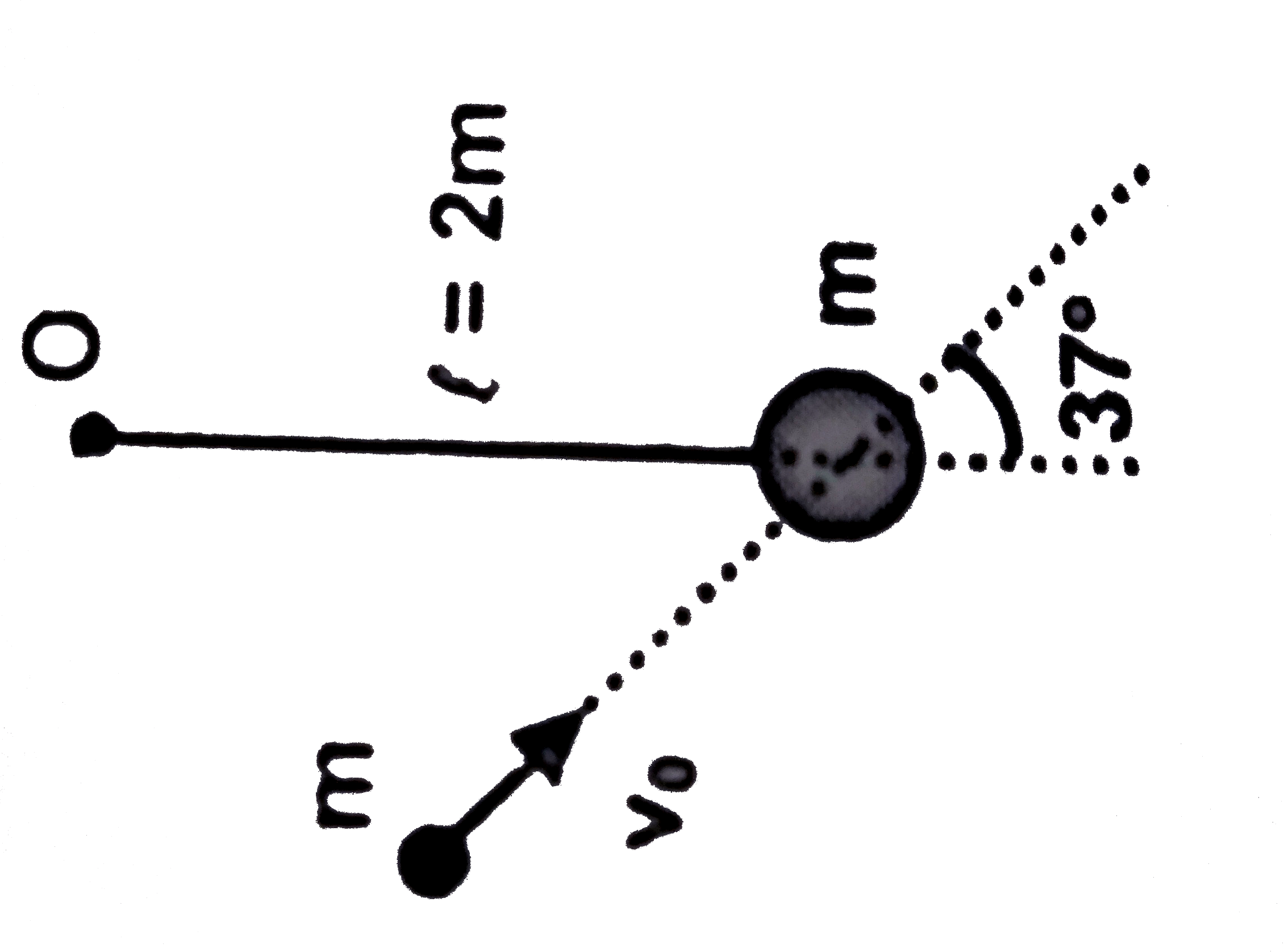
An elastic ball of mass 'm' is suspended from a fixed point 'O' by an inextensible string of length `2m`. A small particle of mass m moving downward at angle of `37^(@)` with the vertical hits the ball with `v_(0)`. The coefficient of restitution for collision is `4//5`. the velocity of the particle `v_(0)` such that ball just comoplete on revolution after the collision.

A

`(170)/(27) m//s`

B

`(85)/(27) m//s`

C

`(680)/(27) m//s`

D

`(340)/(27) m//s`

Text Solution

Verified by Experts

The correct Answer is:
D

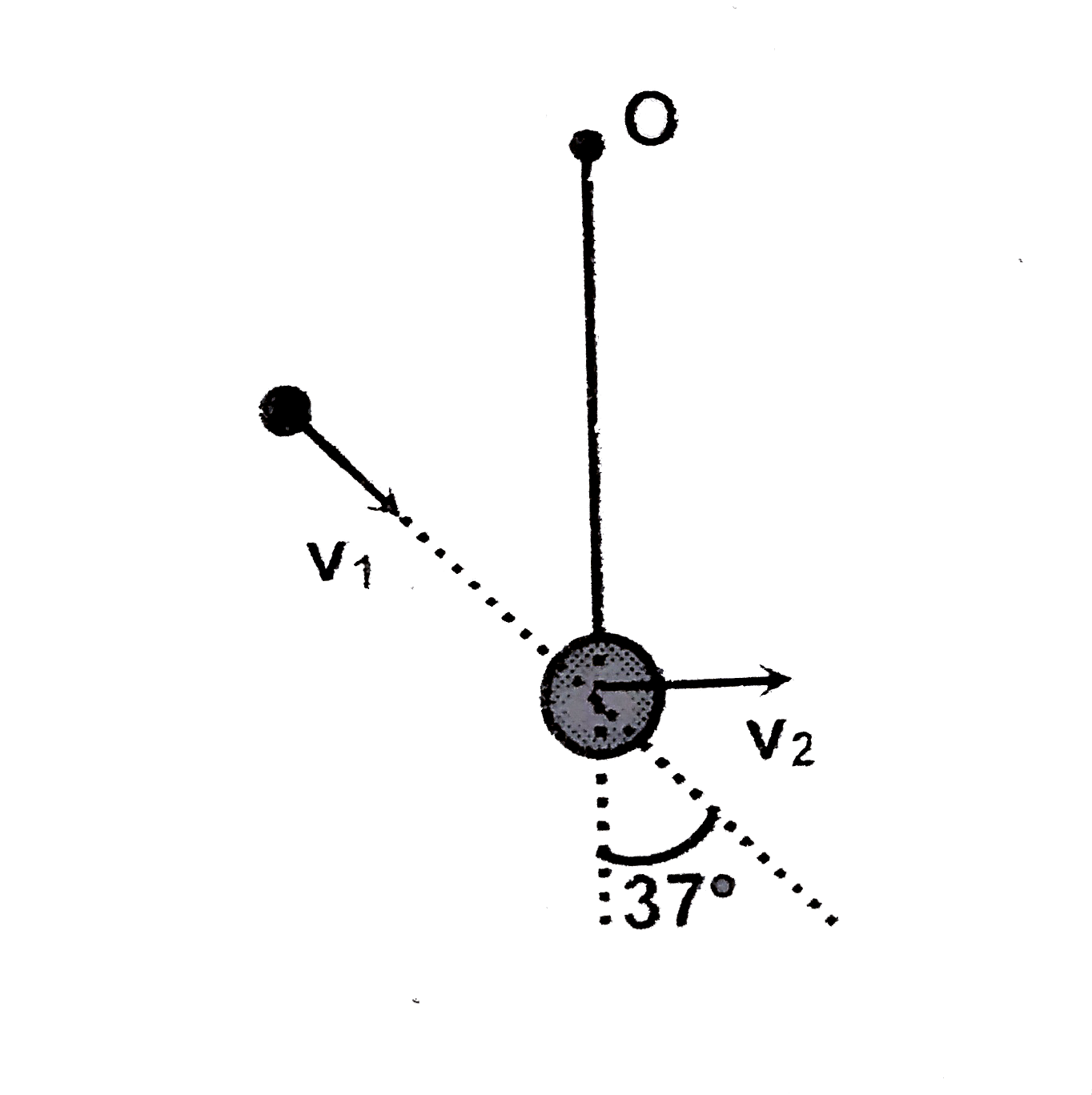
`v_(1)` and `v_(2)` are the velocity after the collision.
`mv_(0)sin 37^(@) = mv_(1)sin 37^(@) + mv_(2)`....(i)
`e = (4)/(5) = (v_(2) cos 53^(@) - v_(1))/(v_(0))` ...(ii)
From (i) and (ii)
`v_(2) = (27)/(34)v_(00 = sqrt5gl`
`(27)/(34)v_(0) = 10`
`rArr v_(0) = (340)/(27) m//sec`
Promotional Banner

Similar Questions

Explore conceptually related problems

An elastic ball of mass 'm' is suspended from a fixed point by an inextensible string. A small particle of same mass m , moving downwards at an angle of 37^(@) with the vertical lits the ball directly with the velocity v_(0) . If the coefficient of restitution is 4//5 , ( i ) find the velocity of the ball just after the impact. ( ii ) determine the impulsive tension(i.e impulse) in the string at the instant of collision.

A glass ball collides with an identical ball at rest with v_(0)=2 m/sec. If the coefficient of restitution of collision is e = 0.5, find the velocities of the glass balls just after the collision.

A particle of mass m, collides with another stationary particle of mass M. If the particle m stops just after collision, then the coefficient of restitution for collision is equal to

A glass ball collides with a smooth horizontal surface ( xz plane) with a velocity V = ai- bj . If the coefficient of restitution of collision be e , the velocity of the ball just after the collision will be

A small ball is suspended from a fixed point 'O' by means of a light and inextensible string of length 'l'. The ball is first taken aside such that string becomes horizontal and then released from rest. At the borrom it collides with a fixed obstacle. The co-efficient of restitution is 'e'. Find the maximum angular deflection of the string after n^(th) collision.

A ball of mass 1 kg is dropped from a height of 3.2 m on smooth inclined plane. The coefficient of restitution for the collision is e= 1//2 . The ball's velocity become horizontal after the collision.

A ball of mass m moving with a speed 2v_0 collides head-on with an identical ball at rest. If e is the coefficient of restitution, then what will be the ratio of velocity of two balls after collision?

A ball of mass m moving with a speed 2v_0 collides head-on with an identical ball at rest. If e is the coefficient of restitution, then what will be the ratio of velocity of two balls after collision?

The first ball of mass m moving with the velocity upsilon collides head on with the second ball of mass m at rest. If the coefficient of restitution is e , then the ratio of the velocities of the first and the second ball after the collision is

A ball of mass m moving with velocity u collides head-on which the second ball of mass m at rest. If the coefficient of restitution is e and velocity of first ball after collision is v_(1) and velocity of second ball after collision is v_(2) then

