Home
Class 12
PHYSICS
Two smooth horizontal parallel conductin...

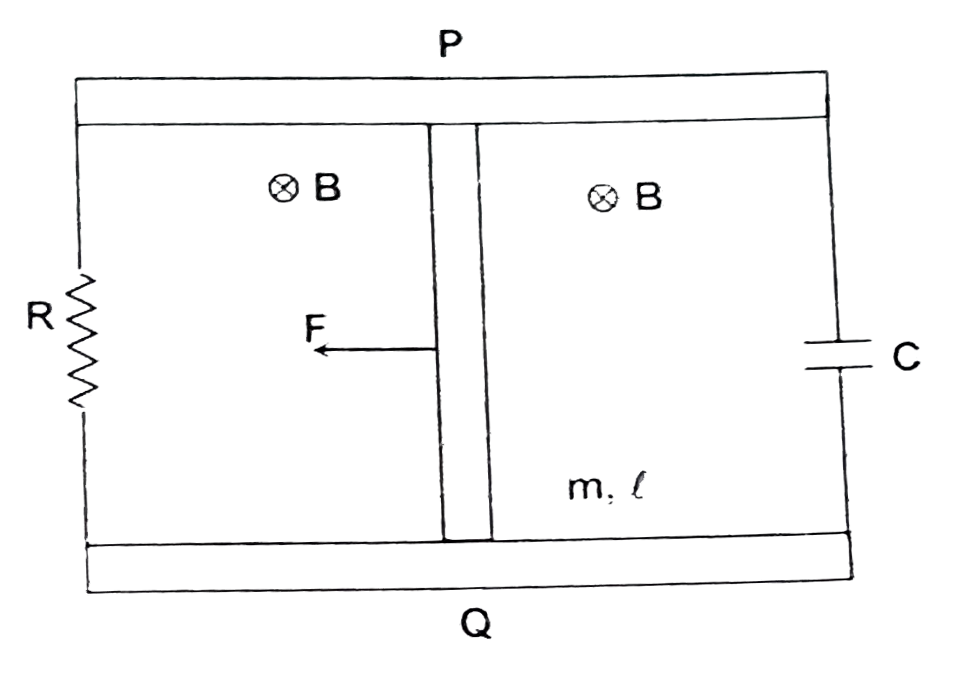
Two smooth horizontal parallel conducting rails are connected with a capacitor and a resistor at the two ends as shown. A uniform conducting rod PQ of mass 'm' and length 'l' is dragged with a constant horizontal force 'F'. The terminal velocity aquired by the conducting rod is

A

`(4FR)/(B^(2)l^(2))`

B

`(2FR)/(B^(2)l^(2))`

C

`(FR)/(B^(2)l^(2))`

D

`(FR)/(2B^(2)l^(2))`

Text Solution

Verified by Experts

The correct Answer is:
C

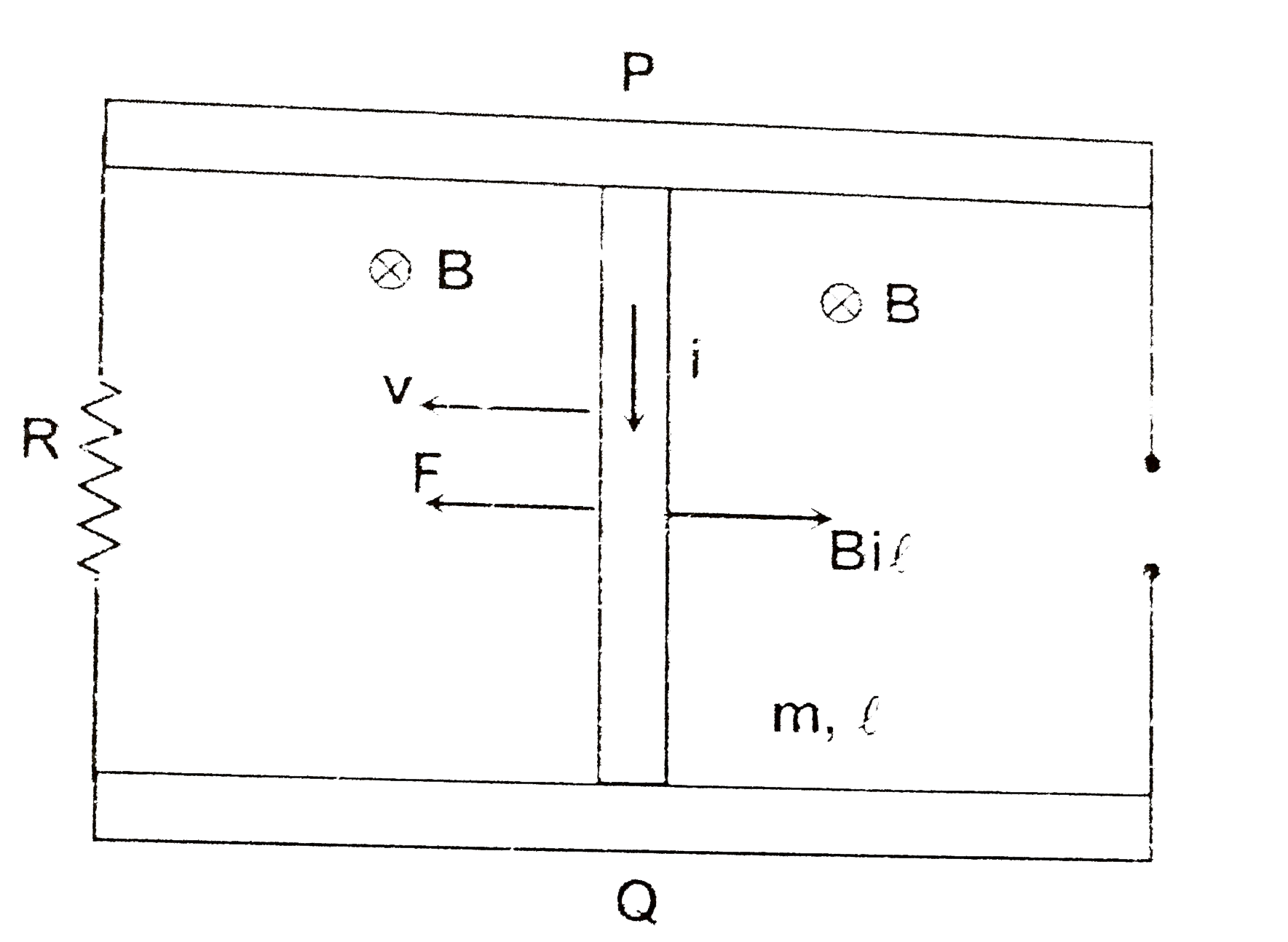
When the trminal velocity is acquired
`i = (Bvl)/(R )`
`F= Bil`
`F = (B^(2)l^(2)v)/(R )`
`:. V = (FR)/(B^(2)l^(2))`
Promotional Banner

Similar Questions

Explore conceptually related problems

A conducting rod MN of mass m and length 'l' is placed on parallel smooth conducting rails connected to an uncharged capacitor of capacitance C and a battery of emf epsilon as shown. A uniform magnetic field B is existing perpendicular to the plane of the rails. The steady state velocity acquired by the conducting rod MN after closing switch S is (neglect the resistance of the parallel rails and the conducting rod)

A conducting rod with resistance r per unit length is moving inside a vertical magnetic field B with speed v on two smooth horizontal parallel ideal conducting rails. The end of the rails are connected to a resistor R. the separation between the rails is d. The rod maintains a tilted angle theta to the rail. Find the external force F required to keep the rod moving

Two parallel long smooth conducting rails separated by a distance l are connected by a movable conducting connector of mass m . Terminals of the rails are connected by the resistor R and the capacitor C as shown in figure. A uniform magnetic field B perpendicular to the plane of the rail is switched on. The connector is dragged by a constant force F . Find the speed of the connector as a function of time if the force F is applied at t = 0 . Also find the terminal velocity of the connector.

As shown in figure, the two parallel conducting rails, in a horizontal plane, are connected at one end by an inductor of inductance L. A slider (metallic) of mass m, is imparted a Velocity v_(0) , upon the rails, as shown in figure. The period of oscillation of the conducting rod is

A uniform conducting rod of length I is moving with speed v_0 in a uniform transverse magnetic field B_0 as shown in figure. The emf developed across the two ends of the rod will be

A small conducting rod of length l, moves with a uniform velocity v in a uniform magnetic field B as shown in fig __

A wire of mass m and length I can freely slide on a pair of parallel, smooth, horizontal rails placed in a vertical magnetic field B . The rails are connected by a capacitor of capacitance C. The electric resistance of the rails and the wire is zero. If a constant force F acts on the wire as shown in the figure, find the acceleration of the wire.

A uniform rod AB of mass m and length l at rest on a smooth horizontal surface . An impulse P is applied to the end B . The time taken by the rod to turn through a right angle is :

A uniform rod AB of mass m and length l at rest on a smooth horizontal surface . An impulse P is applied to the end B . The time taken by the rod to turn through a right angle is :

a copper rod of mass m slides under gravity on two smooth parallel rails with separation I and set at an angle of theta with the horiziontal at the bottom rails are joined by resistance R. There is a uniform magnetic field B normal to the plane of the rails as shown in the figure The terminal speed of the copper rod is :

