Home
Class 12
CHEMISTRY
A compound 'D' (C(8)H(16)O) has followin...

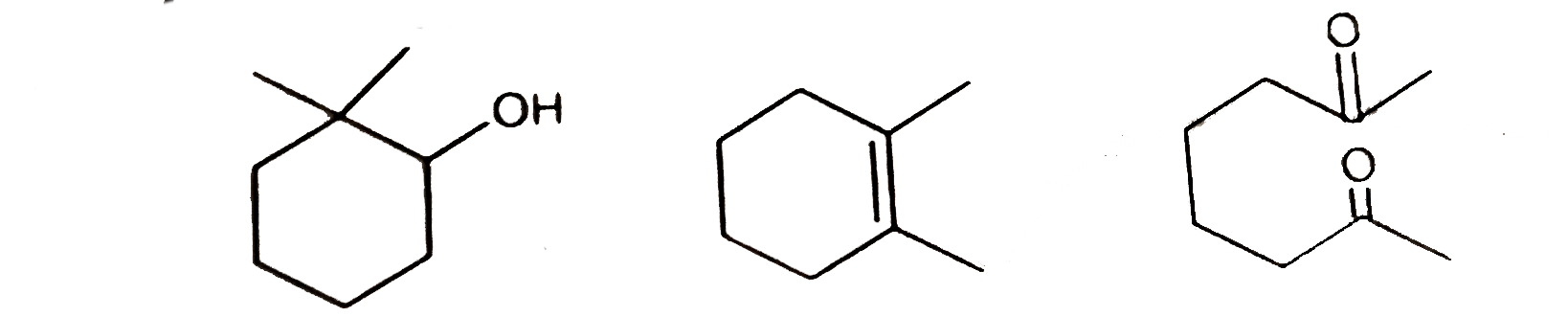
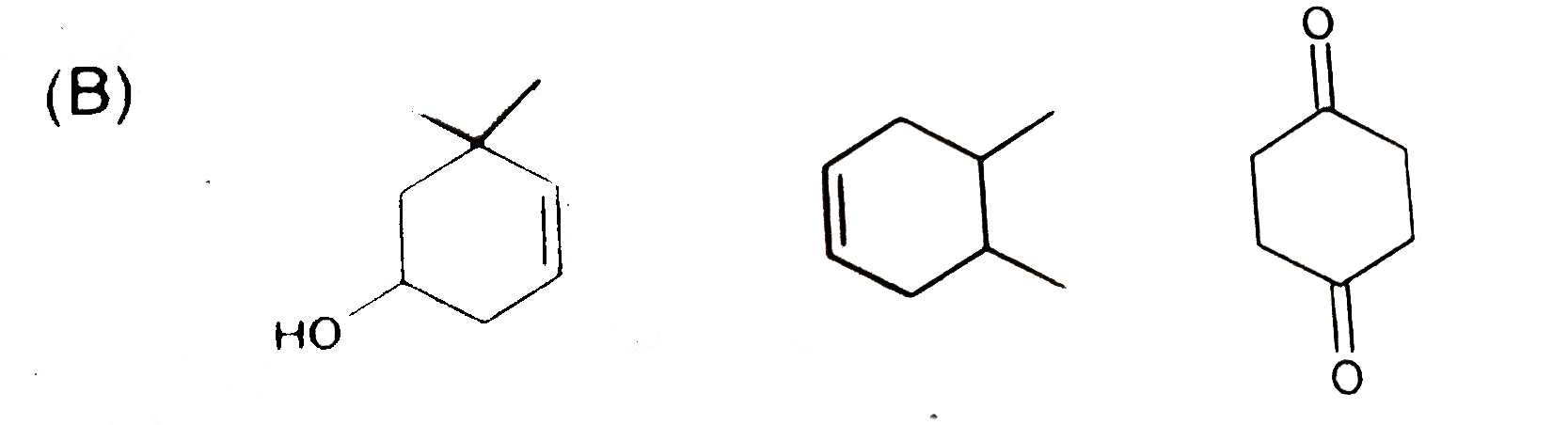
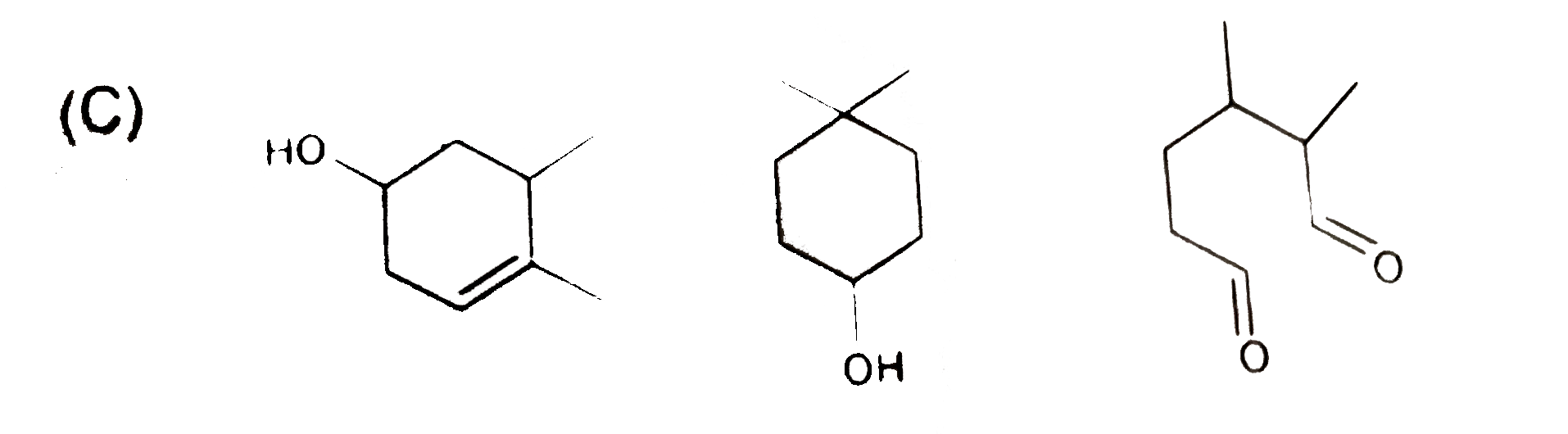
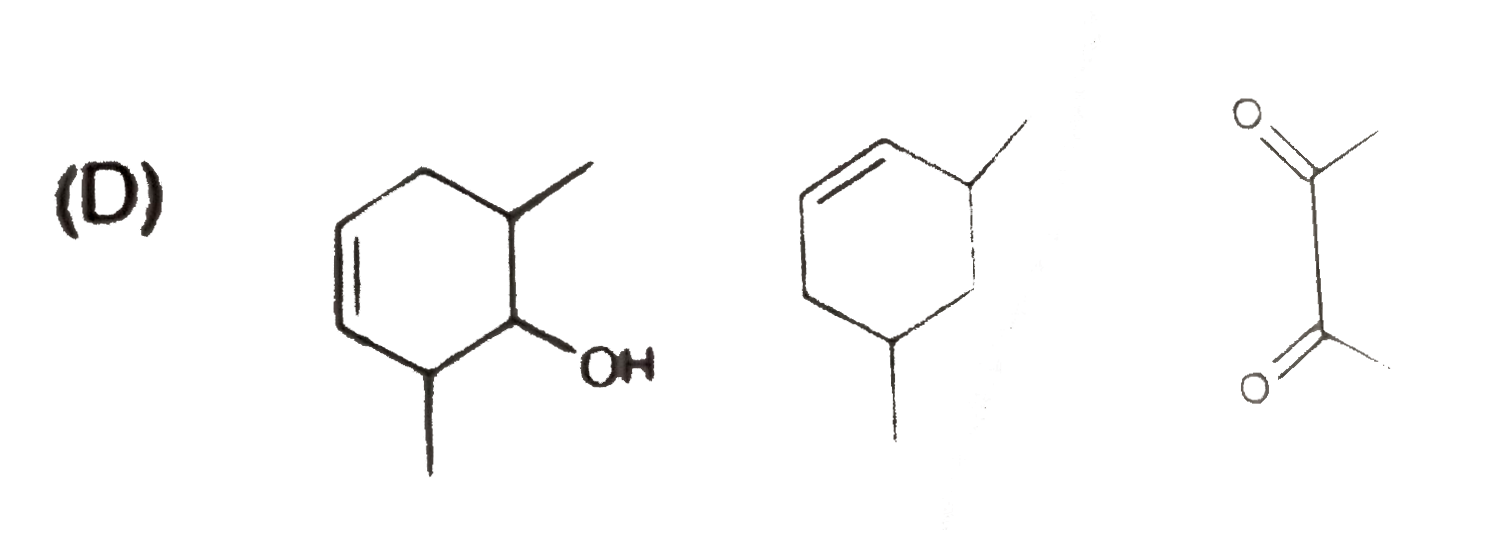
A compound 'D' `(C_(8)H_(16)O)` has following observation
(a) It reacts with Lucas reagent with in `5 min`.
(b) On heating in presence of acid given a compound X, which can decolorize `KMnO_(4)` as well as `Br_(2)//CCl_(4)`.
(c ) compound `Xoverset("ozonolysis")rarr Yoverset(I_(2)//NaOH)rarr2` moles of iodoform `+` sodium salt of dibasic acid `overset("Sodalime")rarr n -` butane
Then D, X, Y are

A

B

C

D

Text Solution

AI Generated Solution

The correct Answer is:

To solve the problem step by step, we will analyze the given observations about the compound 'D' with the molecular formula \( C_8H_{16}O \). ### Step 1: Identify Compound D Given that compound D reacts with Lucas reagent within 5 minutes, we can conclude that it is a secondary alcohol. This is because secondary alcohols react with Lucas reagent (a mixture of hydrochloric acid and zinc chloride) relatively quickly, while primary alcohols react much slower. **Hint:** Lucas reagent is used to differentiate between primary, secondary, and tertiary alcohols based on their reactivity. ### Step 2: Determine Compound X Upon heating compound D in the presence of acid, it produces compound X, which can decolorize both KMnO4 and Br2/CCl4. The ability to decolorize these reagents indicates that compound X is likely an alkene, as alkenes can undergo oxidation with KMnO4 (Baeyer test) and addition reactions with bromine. **Hint:** Alkenes are characterized by the presence of a carbon-carbon double bond, which is responsible for their reactivity with bromine and permanganate. ### Step 3: Analyze Compound Y Compound X undergoes ozonolysis to yield compound Y. Ozonolysis typically cleaves double bonds and can produce carbonyl compounds. The problem states that Y can yield 2 moles of iodoform and a sodium salt of a dibasic acid upon treatment with iodine and NaOH. The iodoform test indicates that Y must contain a methyl ketone (a carbonyl group adjacent to a methyl group). The presence of a dibasic acid suggests that Y also has a structure that allows for the formation of two carboxylic acid groups upon decarboxylation. **Hint:** The iodoform test is a qualitative test for methyl ketones and some alcohols that can be oxidized to methyl ketones. ### Step 4: Decarboxylation to Form n-butane The sodium salt of the dibasic acid derived from Y can undergo decarboxylation (removal of CO2) using soda lime to yield n-butane. This indicates that Y must have a structure that, after losing two CO2 molecules, results in the straight-chain alkane n-butane. **Hint:** Decarboxylation typically occurs at the terminal carbon of a carboxylic acid, leading to the formation of alkanes. ### Step 5: Construct the Structures 1. **Compound D**: Since D is a secondary alcohol, it could be something like 2-octanol. 2. **Compound X**: Upon dehydration of D, X could be an alkene like 2-octene. 3. **Compound Y**: Ozonolysis of 2-octene could yield a compound that contains a methyl ketone and a carboxylic acid, such as 3-oxooctanoic acid. ### Conclusion Based on the analysis: - **D** is likely 2-octanol (C8H16O). - **X** is likely 2-octene. - **Y** is likely 3-oxooctanoic acid. Thus, the final answer is: - **Compound D**: 2-octanol - **Compound X**: 2-octene - **Compound Y**: 3-oxooctanoic acid
Promotional Banner

Similar Questions

Explore conceptually related problems

C_8H_8Cl_2(A)overset("Aq. NaoH")rarr(B)overset("Mild reduction")rarr(C)overset(l_2//NaOH)rarr"iodoform + acid salt" (D)

X' compound (C_(4)H_(8)O) decolorises bromine water react with I_(2) & NaOH it give yellow ppt identify 'X'

Compound (A)(C_(8)H_(12)) on oxidation gives an acid B(C_(4)H_(6)O_(2)) . One mole of compound (A) reacts with 3 mol of H_(2) in the presence of Pt catalyst to give octane. Identify compound (A) .

The final product (Y) of the following reaction is: C_(2) H_(4) overset(Br_(2))(rarr) " X " overset(Ph_(3)"SnH")(rarr) Y

Compounds A, B and C in the following reaction sequence are: C_(2) H_(5)Br overset("AgCN")(rarr) A overset(H3O^(+))(rarr) B + C

In the following sequence of recation, identify the compounds (A), (B), (C ) and (D): underset("Solution")Na_(2)CO_(3)overset(SO_(2))rarr (A) overset(Na_(2)CO_(3))rarr (B) overset(S)underset("Heat")rarr (C ) overset(AgNO_(3))rarr (D)

A compound [A] with molecular formula C_(4)H_(10)O reacts rapidly with metallic sodium but very slowly with Lucas reagent. When [A] treated with hot concentrated H_(2)SO_(4) , it gives a compound [B] C_(4)H_(8) which upon hydration with aqueous H_(2)SO_(4) forms a compound [C] with molecular formula C_(4)H_(10)O . The compound [C] is almost unert to metallic sodium but reacts rapidly with Lucas reagent. What are the compounds [A], [B] and [C] ? Explain the reaction involved.

Identify the following: Na_(2)CO_(3)overset(So_(2))rarr A overset(Na_(2)CO_(3))rarr B overset("Element s")underset(Delta)rarr C overset(I_(2))rarr D Also mention the oxidation state of S in all the compounds.
