Home
Class 12
PHYSICS
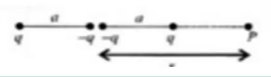
Figure shows a charge array known as an ...

Figure shows a charge array known as an "electric quadrupole". For a point on the axis of the quadruple, the dependence of potential on `r(r/agt gt1)` is `1/(r^(n))`. Find `n`?

Text Solution

Verified by Experts

The correct Answer is:

3

3
Promotional Banner

Similar Questions

Explore conceptually related problems

Fig shows a charge array known as an 'electric quadrupole'. For a point on the axis of the quadrupole, obtain the dependence of potential on r for r//a gtgt 1 , and contract your results with that due to an electric dipole and an electric monopole (i.e, a single charge).

Figure shows three circular ars, each of radis R and total charge as indicated. The net electric potential at the centre of curvature is :

Figure shows thick metallic sphere. If it is given a charge +Q , then electric field will be present in the region (A) r lt R_(1) only (B) r gt R_(2) only (C) r lt R_(1) and r gt R_(2) (D) R_(1) lt r lt R_(2)

Show that electric potential at a point P, at a distance .r. from a fixed point charge Q, is given by : V=(1/(4piepsilon_0))Q/r

Two coaxial rings, eacg of radius R, made of thin wire are separated by a small distabce l(l lt lt R) and carry the charges q and -q . Find the electric field potential and strength at the axis of the system as a function of the x coordinate (see figure). Investigate these functions at |x| gt gt R

The electrostatic field due to a point charge depends on the distance r as 1/r^2 . Indicate which of the following quantities shows same dependence on r.

A charge -q is placed at the axis of a charged ring of radius at a distance of 2sqrt(2) r as show in figure . If ring is fixed and carrying charge Q, the kinetic energy of charge - q when it is relased and reaches the centre of ring will be (qQ)/(n pi epsi_(0)r) .Find n

n charged drops, each of radius r and charge q , coalesce to from a big drop of radius R and charge Q . If V is the electric potential and E is the electric field at the surface of a drop, then.

Three charged particles having charges q, -2q & q are placed in a line at points (-a, 0), (0,0) & (a , 0) respectively. The expression for electric potential at P(r, 0 ) for r gt gt a is

A conducting sphere of radius R is charged to a potential of V volts. Then the electric field at a distance r ( gt R) from the centre of the sphere would be
