Home
Class 12
PHYSICS
A uniform solid cone (height h=4m, alpha...

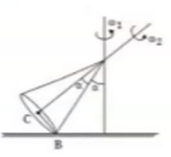
A uniform solid cone (height `h=4m, alpha=30^(@)`) is inclined agains a vertical axis as shown in the figure. The cone rotates about its own axis as well as rotates about the vertical axis with angular speeds marked in the diagram. If the cone does not slip at point `B`,find `(omega_(1))/(omega_(2))`

Text Solution

Verified by Experts

The correct Answer is:
1

`omega_(1) h tan alpha= omega_(2)R`
`implies(omega_(1))/(omega_(2))=(R//h)/(tanalpha)=1`
Promotional Banner

Similar Questions

Explore conceptually related problems

A solid cylinder of mass M and radius R rotates about its axis with angular speed omega . Its rotational kinetic energy is

A particle of mass m rotates with a uniform angular speed omega . It is viewed from a frame rotating about the Z-axis with a uniform angular speed omega_0 . The centrifugal force on the particler is

A thin uniform ring of radius R carrying charge q and mass m rotates about its axis with angular velocity omega . Find the ratio of its magnetic moment and angular momentum.

A uniform rod AB of mass m and length L rotates about a fixed vertical axis making a constant angle theta with it as shown in figure. The rod is rotated about this axis, so that point B the free end of the rod moves with a uniform speed V in the horizontal plane then the angular momentum of the rod about the axis is:

A uniform rod AB of mass m and length L rotates about a fixed vertical axis making a constant angle theta with it as shown in figure. The rod is rotated about this axis, so that point B the free end of the rod moves with a uniform speed V in the horizontal plane then the angular momentum of the rod about the axis is:

A solid sphere of radius r and mass m rotates about an axis passing through its centre with angular velocity omega . Its K.E . Is

A rod of mass m and length l is rotating about a fixed point in the ceiling with an angular velocity omega as shown in the figure. The rod maintains a constant angle theta with the vertical. What angle will the rod make with the vertical

The general motion of a rigid body can be considered to be a combination of (i) a motion of its centre of mass about an axis, and (ii) its motion about an instantaneous exis passing through the centre of mass. These axes need not be stationary. Consider, for example, a thin uniform disc welded (rigidly fixed) horizontally at its rim to a massless, stick as shown in the figure. When the disc-stick system is rotated about the origin on a horizontal frictionless plane with angular speed omega the motion at any instant can be taken as a combination of (i) a rotation of the disc through an instantaneous vertical axis passing through its centre of mass (as is seen from the changed orientation of points P and Q). Both these motions have the same angular speed omega in this case Now consider two similar system as shown in the figure: Case (a) the disc with its face vertical and parallel to x-z plane, Case (b) the disc with its face making an angle of 45^@ with x-y plane and its horizontal diameter parallel to x-axis. In both the cases, the disc is welded at point P, and the systems are rotated with constant angular speed omega about the z-axis. Which of the following statements regarding the angular speed about the instantaneous axis (passing through the centre of mass) is correct?

A rod of mass m and length l is rotating about a fixed point in the ceiling with an angular velocity omega as shown in the figure. The rod maintains a constant angle theta with the vertical. What is the rate of change of angular momentum of the rod ?

The general motion of a rigid body can be considered to be a combination of (i) a motion of its centre of mass about an axis, and (ii) its motion about an instantaneous exis passing through the centre of mass. These axes need not be stationary. Consider, for example, a thin uniform disc welded (rigidly fixed) horizontally at its rim to a massless, stick as shown in the figure. When the disc-stick system is rotated about the origin on a horizontal frictionless plane with angular speed omega the motion at any instant can be taken as a combination of (i) a rotation of the disc through an instantaneous vertical axis passing through its centre of mass (as is seen from the changed orientation of points P and Q). Both these motions have the same angular speed omega in this case Now consider two similar system as shown in the figure: Case (a) the disc with its face vertical and parallel to x-z plane, Case (b) the disc with its face making an angle of 45^@ with x-y plane and its horizontal diameter parallel to x-axis. In both the cases, the disc is welded at point P, and the systems are rotated with constant angular speed omega about the z-axis. . Which of the following statements about the instantaneous axis (passing through the centre of mass) is correct?

