Home
Class 12
PHYSICS
A uniform ball of radius R rolls without...

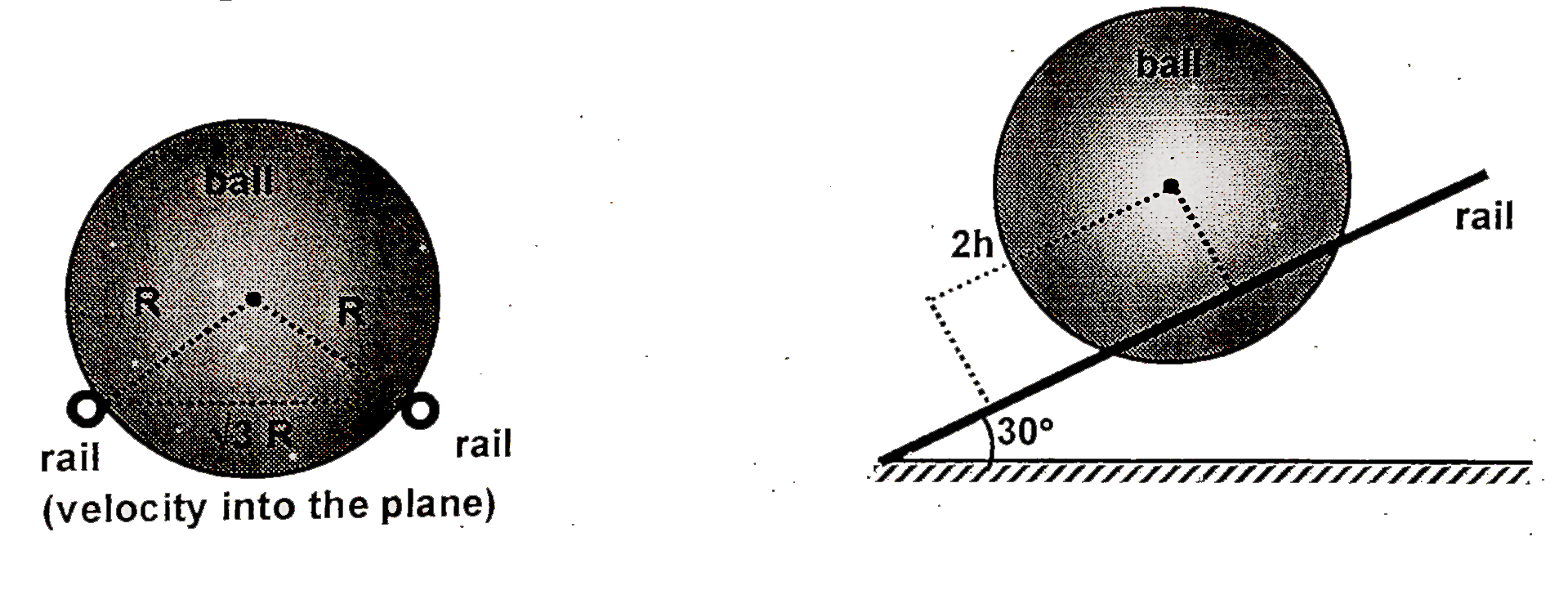
A uniform ball of radius `R` rolls without slipping between the rails such that the horizontal distance is `sqrt(3)R` between the two contact points of te rails of the ball. Figure (a) shows front view of the ball and figure (b) shows the side view of the ball. `v_(CM)` is the velocity of centre of mass of the ball and `omega` is the angular velocity of the ball after rolling down a distance `2h` along the incline then

A

`V_(CM)=omegaR`

B

`V_(CM)=omega R/2`

C

`V_(CM)=sqrt((10gh)/13)`

D

`V_(CM)=sqrt((10 gh)/7)`

Text Solution

Verified by Experts

The correct Answer is:

B, C

`v_(CM)=omega sqrt(R^(2)-(3R^(2))/4)=omega R/2` (from pure rolling)
`mgh=1/2mv_(cm)^(2)+1/2 2/5 mR^(2)omega^(2)` (from conservation of energy)
`:.v_(CM)=sqrt((10gh)/13)`
Promotional Banner

Similar Questions

Explore conceptually related problems

A uniform ball of radius r rolls without slipping down from the top of a sphere of radius R Find the angular velocity of the ball at the moment it breaks off the sphere. The initial velocity of the ball is negligible.

A uniform ball of radius r rolls without slipping down from the top of a sphere of radius R Find the angular velocity of the ball at the moment it breaks off the sphere. The initial velocity of the ball is negligible.

A sphere of radius R rolls without slipping between two planks as shown in figure. Find (a) Speed of centre of sphere (b) Angular velocity of the sphere

In the figure, a ball of mass m is tied with two strings of equal as shown. If the rod is rotated with angular velocity omega_(1) when

A ball is whirled in a circle by attaching it to a fixed point with a string. Is there an angular rotation of the ball about its centre? If yes, is this angular velocity equal to the angular velocity of the ball about the fixed point?

A ball rolls without slipping. The radius of gyration of the ball about an axis passing through its centre of mass is k . If radius of the ball be R , then the fraction of total energy associated with its rotation will be.

A ball rolls without slipping. The radius of gyration of the ball about an axis passing through its centre of mass is k . If radius of the ball be R , then the fraction of total energy associated with its rotation will be.

A ball of mass m moving with velocity v collides head-on which the second ball of mass m at rest. I the coefficient of restitution is e and velocity of first ball after collision is v_(1) and velocity of second ball after collision is v_(2) then

A ball of mass m moving with velocity u collides head-on which the second ball of mass m at rest. If the coefficient of restitution is e and velocity of first ball after collision is v_(1) and velocity of second ball after collision is v_(2) then

A ball of mass m moving with a speed 2v_0 collides head-on with an identical ball at rest. If e is the coefficient of restitution, then what will be the ratio of velocity of two balls after collision?
