Home
Class 12
PHYSICS
A copper rod of mass m rests on two hori...

A copper rod of mass m rests on two horizontal rails distance L apart and carries a current of I from one rail to the other. The coefficient of static friction between rod and rails is `mu_(s)` What are the (a) magnitude and (b) angle (relative to the vertical) of the smallest magnetic field that puts the rod on the verge of sliding?

A

The greatest height of sand pile that can be created is `mu_(s)R`.

B

The greatest height of sand pile that can be created is `R//mu_(s)`

C

Minimum work required to create greatest height sand pile is `(pi)/12 mu_(s)^(2)R^(4) rho g`. Where `rho` is the density of sand volume

D

Sand pile will be in stable equilibrium

Text Solution

Verified by Experts

The correct Answer is:
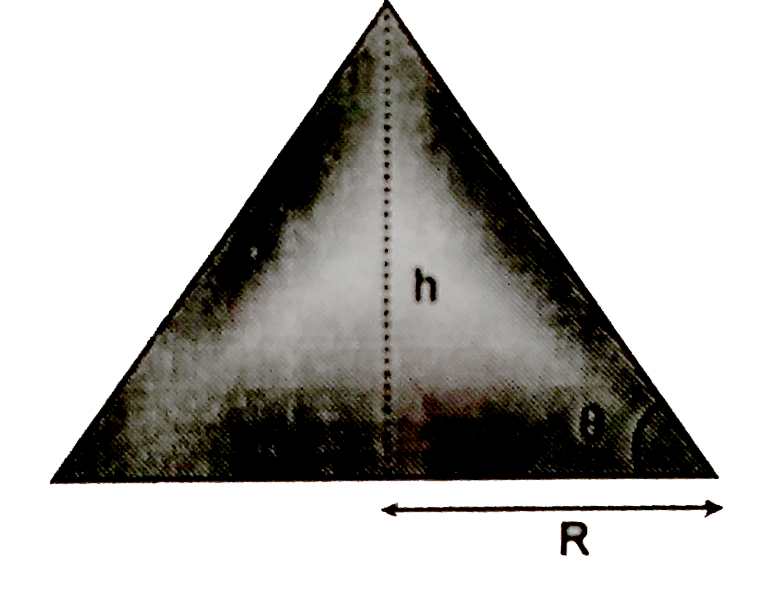
A, C

From free body diagram of sand particle
`tantheta=mu s =h/R`
work required `=(1/3 pi R^(2)h rhog)h/4`
The system is in unstable equilibrium.
Promotional Banner

Similar Questions

Explore conceptually related problems

A conductor (rod) of mass m, length l carrying a current i is subjected to a magnetic field of induction B. If the coefficients of friction between the conducting rod and rail is mu, find the value of I if the rod starts sliding.

A copper rod of mass m slides under gravity on two smooth parallel rails l distance apart set at an angle theta to the horizontal. At the bottom, the rails are joined by a resistance R . There is a uniform magnetic field perpendicular to the plane of the rails. the terminal valocity of the rod is

A straight wire of length l can slide on two parallel plastic rails kept in a horizontal plane with a separation d. The coefficient of friction between the wire and the rails is mu . If the wire carries a current I, what minimum magnetic field should exist in the space in order to slide the wire on the rails.

On an inclined plane, two conducting rails are fixed along the line of greatest slope. A conducting rod AB is placed on the radils so that it is horizontal. A vertically upward uniform magnetic field is present in the region. A current i flows through AB from B to A. The mass of AB is m and the coefficient of friction between the rod and rails is mu . Find the minimum and maximum value of B, so that the rod can stay in equilibrium. Assume that mu lt tan theta

Shows two long metal rails placed horizontally and parallel to each other at a separation i. A uniform magnetic field b exists in the vertically downward direction. A wire of mass m can slide on the rails. The rails are connected to a constant current source which drives a current I in the circuirt. The friction coefficient between the rails and the wire is mu . (a) What should be the minimum value of mu which can prevent the wire from sliding on the rails? (b) Describe the motion of the wire if the value of mu is half the value found in the previous part.

Two hemispheres of radii R and r(lt R) are fixed on a horizontal table touching each other (see figure). A uniform rod rests on to spheres as shown. The coefficient of friction between the rod and two spherers is mu . Then the maximum value of the ratio (r)/(R) for which the rod will not slide is :

a copper rod of mass m slides under gravity on two smooth parallel rails with separation I and set at an angle of theta with the horiziontal at the bottom rails are joined by resistance R. There is a uniform magnetic field B normal to the plane of the rails as shown in the figure The terminal speed of the copper rod is :

A conducting rod with resistance r per unit length is moving inside a vertical magnetic field B with speed v on two smooth horizontal parallel ideal conducting rails. The end of the rails are connected to a resistor R. the separation between the rails is d. The rod maintains a tilted angle theta to the rail. Find the external force F required to keep the rod moving

A conducting rod of length 'l'=2sqrt(5) meter and mass 'm'=4kg lies on the horizontal table. Coefficient of friction between the rod and the table is 'mu'=(1/2) . If the current in the conductor si 2 ampere, then find the minimum magnitude of magnetic field strength (in Tesla) such that conducting rod just starts to translate along x -axis (take g=10m//sec^(2) ) [neglect the radius of rod]

A rod of mass 0.720 kg and radius 6 cm rests on two parallel rails that are d=12 cm apart and length of rails is L=49 cm. The rod carried a current of I=48 A Fig. and rolls along the rails without slipping. A uniform magnetic field of magnetude 0.240 T is directed perpendicular to the rod and the rails. If it starts from rest, what is the speed of the rod as it leaves the rails?

